This photo has the largest number of contrails I’ve seen in a single photo:
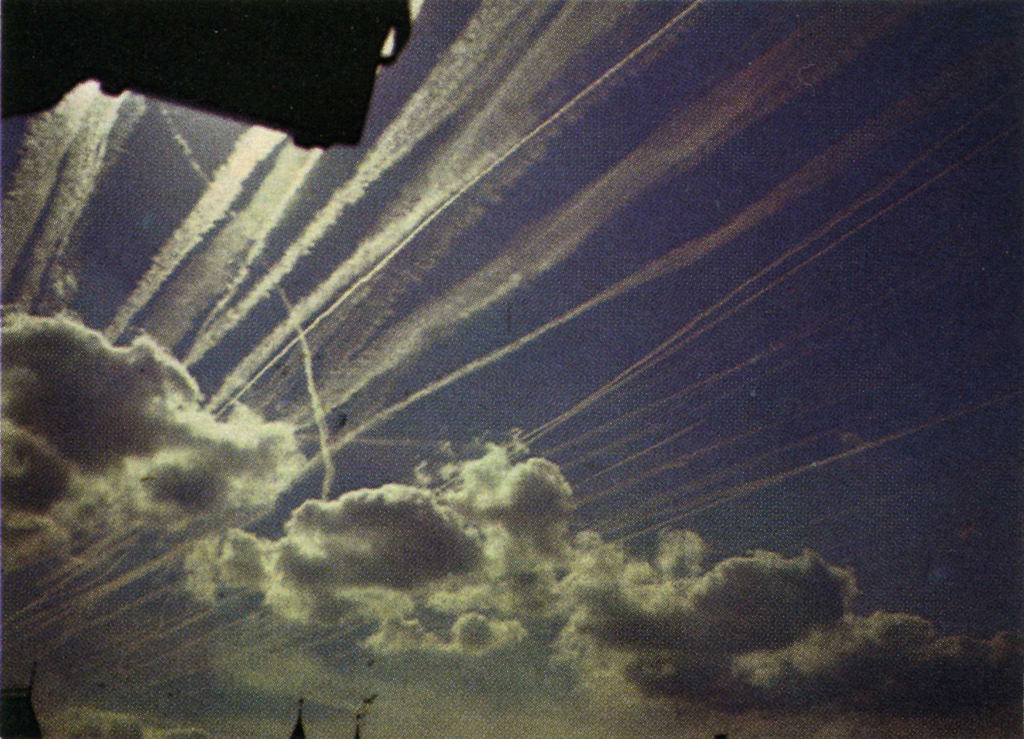
There seem to be at least 30, possibly more (click the photo for a larger verision). What is even more remarkable is that it was taken sometime before 1967. That’s over forty years ago.
The photo is plate 113 of the book Cloud Studies in Colour, by Richard Scorer and Harry Wexler, published in 1967 by Pergamon Press. The photo was taken by Richard Scorer, probably in England. The accompanying text reads:
Condensation trails are left by aircraft when the air is sufficiently cold for the mixture of air and exhaust to be saturated. This does not usually happen except when the temperature is close to or below -40C, in which case the cloud freezes almost instantaneously and does not readily evaporate. The cloud is then spread out by any wind sheer which may be present.
This does not explain the weird dark shadows we are seeing today, the fact that even in plus forty weather these streak linger FOR HOURS on end and seem to criss cross eachother in weird patterns. Time lapse will reveal they decend into a hazz cloud. On recent new broadcasts someone that noticed the hazy cloud decending on the ground took a sample of it and seems to have high levels of barium that can weaken the immune system. And in 1967 why would thirty planes randomly seem to fly close to eachother..its like they need to gain some ground. If these were normal contrails then not only would they last for 20 minutes and dissapear but they wouldn;t linger for as long as they do and cover the ground. Why would the planes fly so close together and form patterns in the sky.
Just adolf reporting here
my indoctrination of modern weather science is going good we have convinced the public that these strange formations of our harmful chemicals we are spewing into the enviroment are normal condensation when its winter
but damn they look so notceable..
i wish we had a plan B
Joseph, the planes do not all have to fly close together. One could be several miles behind the others, just flying roughly the same route. None of those trails is probably within 1000 feet of another. Remember they are six miles up in the air.
Forty plus on the ground does not mean it is not forty below at 36,000 feet. How cold do you think it is at the top of Mt. Everest (30,000 feet)?
Dark lines have been explained:
https://contrailscience.com/contrails-dark-lines-chemtrails/
Contrails DO spread out sometime, and create haze, this is in the encyclopedia:
nice try. I’ve seen the spray turn on and off. I’ve seen contrails right next to chemtrails. Nice job of maintenence of public myths though.They’re teaching this disinformation in school now. creepy.
Both issues you mention have been addressed
For “I’ve seen the spray turn on and off.“, see:
https://contrailscience.com/broken-contrails/
For: “I’ve seen contrails right next to chemtrails., those are planes at differing altitudes. It only takes a thousand feet for one plane to form a contrail, and another not to.
Excellent work. Exhaustive work. And, nice job keeping your cool having to repeat the same science over and again. I believe in many true conspiracies (global banking), and am well-aware of government projects like HAARP, Operation Cloverleaf, Project Bluebeam and the like. What you present here is well documented and often self-evident once you turn the conspiracy spigot off for a second. Thanks for helping me turn the spigot off. Now, I have much more time and energy to fight the evil bankers.
Quoting, “This does not explain the weird dark shadows we are seeing today, the fact that even in plus forty weather these streak linger FOR HOURS on end and seem to criss cross eachother in weird patterns.”
RYAN – Whats weird about dark shadows? They are SHADOWS. Clouds/contrails produce shadows; anything between the sun and the ground will produce a shadow…right? Yeah, 40-plus temps on the ground may equal minus 40 degrees at altitude. What’s the big deal? I see it all the time. Criss crossing? Again, for the third time, what’s the problem with that? Have you ever heard of airlines flying in one direction? Are you that ignorant? We cross aircraft contrails on a daily basis at every degree imaginable. What do you want….right angles? 45-degree angles? Write the U.S FAA your concerns and request we all fly in one direction…
Quoting, “Time lapse will reveal they decend into a hazz cloud. On recent new broadcasts someone that noticed the hazy cloud decending on the ground took a sample of it and seems to have high levels of barium that can weaken the immune system.”
RYAN – Hazz cloud? You mean haze cloud, right? Anyway, this statement is the biggest waste of our time. Samples SEEM to have high levels of barium that can weaken the immune system? And your proof is where? Actually Barium occurs naturally in the environment where it combines with oxygen, sulfur and carbon. Look around you and see what the big polluters are. How about the car you drive. How about your fireplace. They produce the most pollutants. What about the coal refinery? Airplanes as the single contributor, come on. Don’t forget that Barium is the 14th-most abundant element on earth. And you thought it just came from planes.
Quoting, “And in 1967 why would thirty planes randomly seem to fly close to eachother..its like they need to gain some ground. If these were normal contrails then not only would they last for 20 minutes and dissapear but they wouldn;t linger for as long as they do and cover the ground. Why would the planes fly so close together and form patterns in the sky.”
RYAN – 1967, the dawn of the jet age. A new era in jet travel. Must I say more? Are these planes randomly flying close together? I don’t see evidence of that at all. To me, as an airline pilot, randomly close together would be another aircraft above and below at 1,000 feet. Maybe 15 of them were traveling in the OTHER direction. Ever think of that? Apparently not.
Ryan
jetBlue Pilot
Very informative site, Uncinus. You’ve definitely made me question the solidarity of this whole “chemtrail” uprising. Though, there is one thing that confuses me:
The irregular occurrence of being able to visualize contrails in the sky.
From what I understand the main modifier of a contrail is based on the temperature of the high altitude (~-40°C render it visible) at which the plane is flying. Yet, during the summer season, 105°F on the ground, there will be criss cross contrails to the horizon. Then the very next day, 100°F on the ground, and the sky is completely clear.
I think you know what I’m getting at. This alone gives me a slight impression that these lingering contrails are intentional, and really if you could give me a structural explanation as to the reason for this drastically changing sky we live in today I would be very grateful.
Also, do you happen to have any photographs of “chemtrails” in America that were taken before 1997? Before the Open Skies Treaty was established in this country? That would be helpful as well.
Thank you for your efforts!
I used http://www.engineeringtoolbox.com/air-altitude-temperature-d_461.html?v=-40&units=degC# and
http://www.state.gov/www/global/arms/treaties/openskies/openskie02.html as a reference.
Two reasons – firstly the temperature on the ground is not always a good indicator of the temperature aloft, as an air mass could be moving in. Secondly it also depends on the humidity.
There are lots of photos of contrails (that look just like chemtrails) from before 1997, see:
https://contrailscience.com/contrail-photos-through-history/
And also:
https://contrailscience.com/persisting-and-spreading-contrails/
Especially note the 1970 US paper where they say:
“The spreading of jet contrails into extensive cirrus sheets is a familiar sight.”
Thanks again…
Do you know of anyway to get a temperature or hygrometer reading from altitudes of 30k+ feet?
I think I would be completely convinced that these chemtrail theorists are misinformed if I could go outside, see contrails in the sky, and be able to compare them to my readings, and vice versa.
Obviously that’s a complex task. Currently in the US, most of the data comes from weather balloons. These are no particularly accurate unless you happen to be right underneath one. They are only released at 12 hour intervals, and at weather stations that are on average 300 miles apart. Given that humidity can vary greatly over the space of of mile, it’s obviously no much help.
In fact, given that the formation of contrails is reasonably well understood, it’s sometimes more accurate to observe how long contrails last, in order to get a rough idea of the conditions aloft, rather than the other way around.
I did find something that may or may not spark interest.
Reference: http://adds.aviationweather.noaa.gov/winds/
Currently here in Reno, NV there’s not one cloud or contrail in the sky, its clear and blue to the horizon.
Yet, according to this validated analysis of the ADDS, it’s -40°C at 30,000FT as of 2200 Greenwich Mean Time.
Sure, the exact humidity readings aren’t available, but in these conditions there should be at least some sort of visible contrails, maybe some rapidly diminishing ones shortly behind the plane. Though, there is nothing in sight, and I speak the truth, considering I only want to find out the truth.
Your thoughts? Oh, great debunker.
I do not doubt your observations, but that simply indicates the humidity is not high enough for contrails to form.
Water in jet exhaust starts out as water vapor, a gas. Cold air can hold a certain amount of water vapour, so if the air is dry, then adding more water to it will not cause the water gas to change phase into a liquid or solid.
Rapidly diminishing contrails indicate that the humidity is high enough so the addition of the jet exhaust causes water to precipitate (as ice). However this is only local, and the surrounding air will even out the moisture, quickly evaporating (sublimating) the trail.
The more moisture in the air, the longer a trail will last.
I think I can help with the meteorology concerning contrails. I have developed a program that analyses a radiosonde data (weather ballon data) to see if contrails will form and if they will be persistent.
Here is a whole bunch of the resulting graphs for March 2008 in central New Zealand….
http://www.freewebs.com/diagnosis1contrails/0803Mar.htm
Click on a date to see the whole chart.
See that 1, 8, 11, and 13 were days with persistent contrails around this area.
This type of data is actually very useful for this but has not been widely used in the chemtrail/contrail controversy.
Contact me or see http://www.freewebs.com/contraildiagnosis/index.htm for more information.
I can make these charts using data from any radiosonde station and any date.
This implies that the occurrence of persistent contrails can be predicted to a certain extent, or that the absence of them can be explained in terms of the data. This means that these are not “chemtrails”.
The best reference for how to do this is the first link on the page here: http://www.freewebs.com/contraildiagnosis/Links.htm
Cheers
NVrep, I have had a look at the Reno radiosonde data for 0000 UTC 1 May 2008.
The temperature at F300 (30000 ft ISA) is -43.4C which is too warm for contrails to form with high bypass jet engines.
However, above F327 (32700 ft ISA) I would expect that high bypass jet engines would have been forming “normal” short contrails.
I have made the chart for that time available for you to examine at
http://www.freewebs.com/contraildiagnosis/Figures/REV_20080502_00Z_hb.PNG
Cheers.
Very intriguing bundle of accumulated data you got there, Ross. I will start running some studies myself and let you, and the chemtrail theorists, know if I see any persisting contrails in conditions that they shouldn’t be, and I’ll properly document it.
I’ve flown in -60 degree temps at 40,000 feet (FL400) and have had planes pass me at 41,000 feet leaving no contrail. However, I’ve looked down and have seen planes as 37,000 feet leaving long contrails. Temperature alone is not an indication that contrails will form. Relative humidity (plus temperature) is. Then again, I’ve seen temps well above -40 degrees C, with very high humidity and have passed airplanes (turboprops nonetheless) contrailing at 16,000 feet! The temperature was more like -20 degrees C. So it can happen! Normally, humidity decreases as altitude increases into the 40’s (40,000 feet-plus).
Ryan
JetBlue pilot
Ryan, you are quite correct; temperature alone does not determine if contrails will form. The temperature below which contrails will form depends on the pressure, and to a lesser extent on relative humidity (with respect to water, RHw), and to a lesser extent still on the engine type.
For instance, for high bypass engines at F300 (30,000 ft and 301 hPa), contrails will not form if the temperature is higher than (warmer than) -40.5 degrees C no matter how high the RHw is. If the temperature is less than -50.0°C, contrails will always form, even in bone-dry air. Between those temperatures, the formation of contrails depends on the RHw… temperature below -43.3°C at 95%, -45.6°C at 80% and -47.9°C at 50%.
For F410 (41,000 ft, 179hPa) and high bypass engines the critical temperatures are: -45.9°C at 100%, -48.5°C at 95%, -50.7°C at 80%, -52.8°C at 50% and -54.9°C at 0%.
For F160 (16,000 ft, 549 hPa) non-bypass engines the critical temperatures are: below -36.9°C at 100%, -39.7°C at 95%, -42.1°C at 80%, -44.5°C at 50%, -46.7°C at 0%. So, yes, at 16,000 feet and in high humidity, contrails will form in air warmer than -40.0°C
See “Calculations of Aircraft Contrail Formation Critical Temperatures” at http://ams.allenpress.com/perlserv/?request=get-document&issn=1520-0450&volume=036&issue=12&page=1725 for how all this is done.
According to the method described in that paper, for non-bypass engines (perhaps a high performance bomber or fighter ??) at F410, contrails will form in bone-dry air when the temperature is below -57.2°C. I would be interested to know where (geographically) and when you saw no contrails from a jet at F410 and -60°C. I will see if there is any nearby radiosonde data. What type of aircraft was it?
Finally, relative humidity does not necessarily decrease as altitude increases (and temperature decreases), but the moisture content of the air (specific humidity) certainly does. Above the tropopause, in the stratosphere (where the temperature is more or less constant with altitude), the air is very dry because tropospheric air seldom penetrates far there. The height of the tropopause varies; between quite high (F450) in the tropics and lower in higher latitudes.
Ross
Meteorologist
Great site!! The pictures of persisting contrails from long ago are very, very helpful….
People are so easily duped by their own skewed memories and perceptions….”I never saw persistent contrails 30 yrs ago…therefore there must not have been any…”
No, you just never noticed. For one thing there was a lot less air travel 30 yrs ago…and no one on the internet filled your head with paranoid theories and told you to “look up”!!
Chemtrails are a figment of the internet’s imagination.
Also, a main variable determining the persistence and indeed cirrus inducing effects of jet exhaust is the level of ice in the atmosphere…clear air ice supersaturation…not just humidity…but ice which is forms the condensation nuclei for the trail-ice crystal to grow…Ice supersaturation is not easily measured…not by temp or humidity level…Moreover, the atmosphere is extremely dynamic and changes from spot to spot even at the same altitude…add in all the variables of the plane, type of engine, fuel mix, speed, weight, altitude etc…and there are so many possibilities for any given air space.
Most chemtrail “believers” that any trail that persists must be a “chemtrail” and this just is not the case…thus, they start their argument based on a fallacy…not a good place to start.
Ignorant speculation leads to ignorant conclusions.
here is a great photo of a persistent contrail (and shadow) and sun dog from 1983:
http://www.1000plus.com/Imagic/8301sund.htm
love ur site man. plus im liking ryans input, cant get any better than a real airline pilot giving first hand experience, flying through,past,over,under these contrails. is it interesting that NO pilots have complained about chemtrails hey. because they know they dont exist, yet arogant ppl on terra ferma still think different lol. i start flight school on wednesday, hope i’ll be joining u making contrails someday ryan!
You know, all of the explanations would be fine EXCEPT how doe one explain away the fact that in May 2005 a family in Iowa contacted the office of Sen. Tom Harkin (D-IA) to report the constant criss-crossing of “chemtrails” in the sky above their neighborhood. They received back from the senator’s office a General Accounting Office (GAO) report on “military chaff” and the material safety data sheet for aluminum-coated fiberglass fibers being spread_seven days a week for several hours each day_in the skies above their home.
The link to the actual report is: http://www.fas.org/man/gao/nsiad-98-219.htm
I find that a pretty damning and revesaling admission.
After personally observing rain following episodes of the so-called contrails or “chaff” that lingers for hours and personally being afflicted with upper respiratory problems, along with several others in the same area, which are hard to get rid of, and having the same thing happen repeatedly, I have to say that there is more here than meets the eye or the explanations that have been offered, no matter how logically presented.
It is kind of like “who are you gonna believe, the explanations or your lying eyes (and nose and chest)?”
Tony, chaff is invisible to the naked eye, as it just consists of hair-thin fibers so cannot be responsible for what you call “chemtrails”.
Notice that you can’t find any photos of aircraft dispensing chaff. That because they just look like regular planes flying along, so are not particularly interesting.
Find me a photo of a plane dispensing chaff that looks like a persistent contrail, and then we can discuss your theory.
Tony-
the dispersal of chaff does not result in persistent trails that spread out into sheets of cirrus clouds…and the chances of a global, daily, clandestine campaign of chaff spraying is highly unlikely…to say the least.
Moreover, given the nature of atmosphere in which trails form, it might be helpful to know that what you see in the sky above you in the form of persistent trails will not fall down on you but drift for 100s and 1000s of miles before falling…if ever…to the ground…I encourage you to research fall rates and dispersal theory if you truly think that that which you see in the trail above you will fall directly down on you.
The atmosphere is often supersaturated with ice (a condition that causes persistent contrails) immediately prior to a front moving in…and thus, the fact that you saw persistent contrails right before it rained is highly logical and easily explained by basic atmospheric science.
Attributing your illness to that which you see in the sky is a bit of an exercise in futility…and/or flawed logic…its like saying the pile of rags in my garage turned into mice…I put rags there and now there are mice…
remember- correlation does not equal causation.
So what accounts for the chaff being tested over our nation by the military?
I never signed up to be a guinea pig!
Keith, there are no known health problems with chaff. It’s made from glass and aluminum – elements that are naturally found in the ground, and in airborne dust. They are not experimenting on you – they are simply using chaff to practice their radar countermeasures. It’s really no different from any kind of industrial emission – there are far worse kinds of pollution to worry about – like diesel exhaust.
http://www.nhrc.navy.mil/ehel/degradablechaff.htm
But this had nothing to do with contrails, does it?
sorry, im new of the subject, it is a picture of contrails? but chemtrails really exist?
thanks
It’s a photo of contrails. There is no evidence to indicate chemtrails exist.
Those are MILITARY AIRCRAFT in the single colour photo, in formation. NO commercial aircraft could fly that pattern.
YOU are starting with a”Straw Man” and then happily destroying that Straw Man.
ANYONE who has done their research does not deny that aircraft contrails have existed since aircraft reached high altitude. The VAST majority of the contrails you show from WW2 are simple persitent contrails that would have dissapated within 20 minutes to half an hour.
The fact that black and white film is used also makes the contrail stand out. In most of the photo’s the dense contrails are obviously dissapating rapidly. The density of aircraft in the sky also adds to the effect of the contrails as being dense and thick.
At first I was impressed with what you had collected but I find you a dishonest debater who puts out over and over the same answer to the same amateurish questions.
My fave response of yours regarding UAS weather stations makes me laugh every time…
You must have this answer ready to go and just paste it in. 🙂
You make out as if UAS data is “unimportant” and “barely worth mentioning”. Your attitude is quite dishonest. A range of UAS data points can give you a VERY good indicator of the general R.H at altitude over a wide area. R.H is a “layered” effect and though it can change rapidly in the vertical it remains quite stable over a huge area laterally, covering perhaps hundreds of miles. To so casually dismiss UAS data beggers a VERY dishonest debater.
I just happened to live RIGHT UNDERNEATH a Weather Balloon release point and also right underneath a main commercial aircraft route in Esperance, Western Australia. MASSIVE and DENSE contrails would fill the sky as low as 25-30% R.H.
There are MOUNTAINS of documentation showing Airforce and Civilian discussions on a range of subjects from weather modification to HAARP to IPCC documents on the release of particulates into the upper atmosphere and on and on.
YOU refuse to acknowledge ANY of this but get your kicks outta pasting in the reply’s to fools who don’t have a clue what they are talking about.
I have personally seen (and have photo’s of) a perfect rectangle of rapidly spreading contrails over Esperance. I have seen aircraft stop and start the emission of contrail just before and just after the town. You will hear constant reports of this from all over the world.
You beat up babies for a living mate.
“I just happened to live RIGHT UNDERNEATH a Weather Balloon release point and also right underneath a main commercial aircraft route in Esperance, Western Australia. MASSIVE and DENSE contrails would fill the sky as low as 25-30% R.H.”
Quotodt, If you take a look at the appleman chart you will clearly see that contrails will form in the 25-30% rh, as you’ve witnessed. Contrails can also be formed in even lower humidity’s than those, depending on the air temperature and pressure.
If the babies do a little more research they can avoid the frequent spankings that Ucinus delivers, mate
http://asd-www.larc.nasa.gov/GLOBE/resources/activities/appleman_student.html
I don’t understand the point you’re trying to make here. Why would Uncinus answer “the same amatueurish questions” differently? If anything, that solidifies the fact that he is correct on this subject.
There may be “mountains” of documentation in regards to discussion on these subjects, but where is the proof that they’re actually doing it?
Quo Todt, it is up to the chemtrail believer to provide proof that “chemtrails” are significantly different in characteristics and composition to contrails. If a chemtrail believer can do that, then they’ll have everyone’s attention, especially Uncinus!
Sadly, all we see from the believers are personal observations or beliefs, incorrect assumptions about the behavior of contrails and loads of consipracy theory. Not very convincing proof if you ask me.
Man, are you debunkers gullible. Looks like the NWO chemicals have already gotten to your brain.
Someone answer me this question, because I have yet for a debunker to answer it. It usually sends them crying like girls with their tail tucked between their legs because they cant answer it. And they KNOW IT. Now debunkers, pay attention. That is, if there is anything left of your chemically rotted brain to do so.
ALL debunkers agree that it takes specific and ideal conditions to create contrails. There is debate as to whether or not they can linger for hours, I personally dont think they can because Nasa has stated its rare for them to linger for twenty minutes.. but I will grant that maybe they can under ideal conditions. IDEAL AND SPECIFIC conditions. Now focus debunkers. Remember thos words. CERTAIN SPECIFIC CONDITIONS, by your own words.
Now pay attention. Read SLOW if you have to debunkers..
So in essence, what the debunkers are asking the public to believe is that ALL the thousands of (documented and witnessed) planes flying in ALL the Nato countries, in EVERY SEASON,Spring, Summer, Winter, and Fall, at EVERY RANGE OF TEMPERATURE, at VARYING ALTITUDES, ALMOST EVERY DAY, and at EVERY GIVEN MOMENT, are ALL meeting the aforementiond IDEAL AND SPECIFIC CONDITIONS, creating MILES LONG CONTRAILS that linger for HOURS and create a haze?
Does anyone else with half a brain see how ABSURD that is to believe that. THEY ARE NOT CONTRAILS. And who might you think you are kidding?
NOw, the brains of debunkers seem small, so i dont want to overwhelm them, but im going to try a second question. Yes, you can do it. Concentrate. Here goes:. When tests are done around the country after a heavy spraying, can you explain why high levels of barium salts, aluminum oxide, and other heavy metals are being found? I suppose that is a bi-product of a contrail! Sure! And an apple is an orange! I believe ya partner!!!
As far as the picture being taken in 1967.
HOGWASH. Prove it.
Bottom line. Spare me oh little brains, NOt ALL Americans are oblivious and stupid. Most are. But not all.
frank:
Whoa there. That is what YOU believe.
From what follows, anyone who was taught the science of Earth’s atmosphere will know you to be ignorant of several crucial atmospheric facts.
“why high levels of barium salts, aluminum oxide, and other heavy metals are being found
Because they’re found as dust in the air (especially, for instance, when the material is mined locally). There are thousands of air sampling stations operating 24/7 all over the land. They don’t find anything unusual.
Take yourself off and visit a public library. Forswear YT. Discover the real meaning of “research”.
“So in essence, what the debunkers are asking the public to believe is that ALL the thousands of (documented and witnessed) planes flying in ALL the Nato countries, in EVERY SEASON,Spring, Summer, Winter, and Fall, at EVERY RANGE OF TEMPERATURE, at VARYING ALTITUDES, ALMOST EVERY DAY, and at EVERY GIVEN MOMENT, are ALL meeting the aforementiond IDEAL AND SPECIFIC CONDITIONS, creating MILES LONG CONTRAILS that linger for HOURS and create a haze?”
Yup! Considering how many flights there are daily in this world, the percentage that leave trails is VERY low. Rare, indeed! What is your point? As someone who is actually educated in the science that explains persistent contrails, it comes as no surprise that NASA has labeled the conditions as “rare”. It really changes NOTHING as far as your position on this “debate” goes. You gain ZERO advantage. I have NO idea why you think that fact is a stumbling block for “debunkers” (also know as “educated people”). Just one note, it doesn’t matter what season it is or the temperature at ground level. The temp at altitude can be FAR below zero even if the ground level is 100 degrees. That’s known as a “fact”. Look it up. You are uneducated about your atmosphere, I can tell that right off the bat! You are ignorant about the dynamic and fluid nature of your own atmosphere and how areas of warm and cold air mingle about and around each other due to winds and thermal activity.
“THEY ARE NOT CONTRAILS”
Please provide ANY evidence for this claim. Please provide a single source that has tested a “chemtrail” and has shown it to be filled with “chemicals”. Please provide ANY evidence that these “chemicals” are in our atmosphere and are doing anything to the weather or to us. Do you understand the word “evidence”? Do you understand it’s importance over speculation and assumption. And when I say “evidence”…I am NOT referring to “videos” or “websites” made by OTHER chemtrail believers. They don’t COUNT! They (you) are, and let me say this slowly so you can pay attention better, U-N-E-D-U-C-A-T-E-D in the subjects that explain the truth in this matter. You “believe” that your youtube/rense/carnicom “education” has given you great knowledge to use as evidence in this “debate” ( I laugh out loud EVERY time I write that word to describe the discussions between chemtards and sane people), you are WRONG. Yes, I’m sure you “think” “the government” has “brainwashed” me into believing the silly lies when I was in school. But, PLEASE tell me, how did they change the SIMPLE science to reflect my beliefs? How are they able to create frozen water vapor through the combustion of hydrocarbons?! How are they “fooling” me into thinking that it’s “normal” for water vapor to be released from jet engines?!? Oh that “government”, so tricky are they!!!! And I LOVE the way they have changed all meteorology books on the planet to reflect my “brainwashed” beliefs! Even those written before the “age of chemtrails” (LOL!!!!!) You know what I mean, the late 90’s, when the first chemtard decided to “look up” and finally notice the trails I had been seeing since I was a young boy in the 70’s and my father had seen during his service in WW2.
“Here goes:. When tests are done around the country after a heavy spraying, can you explain why high levels of barium salts, aluminum oxide, and other heavy metals are being found? I suppose that is a bi-product of a contrail! Sure! And an apple is an orange! I believe ya partner!!!”
“heavy spraying”….LOL!!! Please provide the name of a REPUTABLE lab that has determined any such thing. Please provide proof that “they” tested the trail itself and NOT the ground or water or ground level air because as we all know, testing the ground or water only tells us what is on the ground or in the water or ground level air, NOT in the trail. I know that may be a tough concept for you. But testing these areas only tells us what we as a species do down here…not up there. Get it? I find it hilarious that you accept the “results of testing” you find on line as “fact” yet dismiss the billions of man hours spent understanding persistent contrails and their abilities to last for hours. You are biased, and so is your “research”. You collect information to support you paranoid BELIEF while rejecting scientific fact that says you couldn’t be MORE WRONG if you wanted to be.
“Bottom line. Spare me oh little brains, NOt ALL Americans are oblivious and stupid. Most are. But not all.”
And the assumption you make is that you are intelligent, right? Yet, If you were to study and understand the actual science, and learned about aviation, you would soon find out how wrong you are. I LOVE the fact that you are so convinced of your superiority, yet a bit of education would convince you of just how stupid you are now. Thank you for being part of the American oblivious majority.
Aviation and meteorology are NOT popular subjects to study in college, are they?! So it stands to reason that there are FAR fewer people on the planet who have bothered to properly educate themselves on the subjects. And when I say “properly” I am certainly NOT referring to websites and youtube videos made by OTHER paranoid and uneducated people. I’m sorry, anyone who believes in “chemtrails” is just ignorant of the facts. You can “try” to insult those of us who are educated all you want and it will NEVER change the FACT that we are educated and KNOW you are wrong. To believe you have learned the truth about aviation and meteorology by watching videos and going to websites is insane! I mean that word with all my heart. INSANE is the proper word to describe the paranoid who “believe” they understand the complex nature of their atmosphere just by watching ridiculous psychobabble online. Insane, and stupid.
Sorry Frank, you are just another chemtard.
“As far as the picture being taken in 1967.
HOGWASH. Prove it. ”
Hmm…the book was published in ’67 so forgive my stupidity, but wouldnt LOGIC tell us that the picture was taken before then? Prove it to YOURSELF and go to the library and see.
Here are the details, as written above:
The photo is plate 113 of the book Cloud Studies in Colour, by Richard Scorer and Harry Wexler, published in 1967 by Pergamon Press.
Why is there a single question about the authenicity of the picture?! Silly!
How can it be proven any better than that?!
Hogwash, indeed!
What were they using in the cloud study? There is not enough data from this photo to make any scientific deductions. there is vapor strands at cloud level, that’s all I see. If someone claims it is clean vapor, what is that based on? Its crazy to use a picture to prove whether what exists today is non-harmful to living lungs.
They had barium oxide and aluminum stearate(?) back then. I’m not a chemist but I would guess they did.
What fuel were they using? It may have had lead in it. Gasoline did.
Just because a picture was taken in 1967 doesn’t mean they didn’t have harmful chemicals coming out their exhaust. It could have been deadlier.
I have a problem with people upset about chemicals being pumped into the atmosphere when every time you drive your car you are pumping exhaust which has carbon dioxide (20 lbs per gallon of gas burned?) and other harmful chemicals into the air. We are killing outselves, but transportation is a must and a daily dose of jet fuel and additives thereto up our noses is not a must.
The answer to the problems is developing new clean energy for planes and cars, etc.
The most innovative inventions in the area of clean energy are being ignored.
I wonder if its not time for a revolution. Get a grenade launcher or missile launcher and shoot the XXXing planes out of the sky. If someone was pouring barium and aluminum compunds down on you from your roof you would have a right to shoot him down. Why not shoot the planes down? That’s the only way to stop them. Where are all our brave men ready to fight for their families?
Later
Skizit, I think this topic is just trying to answer the claims that these trails have only existed for X number of years (what are we, about 11 years now?). The whole “I never saw these trails as a child therefore they never existed before 19??” claim.
It’s not trying to prove or disprove anything more than that.
“As far as the picture being taken in 1967.
HOGWASH. Prove it. “-Frank
Frank, the book from which the picture was taken was published in 1967.
And yes, Frank, conditions for persistent and long-lasting contrails happen every day, everywhere at some point in the atmosphere. Your ignorance of the subject matter isn’t evidence of chemtrails. Your arrogance is unjustified, and only serves to show what a jackass you are. Have a nice day.
Amazing bullshit responses! The Alpenhorn News of Running Springs of Crestline, California did an expose several years ago that was followed by the LA ABC affiliate program, Toxic Skies! The Air Force said they were adding a new substance to increase mileage, barium??????????????? Both levels of barium and aluminum were over 100 times higher than ambient background. Hospitals had been (even more today) flooded with sinus and respiratory problems; the Forest Service claimed it was ‘spontaneous pollen explosin- only problem, this was fall!!!!!!!!!!!!!!!!!!! Purdue is currently working ,azocleantech.com/news, on environmentally-friendly??????? heavy metals as propellents in their AFOSR (Air Force office of Science Research) project ALICE. MSN just featured article,’would you be willing to give up blue skies for a climate fix?’ This Stratospheric Welsback seeding that is occurring because of Climate Amelioratization Act (Kay Baylie Hutchinson-R,TexASS) had no legal perview or environmental review and everyday Southern California becomes a killing field, unmarked silvery jets filling up at Luke and bases east, heading several hundred miles west of the Channel Islands, then tic-tac-toeing the skies all the way to the border. Why? Southern Californians, Las Vegeans, Arizonians don’t give a shit because the sun shines (actually, now seers!!!!) and you can golf, surf, go to outside malls, spend, spend, spend! Even the NASCAR race last fall in Fontana- the AF had over 500 trails that took a potent low pressure, steered it east (so as to not disrupt bubbas from whacking each other at 200 per!), then it split and we got NO RAIN………………………..go Dale! Read Earth Island Journal’s latest release on this tragic outcome because of our apathy and consumer appetites!
Toxic Skies – Where?
The Air Force adding a new substance to increase mileage, barium? – Mileage can ONLY be improved by making engines HOTTER, as turbofans are HEAT ENGINES. Burning metals will increase heat, but only by DESTROYING the engine.
Both levels of barium and aluminum were over 100 times higher than ambient backgroundKSLA? MISREAD, and APOLOGIZED FOR. Also it happened WITHIN a barium mining area.
Hospitals flooded with sinus and respiratory problems – Happens every fall, as temps drop and rains increase.
spontaneous pollen explosion – only problem, this was fall!Cypress pollen (it’s an evergreen tree) is RELEASED in the late fall.
environmentally-friendly heavy metals as propellents project ALICENo such thing.
would you be willing to give up blue skies for a climate fix?If it was being done, why would there be need to ask?
Stratospheric Welsback seeding – TWENTY MILLION TONS of BARIUM and seventy thousand tanker flights required. Seen any white splashes? Why spend so much when there are cheaper and less poisonous ways to achieve global cooling?
tic-tac-toeing the skies all the way to the border – I think that 87,000 daily flights over the US might do that easily on a wet day.
500 trails – Seems possible to me. But trails are made of fresh water.
NO RAIN – Also possible. Trails are in the stratosphere, and by the time they have fallen into the troposphere they have mostly evaporated.
apathy and consumer appetites! – Yes, terrible, isn’t it? And it’s another story, too.
Amazing bullshit responses! – These responses of yours truly are… They show you have no scientific understanding, and you were never brought up to understand the pitfalls of thinking.
Perhaps that it is why you are completely wrong 100% of the time. Even a stopped clock is right twice a day…
Here are some aids to thinking which would help you…
http://www.youtube.com/watch?v=n1A9vrsw6Hw
http://www.youtube.com/watch?v=CkJc6c3nKMw
http://www.youtube.com/watch?v=SoCqftOYHX4
Corrected mundo 1. No cypress in southland except basin non-natives and small Otay population on border! O, Tay! Buttwheat? 2. Purdue Unibersity (Project ALICE) be doin’ research (college website lies too?), no,no not the chicken kind! 3. Are you a plant for ESRI? 4. Sinus problem pandemic occurred during summer 05′ with exceptional drought! (Arrowhead Community, Saint Bernardine’s!) 5. Einshhstinnnnnnnnnnnn, read my lips, no barium mining in San Bernardino National Forest!!!!!!!!!!!!!!!!!! Nice try! 6. Yes, I am a scientist, koo,koo,kachoooooo and critical thinker and, you’re probably another San Bernardino hack desparately trying to rationalize no problemo so we can shop,shop til’ you drop, esay!
Aldo, please explain how ANY of these supposed spray programs result in long lasting white trails that look suspiciously like persistent contrails. Also, please explain to me how the water cycle works and how we will find evidence of EVERYTHING we do on the land in the sea and air. Then please provide me with evidence that any trail I see in the sky isn’t a persistent contrail as science explain, but is a “chemtrail”. As a “scientist” you will be familiar with the importance and definition of the word evidence. Also, please provide evidence that any “sinus problem” was caused by “barium”. That will be a neat trick! Also, please provide evidence that there are “levels of barium and aluminum were over 100 times higher than ambient background” ANYWHERE! I do expect you to provide proof and evidence. This should be interesting. Then provide evidence that the trails in the sky have anything to do with elevated levels of these things…Another neat trick.
I know, you found “evidence” on the internet…it MUST BE “true”.
Sorry, it will take a lot more than conspira-crap to convince me that the lines in the sky are anything more than persistent contrails. YOU should be demanding more evidence before you fall for this crap…some “scientist” you are!
No cypress in southland except basin non-natives and small Otay population on border – http://www.google.co.uk/search?hl=en&q=cypress+trees+southland+basin+Otay&start=30&sa=N
“Welcome to the AT&T Electronic Phonebook BASIN HARBOR BASKERVILLE BASKETT BASKIN BASKING RIDGE …… CYPREMORT POINT CYPRESS CYPRESS CREEK CYPRESS GARDENS CYPRESS INN CYPRESS ISLAND CYPRESS LAKE …… OTAY OTEGO OTHELLO OTHO OTIA OTIS AIR FORCE BASE …… SOUTHLAND SOUTH LAUREL SOUTH LEAD HILL SOUTH LEBANON SOUTH LEE SOUTH LIMA …”
Purdue Unibersity (Project ALICE) – http://s100.photobucket.com/albums/m18/JazzRoc/Contrails/?action=view¤t=son-rocket.jpg
Yes, a worldwide ionospheric distribution of aluminum is guaranteed just as soon as Purdue can purchase 750,000,000 of these rockets from a Chinese superstore (not far from you) at the bargain price of a mere 100 bucks each.
Are you a plant for ESRI? – Happily not. I don’t wish to sell you a geographic information system.
Sinus problem pandemic occurred during summer 05′ with exceptional drought! (Arrowhead Community, Saint Bernardine’s!) – Null return on Google search. Must have been so big they erased it from history….
no barium mining in San Bernardino National Forest – Yeah. So I see.
http://www.hobohideout.com/united-states-of-america/california_san-bernardino/barium-queen-mine
http://www.mindat.org/loc-88011.html
http://sourcebook.awwa.org/SearchResult.asp?cid=72
Yes, I am a scientist – In the auricular area of Sus scrofa domesticus.
you’re probably another San Bernardino hack – Bollocks. Have another guess.
no problem so we can shop, shop til’ we drop – That’s what YOU do. It must take your mind off your 100% failure rate pretty well, because you don’t seem to have noticed it yet.
Not bad Jizz Schlock, but, again, the ‘queen barium mine’ is Joshua Tree and been closed for generations, plus the fact it’s east of amelioratization area (ever hear of Google Map?); ESRI (wow, you did use the computer!) has benefitted from over a billion dollars from ‘secret earmarks’ form the ‘most corrupt Congressman’ Jerry Lewis! The money is used for ‘tracking incipient products’ from fires………………………………………at 30,000′? Ever seen a forest fire? The smoke stuff is water vapor and several volatiles, e.g., turpenes- same drift patterns from those unmarked silver streakers! Guess you missed chem 101 too! Barium and aluminum, in conjunction with water vapor forms ‘crystal lattice of persistent nature’ (ref. Chemtrails Handbook, DOD publications, 1993). You have failed like all naysayers to directly respond to my websites/publications, just look…………………………..the truth shall set you free! sus scrofa familiarus!
‘queen barium mine’ is Joshua Tree and been closed – east – There are (or have been) MANY mines in the area.
ESRI – billion dollars – ‘tracking incipient products’ at 30,000′ – Can’t see anything wrong with that. Those products cause global dimming and render global warming measurements suspect.
unmarked silver streakers – If you mean AIRCRAFT here, you should read up on “Rayleigh scattering”. It might help with your “foot-in-mouth” disease.
you missed chem 101 – Not in the slightest. My science training has provided me with an allergy to BULLSHIT.
You have failed to directly respond to my websites/publications – That’s correct. Such allergens can be ADDICTIVE and disrupt one’s immune system. As well as causing one to put one’s foot in one’s mouth.
But their worst property is DEFINITELY that of being 100% WRONG. ALWAYS.
“chemtrails handbook”
LOL!
Merry New Year, shitasm! Did ya notice the skies in southern Cal this week? Although there’s NO front anywhere except north pacific, we’re predicted to get ‘cloudy’ skies all week (Weather Channel)???????????? Also, whorey Dept. of Water Resources is freaking because even with above-average snowfall in the Sierras (70% water needed for SoCal golf courses, theme parks with Micky and Minnie Rat, endless condos), there’s not enough ‘water’ in the snow????????? Seems that some strange metals (barium, arsenic {3xEPA levels}, aluminum) have been finding their way into the rain molecules (condensation nuclei for you building-industry slugs!) and just don’t seem to hold as much moisture as good old salt (from ocean like the old days!). So, Shizzam! Esplain dat to Lucy and have a good con-trail blue moon new year (there’s only 2 left anyway!). ps- did you notice that the Senate’s Environment and Safety Committee passed Kay Bitch Hutchinson’s climate amelioratization bill! That way no one has to worry about a climate bill or tax because the fucking capitalist slobs we are would have to sacrifice our lifestyle, but only drop-outs and poor kids have to do that in the streets on Kabul, Lahore,etc., etc…………………………………………………………………………………
“there’s no front” LOL!!!
It gets funnier by the day!
Half the seasons are above average. California is in a drought, and the problem is just that even with above average snowfall there’s still not enough to make up the shortfall. We need WAY above average. Is the snowfall actually above average this year though? You know that feet of snow does not correlate with inches of rain, except in a very rough rule of thumb way. Obviously the same depth of snow does not always contain the same amount of water – it depends on the fluffiness of the snow.
C’mon Uncunnilingus, you know I was referring to moisture content, and what used to qualify as substantial water/snow ratio has fallen, BECAUSE Shitstickastic, our oceans have WARMED (2-5 degrees of certainty according to NOAA stats), so there’s not as much convection and snow mixes with air producing fluffy powder!!!!!!!!!!!!!!!! Great for skiers, but poopey for water table re-draughting! Yes, Lady googa, a front is usually referred to us working in AQMD as low pressure that produces clouds and precipitation.
ps- check out the planes with their blue-bottoms, then go to Luke AFB and Hood AFB on Google, all those planes have same ‘fingerprint’! Shizzzzzamm! Jessie Ventura will soon have all my empirical evidence and do the best conspiracy theory documentary and you’ll be stuck listening to that fag ‘Dr.’ on KKGO! Rush dies!
Aldo, it would be very helpful if you could provide some references to back up your assertions. Like this snow thing, sure it varies from year to year – so what is so special about this year, and how does it relate to contrails?
This ocean warming – is this not just El Nino? A periodic warming cycle of the oceans? If you are instead talking about Global Warming, then surely you are not blaming that on contrails?
You need to be rather specific – say over a 100 year period, what’s out of the ordinary about the snow this year?
A front is not low pressure. A front is the boundary between to regions of air of differing density. Clouds don’t need fronts to form. Look at the current weather map:
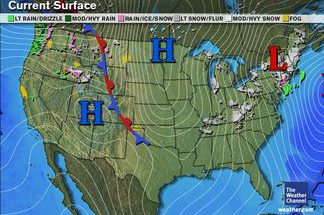
One front, clouds in a variety of places.
Why bother with response? You and your alter ego, Schism NEVER provide any Empirical retort to what I and several others propound! I’d really hoped for a site that could refute the MUFON/Coast2Coast/Birthers/one-world paranoia bullshit, but, other than the slick cover, you are just Schill! Did ya notice the ‘gradient’ (densities have little to do with it as barometric pressure is dependent on many factors, i.e., temp., particle size (remember, Boyle’s, oh, that’s right they didn’t have chem in the continuation school!)- you confused it with temperature between LOW pressure FRONTS and high???????????????? We’ll soon have our own site and look as ‘professional’ as yours financed by the Chambered of Commerce and Cathaholic Church, then the truth will set even you…………………………………………………………………………..free! ps- San Bernardino Emergency Operations Center had US Navy Weather planes flying in consort with the chem-trailers yesterday; our Sentient stopped for fuel and were told the Forest Service firefighting operation is a front for the ‘alteration of Pacific storm ‘fronts’ to mitigate carbon footprint of the Southwest’, this from the FAA services director! Neat, huh?
I’d be very happy to do so, if you could produce the actual evidence. Let’s just take one of your initial claims:
Can you actually back that up? Do you have an actual report that states this?
Aldo Rey:
Ah – PSEUDOPHYSICS.
Next time try “altitude above sea level”.
The whole expression includes the mass and radius of the Earth, the mass of its atmosphere, and of course the weather-induced barometric factor.
We’re waiting for any evidence you have in support of your assertions, and you also have yet to respond to questions asked of you.
I, as a professional biochemist, am interested at ‘odd’ phenomena and was told this site had just that! Wow! A field day of less than acceptable responses and semmingly more layers applied to discourage those who aren’t trained. The Aldo guy was putting forth a sincere posit about factors affecting barometric pressure and JazzRoc retorted ‘above sea level’? Aren’t you both talking about weather that, btw, occurs…….above sea level, regardless of land factors. Mass and radius are unitary measures and have NOTHING to do with question, so why get cute if you can’t supply data? Aldo does mention both NOAA and ICCP findings of several degree change (average) and notes that change in Pacific water temps (this only affects surface waters inshore because of overwhelming high-density cold water current sweeping down coast), so ‘weird’ clouds can’t form if no appreciable moisture present (and Weather Channel shows NO low pressure or fog within 1000 miles for week of 12/20). DSK mentions no chem-trails persist? As a Vietnam vet, I can assure you that Agent Orange persisted in a suspended solution for several months AFTER application and bombers were forced to drop at higher altitudes after pilots become ill (EPA reports Frank Church’s Senate hearings are available in Library of Congress- quite evidenciary). Thank you for forum and hope you can allow real diverse ideas.
Bill de Berg:
His “sincere posit” was entirely wrong. Atmospheric pressure has nothing to do with either temperature or particle size.
You are entirely wrong. Atmospheric pressure has EVERYTHING to do with the mass and radius of the planet.
What’s so “cute” about the both of you being utterly wrong?
Moisture is ALWAYS present in the atmosphere, it’s just a matter of degree.
Agent Orange was used forty years ago as a jungle defoliant. There is always a vertical height of six miles (at least) between contrail and jungle, so you’ll have to explain to me why you see a connection.
ANY idea isn’t really what we’re looking for. We’re looking for any GOOD ideas.
If people want to argue about science and definitions, it would be helpful if they could quote some science to support their arguments. Like:
http://en.wikipedia.org/wiki/Atmospheric_pressure
That aside I think the original claim Aldo Ray made was that in the last week of december there were persistent contrails but “no front”. Now contrails forming in non contrail weather would be interesting, but a front is not what causes contrails – contrails can be a precursor to an approaching weather, of they can just indicate the weather at that location.
If you want to see if contrails are warranted or not, then you need to look at this map:
http://www-pm.larc.nasa.gov/sass/contrail_forecast/contrail_prediction.html
You can compare that with pressure gradients if you like:
http://www.usairnet.com/weather/maps/current/barometric-pressure/
Mr. JazzRoc- you are in error. Could you refer to any succinct formulation, data that shows radius affects bar. pressure (esp. since radius of our planet is pretty damn consistent except for occassional syzigycal perturbation); the other ,mass, is also fairly consistent, so again erroneous and Aldo looking very much the scientist. Uncinus shows maps that to the layman are meaningless, but it was Aldo’s assertion that con or chemical paths have to have a medium to be seen in (your assertion correctly that weather (moisture) always ‘exists’ or portends an advancing ‘front’). The problem that all of you miss, whether intentionally or not, is that Meditteranean countries have had similiar conditions, presence of persistent ‘trails’…………………..all year round (Surfline.com has roving live cams in those areas) for several years; surfer’s depend on consistency of swell and favorable winds for their contest schedule. Those bets have been off and the ASP (Professional organizing body) are asking ICCP for some explanation at any correlation (I’m curiously awaiting) between these observable alterations in ‘weather systems’ and economics of trying to run world-wide contests- no conspiracy here, just reality of sports and weather!
Jazzroc is referring to gravity when he mentions mass and radius. The mass of the planet creates gravity, which holds the atmosphere. The radius (or really the density of the planet) affects the force of gravity at the surface (F = G(M1*M2)/r*r), which then affects the weight of the atmosphere, which creates the atmospheric pressure. See Wikipedia:
http://en.wikipedia.org/wiki/Atmospheric_pressure
Temperature has little to do with it in the Boyle’s law sense of things. High pressure is generally associated with cold air which sinks, rather than hot air, which only increases in pressure when constrained.
As to your ASP claim – could your provide a link to explain exactly what you mean?
“Boyle’s ‘law’ sense of things!” HaAHAHAhhaAAAAAAAAAAAAAaaaaaaaaaaaaaaaaaaaaaaaa “hot air, which only increases in pressure, when constrained”! (by what, government sylphs??? “in most circumstances”, as in a controlled weather station!) HahHhaAAAAAAAAAAAaaaaaaaaaa looks like Unisinus, you’ve met your match with Bill {Deberg} (as in the GROUP). How did you miss that crypticity?)- Weather is ALWAYS dynamic as opposed to earth’s size and mass (except for the phenomenon of chem-trails) and you were provided with web site surfline.com that has NOAA, NWS statistics daily the author referred to- if you were intellectually honest, you would at least note these! ps- wrong formula, again f(g) = m1m2/ d2 and still has NOTHING to do with weather because it’s the WIND moving the air mass around, not some intelligent design altered boiz ‘blowin’ smoke. I’m out!
my bad- the formula referred to ‘incorrectly’ has to do with gravitational attraction between two bodies; how do you swing?
When a gas is heated, it expands. When that gas is constrained by a container (like, it’s in an airtight box) then the pressure will increase as temperature increases. Boyle’s law assumes a constant temperature and a varying constrained volume, so it’s not really directly applicable to the atmosphere as the temperature varies.
The pressure in the atmosphere is created by gravity. The atmosphere is not constrained – if there was no gravity then the atmosphere could escape into space. Thus ground level atmospheric pressure is created mostly by the weight of the air above, and not by the temperature of the air.
The formula I posted F = G(M1*M2)/(r*r) is the force of gravity. Normally we think of gravity as being a constant “g”, g=9.81 m/s (or 32.2 f/s). But really that’s just a simplification of the more general formula, as g is a function of the mass of the earth (M1) and the distance you are from the center (r). When you use equations like s=ut+0.5*g*t*t then that’s just an approximation.
All Jazzroc said was that the whole equation for atmospheric pressure would include the mass and radius of the planet. While that’s true, we can of course factor that out into a simple g, (g = G * M/ r2), which works pretty well over the limited variations of r in the atmosphere.
This, while interesting, is all kind of missing the point though – there’s nothing demonstrably odd going on with contrails. Unless you have some actual evidence you’d like to post?
Pursuant to FOIA for brendanmichaeljames, Secretary of the Air Force 11 CS/ SCSR, 1000 Air Force Pentagon, the following article ahs been released and can be reviewed, Chemtrails Chemistry, course policies and lab manual, 131, fall 1991, USAF Academy, Dept. of Chemistry, USAF, length 232 ppgs.
FYEO- GEMS SMART DUST
Reverend Hunter, whatcha trying to say, peeps? Caught any reverends yet?
Besides the pseudo-science explanations to true observers of climate manipulation, depletedcranium.com is another diversion, beware! Mr. JazzRat, why are you so angry with your inference?- my feeling is you are one of the poor who were anally assaulted (common probe) and try to hide, with cynicism, these scars so others have to also endure what’s occuring!
“anally assaulted” – Reverend Hunter, forwarding the “low road” chemtrailer stereotype one post at a time.
American Geologic Institute (in geo-engineering)- “environmental effects of currently injecting sulfur dioxide creating a light haze and spraying of additonal water vapor (persistent vapor trails caused by chemical injection) could affect weather patterns, increase acid rain and deplete ozone!” Professor Fred Schwab, Lee University
Another fraud naysayer site godlikeproductions.com, depletedcranium.com……………………………JazzRoc, you could at least change font so as to NOT draw suspicion………………………….geez, you’re outed again!
Aldo Rey
Perhaps you might like to use plain English.
I am “JazzRoc” here, in MySpace, ConCen, League of Reason, Opposing Digits, and Club Conspiracy. On YouTube I am now “Beachcomber2008” following a malevolent and wrongful flagging and DMCA attack. I may have once commented in depletedcranium.com. If I did it was under “JazzRoc”.
My website is http://jazzroc.wordpress.com which calls itself “JazzRoc versus Chemtrails” and you could have discovered that just by clicking on my name.
What can be plainer than that?
“Suspicion”, “outed”, is crazy talk, man. It’s OBVIOUS I disagree with your views. 🙂
Enough, already. It’s off-topic.
Why did you erase my post you had accepted that you had used godconnections.com and your pseudonyms? It’s too late to turn back. What you are afraid of?………………………………….are the answers so uncomfortable that don’t quite fit into your limited depcranium. On this day of celebration, jazzWrack (as in flotsam), Skititphrenic, Schill (how appropriate), MLK, you chose to delete that which you fear when, indeed, sometimes it requires risk taking, even to the point that you let go of the calvinism/capitalism delusion that has brought poverty and suffering to sooooooooooo many (Haiti was destroyed long ago by US ‘interventionism’, earhquake was just more injury to insult)- I’ve saved your and your dep. and godshit posts and new forum will clearly expose your fraud with our new site………………..I only have a B.A.(as opposed to your bs), but I also have truth……………………and that, has set me free! Aloha
Aloha. 🙂
The Latin root of the English word ‘Government’, actually breaks down to two parts: Govern = ‘Control’ and Ment = ‘Mind’.
I wonder which department the author of this website works for?
-ment is a suffix that transforms a verb into a noun representing the action the the verb. It has no inherent meaning.
http://www.wordinfo.info/words/index/info/view_unit/1288
It helps to verify your beliefs with the actual facts. That is what I’m doing here. Providing facts that you yourself can go and verify. Don’t trust what I say, and don’t trust what the chemtrailers say, but seek out the facts for yourself. Think for yourself.
In England, forty years ago, the government there was admittedly “Spraying” their citizenry, or don’t you read the papers? It’s funny; when I saw the photo, and read it was forty years old, I knew it had to be taken in England. Then, I read the caption and smiled. ;]
Aren’t conspiracy theories fun!
Why I don’t believe it: I have been flying for over 25 years and training civilian, commercial and military pilots for 20 years. I have yet to talk to any pilot that has been spraying “chemtrails”. The amount of people involved to spray that many “chemtrails” would be enormous. The government is not that good at keeping things quiet. Just look at Bill Clinton and Monica Lewinsky. There were only two people in the room and they couldn’t keep that quiet.
Why I would believe it: Leave it to the government the use the most inefficient way of killing us off or making us stupid or whatever it is supposed to do to us. You should be more concerned with the water you drink and take a shower in.
Ross and NVRep would love to hear more from you both, where have you gone? I am noticing those contrails in the sky again this morning. Nov. 3rd. They are in a bar system across the sky. I have pictures of them in a grid pattern as well, rather unusual. The trails linger for hours, spreading out. Within two-ish days we get rain. I really started noticing them in the early summer here in VA. Please scroll up to 2008 and read some of their remarks.
I enjoy this site,but would rather not have you guys ruin it with your verbal, abusive bantering. Share your ideas, unless your motive is to stop people from reading some of the other more relevant remarks.
I’m still here, rebecca.
I made 3 information-solid posts in this thread… in May 2008 – over 3 years ago!
Where did I “ruin it with … verbal, abusive bantering”?
(The Internet Never Forgets)
Rebecca,
I’d suggest you begin learning the exact identity of the planes you see by using one of the programs that lets you identify planes. Try Flightaware and get back to us. Probably over 90% of the planes you see are ordinary commercial jets.
see my thoughts on this:
http://metabunk.org/threads/100-14-Years-of-Chemtrails-Comments-and-Suggestions
This is a really old military paper, circa 1972 when they first started this work.
Due to that annoying statute that keeps things “secret” for a definate period of time, the more recent stuff is not out there in the open air (yet . . .)
However,
This paper details “barium ion release” experiments which were followed by radiowave bombardment (as a test for whether or not these clouds could be used aerial antennas / and for other purposes) and it contains a nice description of “wave-like” patterns in the clouds after bombardment such as could be achieved through equipment like HAARP and similar..
Research carried out by the Uni of Alaska!
http://www.dtic.mil/cgi-bin/GetTRDoc?AD=AD757916&Location=U2&doc=GetTRDoc.pdf
Observations of the Development of Striations in Large Barium Ion Clouds
Geophysical Institute, University of Alaska S~. GROUP Fairbanks,
Alaska 99701
-;,Striations develop within large (12-352 kg releases) barium ion clouds
in a two-stage process. -First the clouds split into sheets commencing
at the trailing edge of the cloud. Then distortions-or pinching effects
within the individual sheets cause the formation of field-aligned raylike
structures- In the clouds observed, the individual sheets were 200 m to
1000 m in thickness and were spaced 700 m to 2000 m apart. Quasi-sinusoidal
waviness or spatially periodic thickenings exhibited a wavelength
typically 700 m to 1000 m.When rod-like structures appeared, these were
typically-200 im to 400 m. in diameter and were spaced along the pre-existing
sheet at 700 m to 1000 m on centers.
In the course of experiments performed by various groups during the
past few years more than one hundred barium releases have been performed
~in the ionosphere. A listing of many-of these is given by Davis and Wallis
(1972). Most of the ion clouds produced have been observed to develop striations.
The objective of most releases has been to measure the ambient elec-
V tric field through observation of the motion of an ion cloud.
A description of striation formation in a small (2.4 kg) cloud released
at 19i km over Eglin Air Force Base, Florida was given by Rosenberg (1971).
At about 500 sec after release the ion cloud developed three sheet-like
striations which became approximately 10 km long, 30 km high and 0.6 km in
thickness by 930 sec after release
2.4Kg of barium = clouds of 10km long!
Where we describe observations of the motions and striation developments
within very large barium clouds released as parl. of the SECEDE program
sponsored by the Advanced Research Projects Agency both in the auroral zone
at College,, Alaska, and at middle latitude at Eglin Air Force Base, Florida
and in Puerto Rico. The releases discussed here ranged in size from 16
kg to 320 kg to Ba-CuO mixture and were performed at altitudes ranging from
140 km to 250 km. Environmental conditions ranged from magnetically quiet
to very disturbed (in the case of certain of the auroral zone releases).
At least in a qualitative sense the striation developments were similar
to those in the small cloud described by Rosenber
You can read the entire thing yourself if you are so inclined, but most important thing to note is they are discussing barium releases AND the subsequent “spreading” of these clouds in a manner similar to that observed with current day chemtrails!
BARIUM RELEASE PARAMETERS
EVENT AND TIME SIZE, kg ALTITUDE, km RELEASE COORD / TWILIGHT
A(pple) 02 JUN 1968 ‘ 12 196 Puerto Rico Morning 091742 (18,7N,66.8W)
D(ogwood) 12 JUN 1968 12 188 Puerto Rico Morning 091042 (18.7N,66.9W)
E(lm) 05 MIAR 1969 12 170 College Evening, 043247
F(ir) .15 MAR 1969 48 165 Collcge Evening 050814
G(um) 19 MAR 1969 48 163 College Evening O51915
kH(emlock) 20 MAR 1969 96. 176 College Evening 053910
” I(ronwood) 1 MAR 1969 12 140 College Morning, 1408 Pre- twilight
J(uniper) 4 MAR 1969 6 170 College Evening- 043224
N(utmeg) 16 JAN 1971 48 144 Eglin Evening 233440
O(live) 2293 53J5A7N 1971 352 190 Eglin Evening
P(lum) 20 JAN 1971 48 182 Eglin Evening 234705
R(edwood) 26 JAN 1971 48 252 Eglin Evening 235209 I
S(pzruce) 01 FEB 1971 48 184 Eglin Evening
They HAVE been putting Barium into the sky for minimally 40 years – AND they have been observing how trails of it grow – how little of it can produce very long trails (2.4kg for a spreading trail 10km long!)
I suppose this is ok though too right?
@Phasma:
From the article: “were performed at altitudes ranging from
140 km to 250 km”
Do you think the planes leaving white trails in the sky are at an altitude of 140 to 250km?
The 2.4kg cloud was released at an altitude of 194km.
I humbly suggest you read about the kilometre (km) distance units of the Metric system and do some conversions to units you are more familiar with.
The reason the ion clouds spread so much is that there is negligible atmosphere at such extreme altitudes
The barium releases cited were in the ionosphere and were sent up by rockets.
What do you think is the maximum altitude of a 2 or 4 engine winged plane such as those claimed to be leaving “chemtrails”?
Re:
“were performed at altitudes ranging from 140 km to 250 km”
in miles 140 km = 89 miles
250 km = 155 miles
30,000 ft =5.68 miles
The International Space Station, for example, orbits around 300 km. altitude.
So, these clouds were at the edge of space…
What a perfect place to ask questions. What’s up with the heavy spraying just before storm fronts move in? I see that all the time. Is that a normal pattern of occurrence?
And, why don’t they spray on windy days? I usually notice them spraying when the winds are light.
They show up ahead of storm front for the same reason cirrus clouds show up. The front face arrives at high levels first, so you see clouds there.
I’ve not noticed any really correlation with windy days, but it could be that when it’s windy it’s after the front arrived, so the contrail area has past. Of course that does not cover all cases.
Windy days usually are the result of a high pressure gradient between low and high pressure areas.
High pressure moves towards low pressure. High pressure air is generally falling air, and as a result, moisture is often lacking in the upper atmosphere in a high pressure area. This is pretty elementary meteorology, and the reason why the meteorology community (and tens of thousands of avaiators) don’t buy into the idea of chemtrails.
hmm for people so obsessed with supposed evidence where is the evidence of when this photo was taken, where it was taken and by whom. With no credible info on the photo itself it is just meaningless. As a photographer it is not a photo I would believe is from the era suggested, just by the texture suggesting a scan from a print and the depth of color still in this print.
The photo is plate 113 of the book Cloud Studies in Colour, by Richard Scorer and Harry Wexler, published in 1967 by Pergamon Press. You can look it up.
what does this picture prove. They were seeding the skys over england in the 50s see project cumulas and it worked very well causing a flood that killed 39 in village in lynmouth they denied that as well till 2001 this is on record . but we are the kooks. i see planes fly in a grid pattern. and cirrus clouds grow in front of my eyes till they mesh together and cover the entire sky in a white mush that blocks out the sun and you tell me its codensation. blind us with science and fancy charts then imply we are to stupid to understand it. and you do because you studied it well the arrogance of academia in some. what a load of incomprehensable pifle. the science exists to manipulate weather through the use of spraying chemicals into the sky on record. planes have been spraying in the sky for years for mutliple purposes and thats irrefutable undeniable fact.
Of course, cloud seeding has been openly practiced for 60+ years. But that’s not what the photo shows (it shows contrails), and it’s not what the “chemtrail” theory is about (it’s about long white persistent trails in the sky).
Clouds have been covering the clouds with cirrus since WWII. It’s noting new. That’s what this photo shows, and what all the other photos and evidence shows.
Honest-
contrails can and often do persist and spread onto an overcast of “contrail cirrus”…
Not to blind you with science but here is one of many papers written over the last 60yrs detailing the process:
http://www-pm.larc.nasa.gov/sass/pub/journals/atlas_JAMC2006.pdf
man has attempted to change the weather for 60 years that we can agree upon. and certain projects to do the same have been denied by the agencies involved and people have been uknowingly exposed to the chemicals used in the process. you show a photo and say thats contrails when you have no more knowledge about its origins except for the information you provided us i can show you plenty of photos and say look theirs the proof . we have been sprayed with all sorts of chemicals and biological agents and lied to about havent we
But the point is that there is no evidence that the long white lines people are seeing are anything other than persistent contrails.
Do you think they look or act any different?
thank you for the link i will digest it at a later.date. but my point is i dont have blind faith in science I consider myself a critical thinker but only have my 5 senses and logic to discern reality and other peoples rhetoric. i try not to have fixed opinions. but i can quite believe that science and our goverments wouldnt involve their selfs in geoegineering and lie to the public about it. not as if it would be the first time
maybe you could dismiss our fears. if you could explain what proof you have that they are contrails .
Consider though it would have to be a worldwide conspiracy involving all the world’s scientists and meteorology students. Who must have all been sworn into secrecy.
Is that some they have done before? All the scientists in every country sworn to silence? Even China and North Korea have been silenced?
A) They look and behave exactly like contrails
B) There’s no evidence to suggest they are not contrails.
Pretty much the same proof that every cloud is a cloud. There’s no reason to suspect otherwise.
Think about it. WHY would you suddenly suspect a cloud is not a cloud, and start demanding people prove that they are clouds? Wouldn’t you want some evidence first?
yes they do act differently from normal cirrus clouds i have never seen a natural cirrus cloud develeop in under an hour from jet exhaust
youre asking question that i cant answer but i know the manhatten project invoveld hundreds of people and they kept that secret thats just a belief that goverments could not keep it secret goverments keep secrets all the time answer me this please have goverments sprayed their populations with biological and chemical agents in the past and kept it secret
I asked if they (“chemtrails”) act differently to normal persistent contrails. Is there any visible difference?
The Manhatten project was a wartime project, involving only US citizens who all though they were doing what was right to save american lives. It was also done in a secret location.
That does not translate to somehow convincing all the meteorology students in the entire world to ignore something strange going on the atmosphere.
Really, you think Roxy Lopez and Michael Murphy managed to notice what every single meteorology department in the world has somehow failed to notice?
Do you think there’s ANY actual evidence that something in particular is going on. Not just “they may well be doing something”. But some specific thing that is having some effect?
have goverments and scientist sprayed their populations with chemical and biological agents in the past.