Contrails are long thin clouds of ice crystals that form behind planes that fly through freezing cold air. Usually, you see them behind jets at around 30,000 feet. If the air they fly though has enough moisture in it already, then these contrail clouds can last for a long time before they evaporate. Sometimes you get a lot of them at once in the sky, if the weather is right. They look like this:
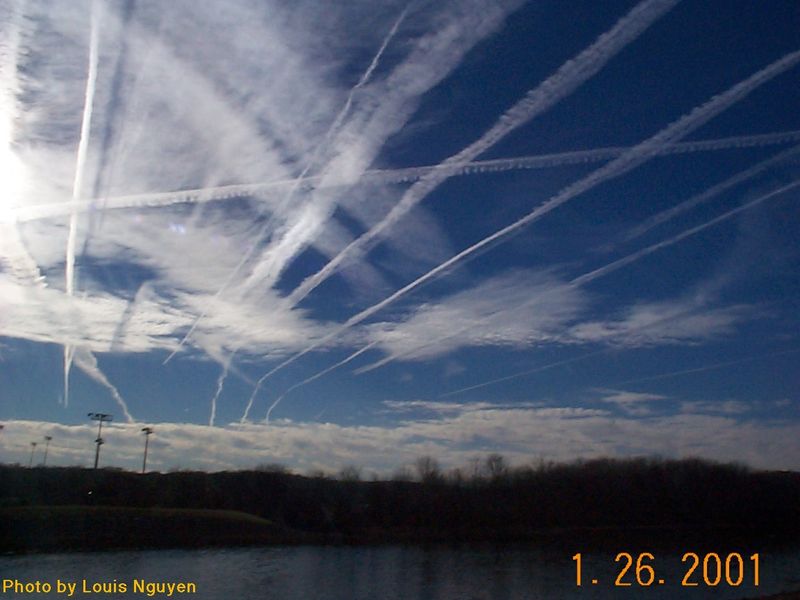
Note: the trails in the above photo ARE CONTRAILS (and some natural clouds). That’s a photo taken by NASA scientist Louis Nguyen from I-95 in northern Virginia, January 26, 2001. This is the only photo of contrails in this article. The remaining photos are NOT contrails.
There are several things that a superficially somewhat similar, in that they involve stuff coming out of the back of an airplane and/or lines in the sky. But these things are not contrails.
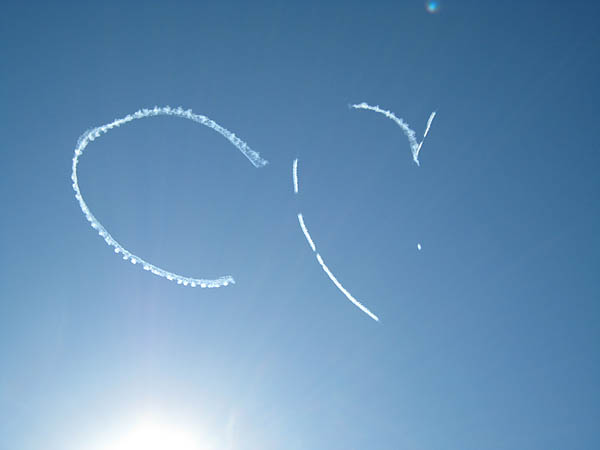
SKYWRITING
Skywriting is making patterns in the sky using smoke trails. Done at a low altitude using small planes, it can look very like a contrail, but it’s very different as skywriting is made from smoke (made from injecting oil into the hot exhaust), and contrails are made from ice crystals.
SKYTYPING
Also known as “Dot Matrix Sky Writing”, See:
http://www.geicoskytypers.com/
Skytyping utilizes five airplanes that fly abreast, 250-feet apart and “type” up to 25-30 character messages in a dot-matrix-like pattern. Skytyping is 17 times faster than skywriting, laying out a letter every 4 seconds. During skytyping aerial exhibitions, the pilots fly their aircraft in a line-abreast formation while a computer in the lead plane sends radio signals to the smoke systems in each plane in the formation, thus creating a customized message in a dot-matrix pattern of environmentally safe puffs of smoke.
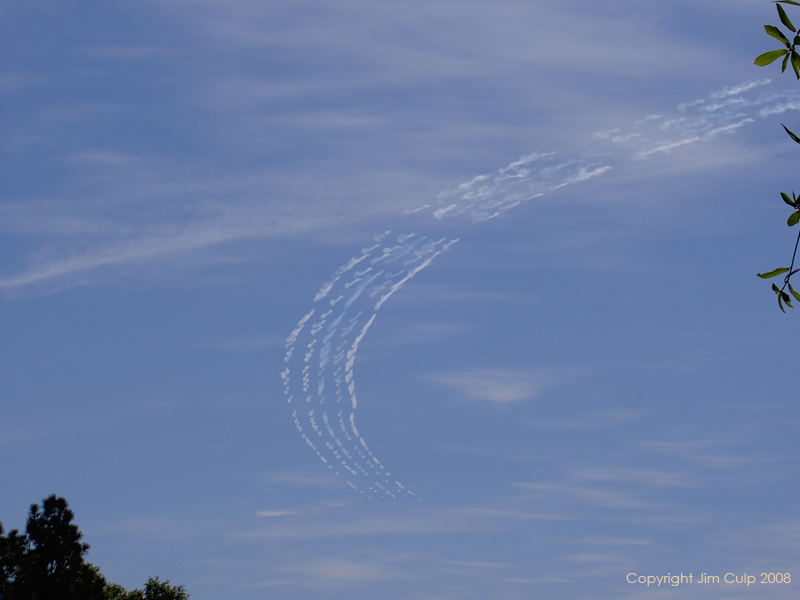
In the above photo, the trails have been blurred by the wind, but you can kind of make out letters in the section to the right.
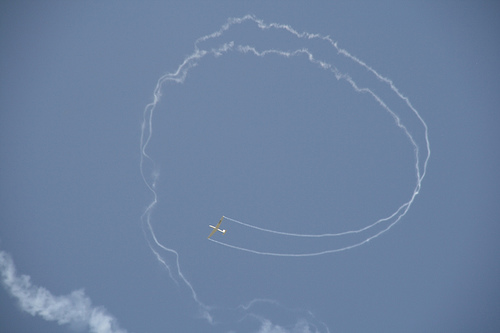
AEROBATIC SMOKE TRAILS
Rather similar to skywriting, smoke trails are used to enhance exhibitions of aerobatics, often with different colored trails. These are the Red Arrows, in the UK.

Even gliders can perform aerobatics, and they often have wingtip smoke generators to show this off:
CROP DUSTING
More technically called “Aerial Application”, this involves spraying crops or agricultural areas with fertilizers, pesticides, fungicides, or defoliants, for a variety of reasons. Typically done with small planes or helicopters just a few tens of feet above the crop, like this:

PEST SPRAYING
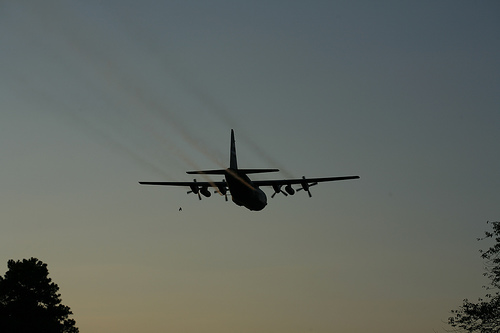
Sometimes larger areas that a few fields are sprayed for things like mosquito control. Larger planes can be used, but they still have to spray very close to the ground. Here’s a C-130 spraying a few hundred feet up:
RESEARCH SMOKE TRAILS
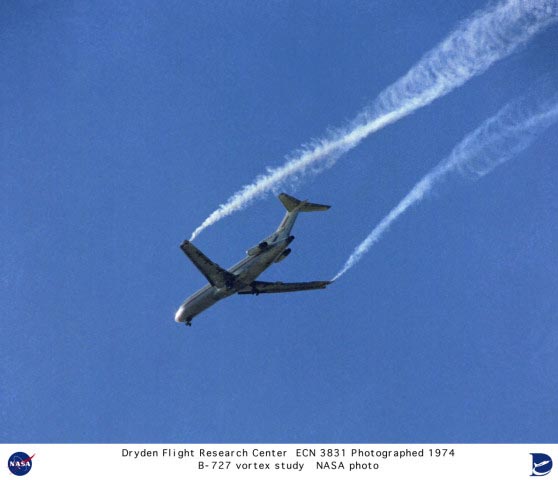
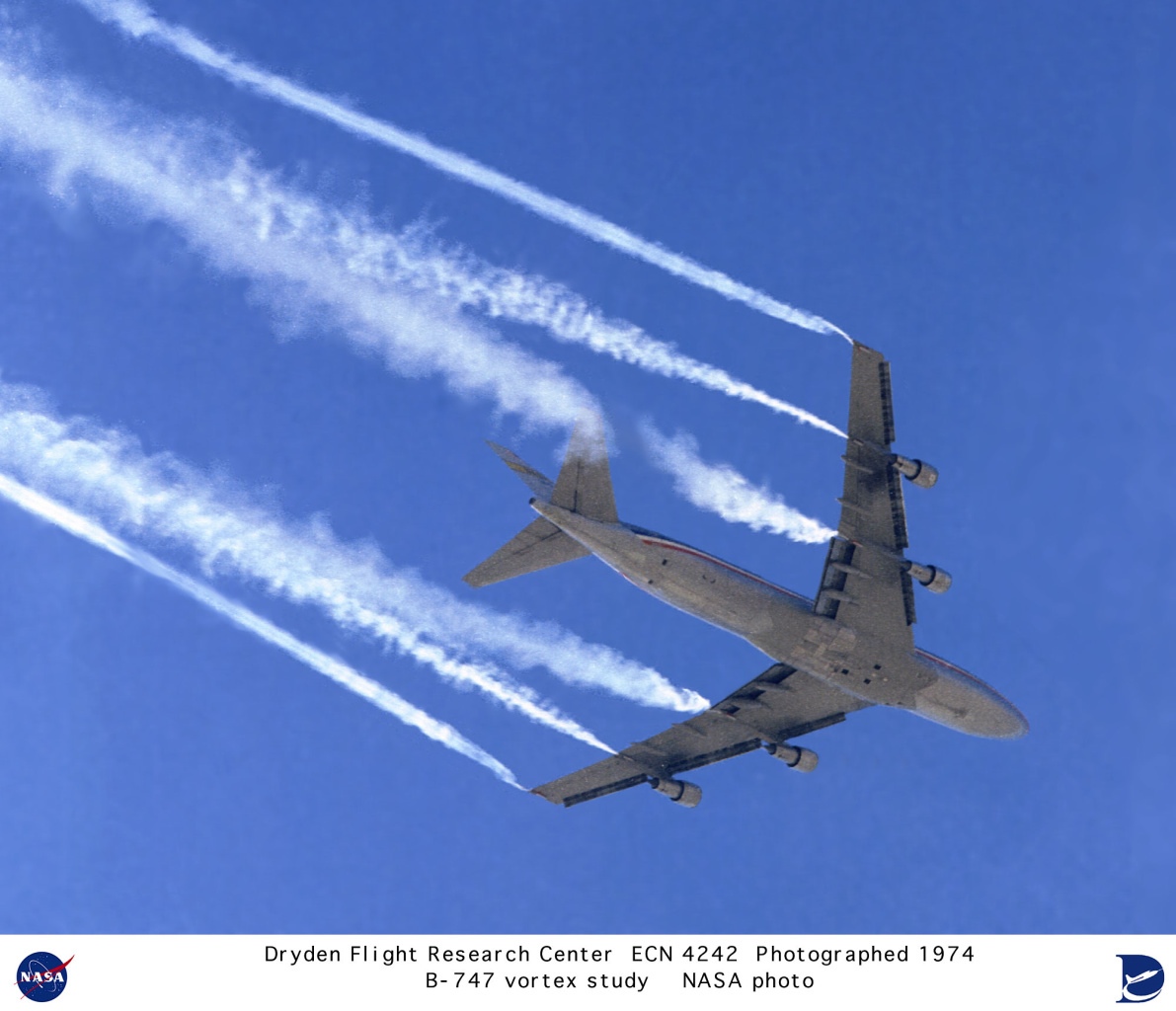
Sometimes planes have smoke emitters placed on them for research purposes – generally visualize the flow of air behind the plane, the vortices, or “wake turbulence” which can be dangerous to other planes. Here’s one example:
http://www.dfrc.nasa.gov/Gallery/Photo/B-747/HTML/ECN-4242.html
CLOUD STREETS
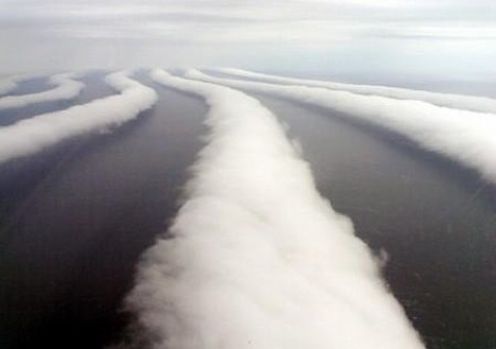
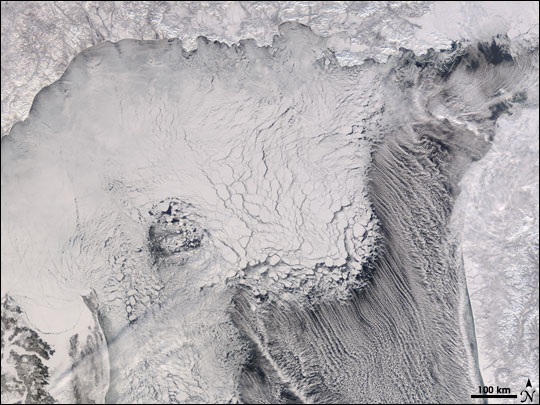
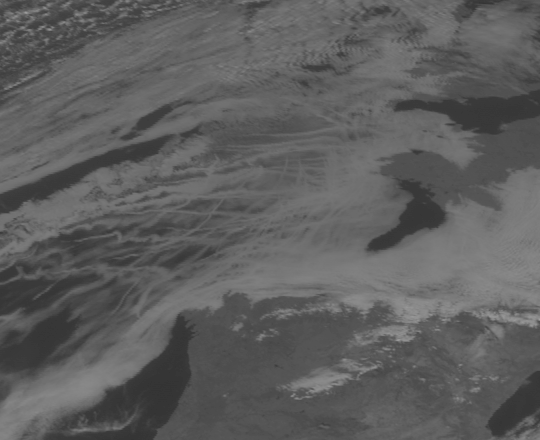
Atmospheric conditions can make clouds form in odd ways. These unusual stratocumulus clouds called “cloud streets” formed over the Sea of Okhotsk, Northern Japan, on June 18th, 2007.
Here’s a satellite photo of the region showing these clouds:
More info here:
http://www.meteorologynews.com/2009/10/29/cloud-streets-photographed-over-gulf-of-mexico/
CLOUD SEEDING
People try to make clouds produce more rain by “Seeding” them with tiny particles of things like silver iodine. This is done using incendiary devices attached to the aircraft. Basically, flares that are burnt one at a time. Here’s what they look like in action.
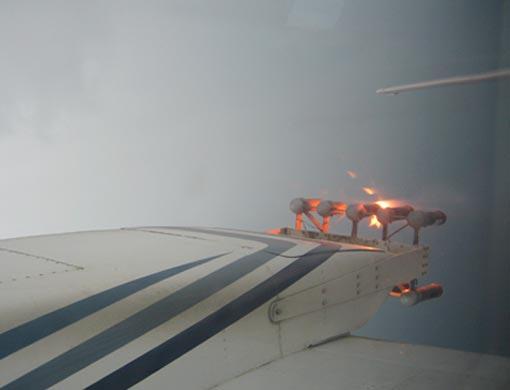
Long shots of clouds seeding are hard to come by because it happens inside or above the cloud. If you see a long trail coming from behind a plane, then it’s not cloud seeding. The trail is very thin, and probably not noticeable from the ground, even if you could see the plane.
FIRE FIGHTING
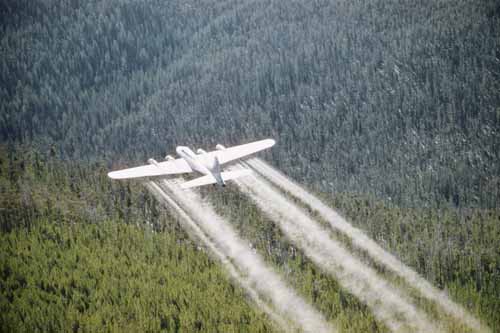
Planes are often used in fighting fires, and typically drop fire retardant from a low altitude. Often it’s bright red, but sometimes it’s just water pulled from a nearby lake. This one is in Missoula, Montana. Note it’s a fairly low altitude, probably 1000 feet or so.
FUEL DUMPING
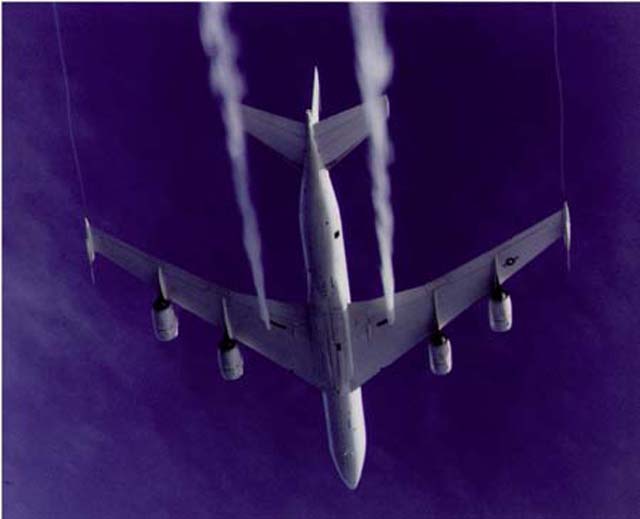
When a plane takes off they are usually full of fuel. At this point, they are too heavy to safely land (it’s a lot easier on a plane to take off than to land). If they have to cut their trip short, then they have to get rid of that excess weight. They can just fly around for hours to burn it off, but some planes have a fuel dump system that lets them get rid of the excess fuel rapidly by just dumping it into the air. This is often from vents at the end of the wing, but sometimes it’s mid-wing, or at the tail.
This is a Navy E-6B Mercury (TACAMO), dumping fuel from its mid-wing vents.
Here’s a rare set of shots from the ground of a jet dumping fuel
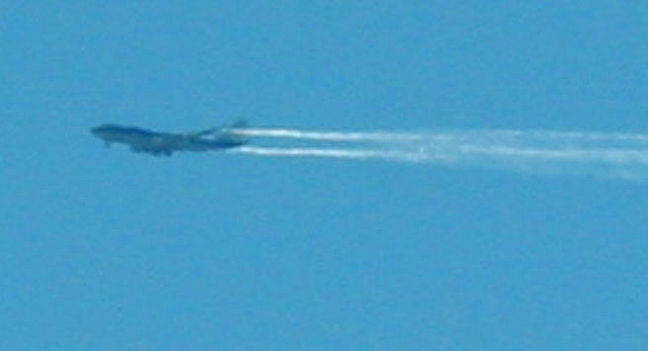
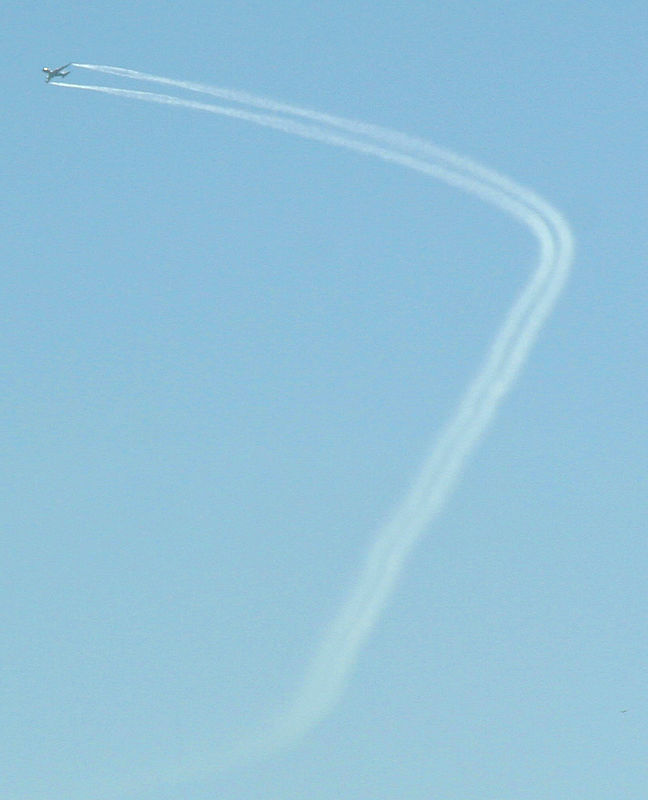
Note the difference between this and a contrail. You can see it’s coming from the wingtips, and you can see the trails just kind of blur out as it spreads and evaporates, unlike contrails which have much more well-defined edges, even as they fade away. See here for the full story behind this incident:
http://www.airliners.net/aviation-forums/general_aviation/read.main/3523366/
The aircraft, of of KLM’s B744 full passenger versions, registered PH-BFG, took off from SFO and somewhere around Sacramento the crew decided to turn back to SFO because the nosewheel wouldn’t retract.
See also:
http://www.modbee.com/local/story/34136.html
And a cool video:
http://www.youtube.com/watch?v=uoUBWEqPu0Q
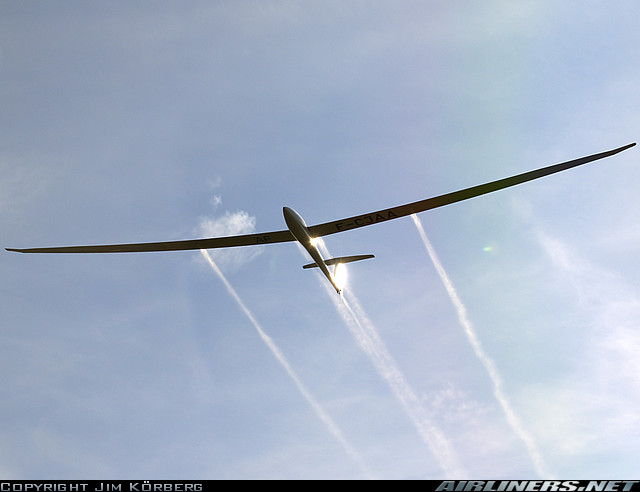
GLIDER BALLAST DUMPING
Gliders use water for ballast, and they sometimes let some out to reduce their descent rate, usually when landing. It looks similar to fuel dumping. Here’s a nice example:
ROCKET TRAILS
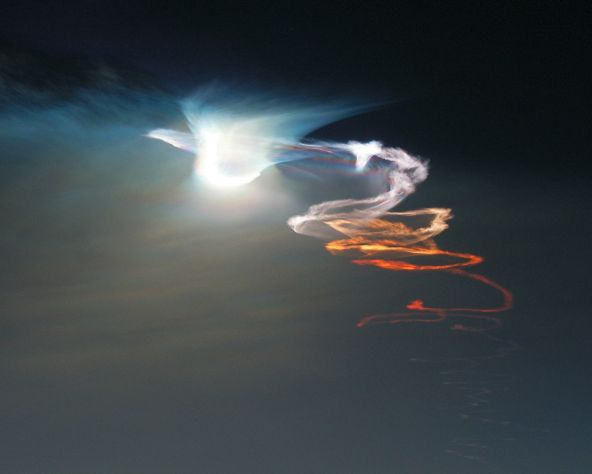
Most rockets can produce a kind of contrail as the combustion of the fuel (especially if they are hydrogen+oxygen fueled) will produce a lot of water. But for many rockets there is also a lot of visible smoke. It’s not always visually clear what is smoke, and what is water. When they get very high up, the trail spreads out and is lit by the sun in unusual ways. You see this a lot with the missile tests in California. You could call this a contrail if you wanted, so long as you note it’s a rocket contrail, and so probably contains smoke.
SHIP TRAILS
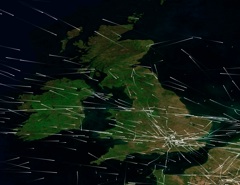
Generally seen best from space, large ships can create a trail in the atmosphere above it that resembles a contrail. These are off the coast of France. They are generally more squiggly than contrails, as the ships move much slower, so the trail is at the mercy of the wind to a greater degree.
FLARES
Military planes shoot out flares to confuse heat-seeking missiles. These are very bright and leave smoke trails. Usually, they shoot off in all different directions, like this:

CHAFF
Chaff is a substance that planes spray to confuse radar. Generally it thin fibers, coated with aluminum. I could not find ANY photos of chaff being sprayed, despite it being used since the 1940s. This is probably because it just looks like fine dust. It does not leave a trail (it would be rather pointless to defeat the radar, but then have a big line pointing to where you are). It’s only visible to radar.
GUN SMOKE
This photo I originally thought was chaff, as that was how it was labeled, but then someone pointed out it was actually smoke from the guns firing. Not chaff, but not a contrail either. There are a variety of reasons why smoke can be coming from an airplane.
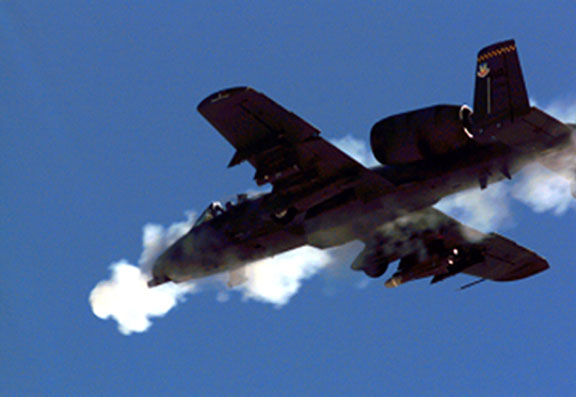
I’m not really sure, but may it be that the “fog” in the last foto is actually the smoke from the GAU-8 gatling gun? The gun firing makes a lot of smoke (you can see a photo of an A-10 firing on wikipedia http://en.wikipedia.org/wiki/Image:A-10_Thunderbolt_II_Gun_Run.JPEG)
I think you are right niio, I’ll have to add a new category “Gun Smoke”
Who are you?
I’m just some guy.
Anyone know if smoke trails (such as those produced for skywriting or aerobatic shows) are also emitted for other purposes – such as wind measurement / indicators for landing aircraft or skydivers? I have been told this is the case – but have been unable to confirm.
Also, what is generally the minimum altitude that contrails form? I saw 30,000 feet mentioned. What about lower?
Nick, smoke trails are used for studying wake vorticies. They can also be used as emergency wind indicators at temporary landing sites (military, usually, with smoke grenades). Skydivers use them for display purposes.
Contrails can form at any altitude if the temperature is cold enough (around -40), so they can form at sea level in Alaska. Normally over the Southern US, they form above 25,000 – higher in summer, but it depends on the weather.
This morning I have seen over a dozen of those rockets with contrails flying overhead – all heading relatively in the same direction. And my curiosity sparked up. Does anyone know the purpose of their flight. Data collection…? Are they even manned? When I searched the web for some answers this site came up. Thanks for the info, it is always rewarding to learn something new.
I can think of at least one other source of smoke or clouds that is not a contrail: Smoke from fires, engine malfunctions or other aircraft problems.
I remember a few years ago an aircraft had to make an emergency landing after it took off and some kind of malfunction caused the APU to catch fire. I’m not sure exactly what happened, I think it may have been lubricating oil that burned or perhaps some extra fuel in the APU, but basically the aircraft landed with gray smoke coming out of the tail and the passengers had to be evacuated with slides and that kind of thing. The emergency response units got things put out pretty quickly by spraying some foam on it.
Once in a while there’s an engine fire or just an engine malfunction that causes smoke to pour out. There are also aircraft systems for suppressing like engine nacelle fire extinguisher systems – these too could leave some clouds or trails when activated.
I dont care what anybody says anymore…Its right infront of our faces people…they are spraying us with something and are not talking about it.
people who make fun of me for saying this are unable to believe the enormity as to which they are manipulated and controled into thinking that they are free by being given a false sense identity and reality through church and education…now the time is coming when the grid that supports their empire (we call it the western world) is going to fall do to the planetary changes and changes in our minds as a whole.
they are doing this to either A.
slow down this proccess of global warming do to the SUN in occordance to their dead line set around 2012..
all the planets are showing an increase in surface temp.
what is happening to our planet is a cosmic event….earth quakes in this decade alone has shot up from an average of 4, 5, 6, a year to atleast…ATLEAST 40 a year starting around 2002…only months afters 9 11 ..is when it shot up.
check the USGS website for a detailed record of annual earthquakes that are above the 3.0 on the R scale…Its real folks…somthing is happening and the ELITE KNOW IT and are in a race to finish what thier ansestors started thousands of years ago.
http://earthquake.usgs.gov/regional/world/historical.php
B they are making us sick or weakening our immunsystem
or C… using this stuff as a conductor for some kind of communications TECH.
hell maybe all 3.
Its like in the movie The Matrix..when the U.N. scorched the sky as a first step in killing off the massive hoard of robotic slaves who began to rebel against there corrupt masters who were eventually defeated.
Kinda IRONIC dont you think my friends…being that the Matrix movie mirrors the situation we are in on this planet.
There are not more earthquakes, just more seismographs, for more details see:
http://neic.usgs.gov/neis/eqlists/eqstats.html
And:
http://earthquake.usgs.gov/learning/topics/increase_in_earthquakes.php
You are spreading/creating propaganda and I hope you burn in hell for it. Any intelligent person who can remember the skies from a decade ago, knows that something is happening.
Well…one person’s truth is another person’s propaganda…
But honestly, when you look at the pictures here:
https://contrailscience.com/contrail-photos-through-history/
What do you make of it??
How do the skies today look any different? How do the trails behave any differently?
The physics of the atmosphere that dictate the behavior of ice crystals have not changed….
So what has? More planes? The internet’s ability to feed mass hysteria? Deterioration in education causing a drop off in the ability for research and logical reasoning skills?
What?
Nick, I hope, as you do, that the persons responsible for spreading propaganda “burn in hell for it”. Unfortunately for YOU, it will be YOU and your friends on youtube and conspiracy sites that will be burning. The simple and basic science that you are ignorant about pretty much guarantees that you are destined for a VERY warm eternity! I have seen these trails over MY region for my entire life, 44+ years. I was VERY interested in science and aviation and took the time to learn the facts before I was 13. I suggest you do the same some day. It will greatly benefit you.
Living life in fear of your own people just because you are ignorant of the facts seems so pathetic. I pity you for failing to properly educate yourself. Like I said, this is basic stuff here…it can’t be “made up” nor is there any reason to make it up! Also, calling for people to burn in hell just because YOU are ignorant of the truth seems quite disgusting! You are bearing false witness! How dare you!
Nick, these guys go all day and night. They are never wrong. Just let them be. You and I both know what is happening.
No Ian, you “think” (and I use that term VERY loosely) you and he both “know” what is happening. Yet, what is obvious you DON’T know is anything about your own atmosphere, or aviation. Go ahead. Believe what you want. It’s amusing how you CHOOSE to be ignorant and concerned about the lines in the sky. Enjoy that! I sleep well knowing that simple and basic science easily refutes what the alarmist chemtards are spreading….ignorance.
Like I said, all day.
And again, YOUR perception of the facts proves you to be paranoid. On here, I check the site out twice a day unless I am actively involved in a conversation. On youtube, I set up my account with a dedicated email address and get an email anytime someone replies to a post of mine or posts something on my channel. When that email arrives I get a tone. Wherever/whenever I am, I’m near a computer (and the iphone itself) and am able to fire off a reply in a few seconds. In this day and age it’s beneficial to multi-task. I’m sorry to hear that you are unable. I have a job that is equally physical and deskjob and have SEVERAL computers available at home and work. I’m able to respond to anyone from anywhere at any time during any day, yet still get my work done and enjoy plenty of time with my family.
yes, I DO spend a LOT of time trying to get chemtards to take the time to properly educate themselves about aviation and atmospheric science. I think they are hurting themselves and this country when they spread paranoid ignorance as fact. It’s disgusting. I have a passion for the truth…and so should you. Instead you have fallen for a hoax and have employed confirmation bias in your research techniques. You, as a group, are also VERY distrustful of those who are educated in these subjects and spread lies about us. I will defend myself from such paranoid rubbish. Just as you would if someone was telling lies about the particular burgers you will undoubtedly spend the rest of your life flipping.
Cool. I congratulate your services on keeping busy.
I feel there is no need to call me a chemtard. After review of the evidence provided on this website I am in complete agreement to this contrail phenomena. I beg your pardon on the slanderous outburst.
A chemtard, is what you are. It’s the name given to those who’s education ended (retarded) BEFORE they learned how the atmosphere works. And I KNOW you are lying about believing the info on this site. No chemtard has ever actually learned the facts and admitted to understand.
Thats where you are wrong. I’ve looked deep into your vault of evidence here on this website and have come to a conclusion that what i am seeing actually a normal phenomenon. I was stupid to think that it as chemicals.
Yes, you sure were.
This is a bunch of hogwash. My 83 year old father knows what’s been in the sky for the last 83 years and what hasn’t. So do I.
I’m sick and tired of people thinking they are actually convincing anyone with the ridiculous fake debunking.
We are being chemtrailed, all over the world. The global elite say it in their own documents! They are out to kill 80-90% of the world’s population and chemtrails are part of it.
Which documents? What exactly do they say?
How do you explain all the old photos of contrails that look just like “chemtrails”?
So now your 83 year old father (and yourself) are ignoring history and rewriting it without persisting contrails? I guess if you don’t like the facts, you can simply make up new ones to support your case. Obviously there are people out there willing to believe hearsay.
As Uncinus says, how do you explain old photos and reports of persisting contrails?
Debunking that relies specifically on facts? Oh yes, that’s very fake lol.
Yeah, I heard that on Coast to Coast AM as well, it must be true! Again as Uncinus asked above, where are these reports?
I have to correct you on the firefighting picture. That B-17 is not fighting fire. It is most likely one of many surplus B17’s that was used up until the early 70’s or so to fight gypsy moth or some other insect or infestations in forests around the country. Surplus B17’s were in fact used to fight forest fire during the same time period, but this airplane is not. If it were fighting fire the material whatever color and composition it might be, would be emanating from the bottom of the fuselage from where the stock bomb bay was not the wings. It would also appear MUCH more concentrated and fall in a more vertical manner than a trailing manner like in the pic. The concentration that is emanating from the wings of this B17 would not put out even a very small fire. When I mean small fire I mean less than a campfire size, more like match intensity. I have over 17 years of aerial crop/ forestry spraying and firefighting experience and I’m positive of what’s happening there.
That’s a fairly rare pic of that B17 in action in that kind of work, it should be preserved.
However, I deeply agree with you that the perception of contrails by the more ignorant among the population who are most likely so bored that they must cook up something to make themselves feel useful to the planet are dead wrong.Thanks for your efforts
Thanks flyinsnoopy. I’m guilty of plucking a pretty picture from Google images, and trusting the caption. Looking at it now it does seem unlikely to be fire-fighting. But I got it from here:
http://www.ngsprints.co.uk/North-America-Geography-Forests/c1_90_573/p102946/Forest-Service-Plane-Drops-Fire-Retardant-On-Forest./product_info.html
Is that possibly accurate?
From personal experience, im an ex-military radio operator and ive had buddies of mine who loaded the planes with drums labeled; “barium”, “thorium” and “aluminum polymers”, didnt think anything of it, until i started lookin at the skies. you think i would be the first to know, but they dont tell us shit. so nick ian dont let ur guard down, just let these passive sleepwalkers have their bottle and let them be overcome by being naive and ignorant. wake up people!!!
Timetowakeup…why are you lying about the drums of chemicals?
That’s such a ridiculous claim it hardly needs addressing. I’d challenge anyone to find a drum labeled “aluminum polymers”. timetowakeup is just trolling.
i like the fact how u werent there and havent even seen anything near what ive seen and somehow u can still judge me and tell me what ive seen and havent. if its science, heres a theory. our military has nearly complete control of everything. we have intelligence and technology unlike anything ive ever seen. if your telling me that the labeled drums werent a part of a aerial spraying, then i dont know why they would be loading unmarked, non-military planes, in which we have never seen a pilot outside of the plane. if u look at any google “chemtrail satellite imagery” or any chemtrail pictures and notice that these grid-lines patterns arent normal flight patterns. when we deployed anywhere, we went from point a to point b, without taking the slightest bit of a turn, yet somehow the patterns in the skies often loop and cross-back over eachother. it isnt skywrting, it isnt cloud seeding, it happens all over the world, most often seen in large cities. if u want to hear more feel free to ask. im not submissive to ur ignorance or inconsideration
timetogotothelibrary:
Actually it’s probably time we all rechecked what happens when a passenger plane flies from start to destination.
Not you, of course. For you it would obviously be the first time.
Military traffic can be outside or within normal civil flight rules, I know, and in the former case it may have been that your military aircraft flew straight to its destination – if it were beneath 25,000 feet or above 40,000 feet it’s entirely possible.
Civil aircraft with transponders, however, have to conform to rules concerning direction and altitude laid down by the appropriate ATC. These involve the use of radio beacons and TURNS.
There are 87,000 daily overflights of US airspace, and these are going to CROSS each other.
IGNORANCE isn’t a defense in a libel or slander case, if you get summonsed…
Right back atcha!
You know NOTHING about aviation or navigation. Please learn more.
@faithinscience
I have a career in aviation and I know for a fact you don’t know what your talking about when it comes to navigation. Look at an online flight tracker sometime and you will see flight passing over each other by a few 100 feat. You may even see aircraft pass right over each other. Also just about every commercial flight will not fly directly to there destination. Don’t base you knowledge of aircraft nav on a single experience.
I am also not here to debunk anything. I have been fascinated by conspiracy theory ever since i was young and have spent countless hours researching a number of things and getting credible peoples opinions on the subjects. I can tell you that there is some scary shit out there and if some sort of chemtrailing was indeed happening I would not be at all surprised. However there is very little credible evidence supporting it. I have researched just about all the chemtrail theories and the only viable theory is that a small amount of military aircraft are leaving something behind. Everything els can be easily disproven.
BTW it is people like you who earn all conspiracy theorists the label of being completely f*cking nuts and completely ignore any information which disproves there beliefs. It seems like only a few will ever admit to being wrong or got carried away (it happens to the best of us).
I would also love to see the documents that M was talking about. I keep hearing about them and would be very interested in seeing them. However all my searches to find them have failed. I keep hearing of these documents without even a quote from them. =/
Would you care to give me an example of where I have supposedly made MY mistakes?
Who said otherwise? I understand how navigation works and have NEVER claimed that any commercial flight flies in a straight line from A to B. Again, please show me where I have made any such claim. I understand radio navigation, VORs and satellite navigation. What “single experience” are you referring to? I have multiple experiences.
Please name ONE “credible” person’s opinion that gives ANY merit to the “chemtrail” hoax. I will suggest that such a person MUST have an education, or at least a BASIC understanding, of atmospheric science and jet aviation.
Why people like ME!? Asking others to use reliable sources of information while not relying on assumption and speculation makes ME the bad guy here?! Sorry, conspiracy nuts are labeled as f*cking nuts…because they ARE f*cking nuts! That isn’t MY fault!
Are you SURE you are replying to the right person?! You seem to be suggesting that I’m a chemtrail believer when in fact, I am not. Also, where is your evidence that “…a small amount of military aircraft are leaving something behind.” I see nothing in the sky, or anywhere for that matter, to support that claim.
I’ll “admit” I’m “wrong” when someone provides EVIDENCE to support the claim that “chemtrails” are real without making assumptions and using circumstantial bullshit AS “fact”.
phew….came across this site today reading about chemtrails…seems ive been missing all the fun.
so, the thoery is that contrails are largely ‘chemtrails’, chemicals being sprayed by officials/military to kill us all off. im no expert, or aviator, or navigator. i do know there are more and more flights every day (ok, not at this monment in time re: volcano)….so logically there will be more contrails…but for me i look at the skies and see these trails stay longer….perhaps the experts will say i just didnt notice, maybe i didnt, but not convincing enough. i do know that after 9/11 the air became cleaner for several days with no flights, but the ground temperature was hotter, telling us that the pollution had a dimming afffect on the temperature, so in effect the polluting of the air was cooling the climate at ground level therefore in some way ‘protecting’ us from the heat.
i meet pilots in my job and just today asked one (who was sitting around his house with nothing to do after being grounded by the volcano here in europe) and asked him if he had heard of chemtrails. he said no, and laughed at my idea that there was a conspiracy by govts to spray the atmosphere for whatever reason. he had never heard of it at all, and after speaking to him i question the logistics of actually doing this, the reality of how many people would have to know, and how many people would have to be kept quiet. surely someone out there can measure the air quality and its composition. surely someone would blow the lid off it..??
to those who believe in this conspiracy, and im not saying i dont, where would you recommend i look into the compelling evidence to support the theory. to those who dont believe it, can i ask: do you think 20 arabs REALLY scammed their way onto US planes and blew up, and collapsed two huge buildings under the noses of the most intrusive govt on the planet? im just saying things arent always as they seem…..
wonderwhy-
Regarding the post 9/11 ground temps- although the local ground temps in NA may have risen you can not correlate the lack of air traffic to this fact and I would highly doubt worlwide temps rose at all. Please provide proof of this if you can because I would be very interested in seeing some data suporting your point.
And yes- I do believe that 20 Arabs were able to pull 9/11 off. As someone who has initimate knowledge of aviation I know there are several holes still open and the threat still exists.
“I’d challenge anyone to find a drum labeled “aluminum polymers”. timetowakeup is just trolling.”
first off, i do challenge anyone to find drums labeled with chemicals, id love to see u even have the privelage of being in the military, and seeing things that you “civilians” would never get to see, or at least coming close to some of the most important people in the world. but ur right, you,ve done it all.
reponse to aluminum polymers
“Polymers are part of the mixture and they do form in threads and in `tufts’. The idea is simple and comes to us from the spider. As you may know spider webbing is very light, some newborn spiders spin a `parachute’ to catch the prevailing breeze to travel far from their place of birth. Spiders have been able to attain high altitudes and travel great distances for long periods of time. Most of the elements used in the spray are heavier than air, even in their powdered form they are heavier and will sink quickly. Mixing them with the polymers suspends the particles in the atmosphere high above the surface for longer periods of time, therefore in theory we do not need to spray as often or as much material. Since the suspended particles eventually do settle into the lowest part of the atmosphere and are inhaled by all life forms on the surface there is an attempt to counter the growth of mold by adding to the mixture mold growth suppressants – some of which may be of biological material.
Mold comes in spores that travel on the winds; the polymers can attract mold spores through static charges created by the friction of the polymer threads and the atmosphere. Add a bit of warmth and moisture and mold begins to grow. The polymer is stored in a liquid form as two separate chemicals. When sprayed they combine behind the plane `spinning’ long polymer chains (threads). Much tinkering has been done which the chemical matrix in past years. Many polymers (plastics) are non-biodegradable thus add to the problem of pollution. Various formula have been used, some which even use biological agents. It would be great if we could reproduce the same web material that spiders make, it is extremely strong, extremely lightweight and breaks down relatively fast in the ecology.”
so eat my butt
Thanks for the science lesson…regardless of how irrelevant all of that was, I’m sure I’m not the only one who appreciates that copy/paste. Do you have any evidence that any of this has anything to do with the trails in the sky? Other than paranoid speculation and assumption, of course.
I really appreciate how uncinus responds to even the most obscene posts with such patience and
respect!!!
I spent a few days listening to radio broadcasts on Chemtrail support sites and was shocked by the open hostility and vulgar tirades to any query with even a hint of critical thought behind it.
Maybe I’m old fashioned but, “Shut up” followed by a venomous string of profanities hardly seems an appropriate response for someone who claims to have any concern for the health and well-being of others. Also, repeating a question in a whiney sarcastic falsetto is not a very adult way to explain or dispel a valid criticism. It’s a childish attempt to dismiss someone on a personal level rather than
answer the question at hand.
You’d think if they actually cared about people that they could dredge up a least a modicum of
sensitivity for the “non-believer” or is polite society that dead?
Lala: You’d think if they actually cared about people that they could dredge up a least a modicum of
sensitivity for the “non-believer” or is polite society that dead?
They are probably young. How would one know if one were arguing with an eight-year-old? Especially from the atrocious spelling, conceptualization, and interpretations one meets.
“Lord of the Flies” meets the SWIFT of science for a high-speed crunchy snack… …nature red in tooth and claw…
Jazzroc,
First, I checked out your site and am impressed with how brave you are to dive into the trenches in
your efforts to educate. Some of those people sound pretty scary.
Second, is it possible that the worst of these chemtrail sites could fall under the RICO Act? Some of
these people are directly profiting by fleecing the people they are scaring to death.
They intentionally falsify and invent data in order to incite panic (terrorism) then use the resulting
platform of fear to hawk their products and the products of their associates (a conspiracy racket
committing mail fraud.)
Analagy for chemtrail and the RICO act:
Let’s say I put up a web site claiming that I have discovered a new form of ultraviolet radiation that’s causing widespread cancer. I call it UVOhCrap. I then alter existing data and even fabricate some of my own to prove it and whip up some serious panic over it. Then, I come back with a special lotion that blocks UVOhCrap waves and I sell it online and mail it to people.
This is the very kind of thing RICO was enacted for. Organized groups selling special “anti-chemtrail”diet suppliments/food and “chembusters” based on intentionally manipulated science is the same thing.
I think that’s a bit of a stretch. There’s thousands of sites selling quack medicine under dubious pretenses. I certainly think the quack medicine field is at least partly to blame for the popularity of this theory (Art Bell originally started talking about “chemtrails” with specific reference to their health effects, and possible remedies), but it’s hardly a RICO offense.
Probably a stretch but, rico does allow for a broad intrepretation particularly when a group or circle of associates is involved in a fraudulent operation if not criminal then civil.
Quack meds don’t typically invent a “disease” then diseminate it with such ferocity. I want people to think through their fear and question the motives of anyone who claims a both a “disease” and a “cure”, especially when either one or both fall outside of mainstream science/medicine.
Russ Tanner at GlobalSkywatch.com comes to mind. Whatever you do, don’t post ANYTHING on his site that suggests that chemtrails are a hoax or he will display your information publicly and sick his minions after you! Hehe…
Lala, I’m OK, really. There are very few hard activists and I don’t believe they can expect “72 virgins” for me…
The problem with fringe activities is that inside them they share their bed with relative innocents and any measure used to moderate them would be a “catch-all” for other less morally-reprehensible activities.
Faith’s advice about Russ Tanner is true. His site is ACTIVE in a most unpleasant way. Unless you too are a hacker…
response to faithinscience
no i cannot provide and hard evidence that these are chemtrails other than assumption or speculation. i was just stating the fact that someone told me that they challenge anyone to find drums labeled aluminum polymers, and i was just stating that polymers “are” used in any spraying weather its cloud seeding, insect control etc. So i dont know if they are chemtrails. but i do know the difference between natural forming clouds and chemtrail overcast. If i can find the web page again, there was an actual doctors chart note on a patient (anonymous) in the Santa Cruz area that had lung tissue samples taken for upper respitory infection. What they found was aluminum and barium polymers that were tested at 6 times the toxic amount that the EPA has given us. And to the ones who say chemtrail conspirists are crazy…maybe so, Einstein was nuttier than squirl shit, and look at him. Sometimes you need to step outside ur comfort zone and open ur eyes a bit more to something that could affect your future. I just think knowing a bit more about a subject that could be going on is better than being naive and then having nothing but the news to tell you whats going on, which we know is hardly ever true.
Thanks tho, please respond, i can talk all day about this. lol
No, there is no such thing as “chemtrail overcast”. They are persistent and persistent spreading contrails. They are simply man made clouds and the “overcast” is simply ice crystals created from the water vapor from the jet engines created when ambient air is drawn in, compressed and then ignited with jet fuel. Calling the trails “chemtrails” doesn’t make it so..
And did it also say on the chart that the “barium and aluminum” came from the sky or from the trails in the sky, or from some sort of factory or industrial setting? Is it “normal” to just “assume” that this patient was exposed to these things through “chemtrails” when there is no evidence to support the claim?!
The “news”?!? Who uses “the news” to learn about the world around us?! Why would you even suggest such a thing? Are you aware of this thing we have now called “college education”??! Or, are those part of “the news”?! “comfort zone”?! Sorry, I can’t unlearn the facts I learned in college and train my mind to accept crap I find online. Sorry, the simple and basic science that explains the trails in the sky is solid, despite your ignorance of that fact. In fact, I can’t remember ever “learning” anything from “the news” other than the local news, and the weather. I don’t even watch TV news…at all! WHEN will you “knowing a bit more about the subject” of “chemtrails”?! You certainly know NOTHING bout the trails in the sky now! And are you suggesting that what you find on the internet on youtube and conspiracy sites is more often “true” than what’s on “the news”?! Holy crap!
easy faithinscience, if u went to college you would learn that in debating, you DONT bash on the opposing side, rather you support and state your opinion and give the fact of the possibility of it being true, and dont try to pull this college education crap with me, I attend WSU and am now receiving my bachelors in medical science. So dont be to quick to judge. Also if you read my response correctly, i never said that you had to learn anything or learn everything from the news, i clearly stated that “the news would be telling you whats going on, which we know is hardly ever true”. if your going to persuade someone that the “contrails” are just ice crystals and not chemicals being sprayed, try being a bit more docile, cuase when you bash, i dont wanna absorb anything you say, and yes i will be ignorant. I will be ignorant until i know the full truth. Yes you have a college education in aviation or idk, that doesnt mean that you know anything about military propaganda, or New World Order propaganda. For instance i was taught that the Swine Flu Vaccination (2008-2009), was going to be the end of the Swine Flu. I then later found out that the vaccination was full of toxic fillers that could lead some people to have suppressed immune systems, autism, Alzheimer’s and etc. So please, respond next time with a little more consideration that i have knowledge as well that you will never know. Faithinscience, have you ever been in the military? if not please dont tell me whats going on and not going on, i know for just the littlest part that the military and our commanders never told us what was “really” going on. Thanks though, your points are valid and true, just trying to sort out my speculation with hard evidence.
Hypocrite! You are the one doing the bashing here. I’m done with you…believe what you want. Oh, by the way, there is no “debate”. Chemtrails are a hoax, you just refuse to accept it.
“so eat my butt”
@timetowakeup
WSU? Like you could really call that a college. Really cool logo though…
Go Huskies.
Why do debunkers use math and science to make their points, while conspiracy theorists use insults?
are u done having fun now faithinscience, are gettin too worked up lol.
and as much as id like to disagree with you Kamran, UW has one of the best medical research facilities in the west, but as far as tuition goes, i would have had to pay an extra $15,000 per year, and im going for 8. So for now…..
Go Cougs.
Love,
The one who bleeds Crimson Red!!
“are gettin too worked up”
You wish, but hardly.
The real reason they don’t want to believe it is they are told that a Shadow Government is responsible for chemtrail, fluoride in drinking water, 911, mercury in flu shots etc etc. put there to dumb down the population. To admit chemtrails are really contrails will bring into question everything else they are told is true, and the credibility of their sources.
ADMITTING THIS DOES NOT CHANGE THE POSSIBILITY OF THESE OTHER CONSPIRACIES OF BEING TRUE OR FALSE.
THEY ARE NOT RELATED.
Sorry for mentioning things that are not related to Contrails or Chemtrails.
I’m still weighing all the facts but I do find it highly suspicious that the word “chemtrails” would be used in a congressional bill if they didn’t exist or is just a hoax.
See HR 2977 from 2001.
http://www.govtrack.us/congress/billtext.xpd?bill=h107-2977
Also, see cloud seeding: http://science.howstuffworks.com/cloud-seeding1.htm. Quote from that page:
“Static cloud seeding involves spreading a chemical like silver iodide into clouds. The silver iodide provides a crystal around which moisture can condense. The moisture is already present in the clouds, but silver iodide essentially makes rain clouds more effective at dispensing their water.”
There’s no doubt that the trails seen in the sky are much more than simple vapor contrails. My analogy of the whole conspiracy surrounding the trails is whether they are harmless or harmful. This is where the evidence needs to point.
Regarding HR 2977, it was written by UFO entusiasts, and lists a lot more than Chemtrails. See the whole story here:
https://contrailscience.com/kucinich-chemtrails-and-hr-2977/
And regarding:
Perhaps for you there is no doubt, but for all the meteorologists, scientists, and even just regular people, it’s the other way around, and since you are making the claim, can you present any evidence to support it.
Can you link to one photo that could not just be a regular contrail? (And note, contrails are actually clouds of ice crystals).
I have read many threads on this site and when I first came here, it was blatantly obvious (to me) that this is a site to debunk “chemtrails.” I wasn’t posting to prove anything to anyone, I was simply giving my thoughts on the matter, based on my own observations and research. As far as the language of that bill, I don’t care if the people who wrote the bill believe in God, UFOs or the Flying Spaghetti Monster. The word “chemtrails” in that bill doesn’t prove anything except that I didn’t make up the term and it’s been around for almost 10 years. “I believe” it’s suspicious as to why they picked that particular term but again, my belief proves nothing, it’s only based on my opinion.
I personally don’t believe that the government is trying to kill us. I personally believe that the longer, thicker blanketing trails are more than clouds of ice crystals. I see them in my area only in the morning and they are very erratic. With that said, I’ll state that I live about 10 miles by car from an airport. Normal air traffic using the airport will flow over my house in north-south directions and don’t leave any trails, as they are either just taking off or descending to land and are very low (and loud! darnit! LOL). I’ve never once observed any of this airport traffic coming from east or west over my house. The crusing-altitude planes that I see leaving short trails are obviously not flying in or out of the airport and, as far as I have observed, are much farther east and west of the airport. I see them moving mostly north-south, as well. I haven’t observed any east-west traffic over my house from these planes. The heavy contrails I see in the mornings blanket the entire area and go in all directions. If these were caused by airport traffic, I would be shaken out of my bed from the noise, as there are dozens upon dozens of lines in all stages of thickness. The planes I see are lower than the cruising-altitude planes I see to the east and west but much higher than the planes using the airport. Thankfully, it’s a very small airport, so planes only take off and land over my house probably once or twice an hour. There’s also an Air Force base next door to the airport, so we get HUGE carrier planes flying over head and last week, a flurry of AF jet traffic was constant for about 2 days. Those do not leave trails, either, as they are way too low. I’m going to start taking some videos over the next couple of weeks of all the different air traffic going on. Maybe I can get something new from that, I don’t know. For now, I can only base my opinions on my own observations of it.
Note the “personally” and “believe” and “opinion” parts of my statements. I suppose I should have worded my previous post: “To me, there’s no doubt…” I’d give you a link to my brain so you can see my thought process but as of today, that technology just isn’t quite ready yet.
And, by the way, I am just a “regular person,” at least in my own eyes and those of my family and peers. (I hope! LOL).
Traffic to an airport ten miles away will never leave contrails, as the planes are too low.
What you are seeing is high altitude air traffic that is travelling to and from airports that are hundreds (even thousands) of miles away from you. Most likely they are at 30,000 or above. If the planes are very large, then they can look lower. If the planes are very small (corporate jets) they can look higher. It’s very hard to judge altitude.
Have you read about the historical accounts that are very similar to what you are seeing? See here for example:
https://contrailscience.com/persisting-and-spreading-contrails/
I know the traffic flying over my house from the airport doesn’t leave any trails because they’re too low. My house would be in an almost constant fog if they did. lol
Just a couple more observations before I leave for the day. All of these planes I see leaving the long, wide contrails are gone, at least from my field of view, by the time I leave to bring the kids to school at 7:30. They don’t come back during the day. I sometimes see 2-3 at a time and I see them when I get up and get my coffee and open the window shades for the day, which is how I first noticed them. I started going outside and watching. The trails slowly expand and finally disappear or at least dissipate to a very thin veil by about 10:30, 11:00 a.m.
I guess that’s why it is not normal to me. It’s so erratic and does not fit the normal air traffic I observe during my normal daily routine and I spend hours a day outside during good weather working in my gardens and yard. If it was being caused by normal air traffic, they should be there at any given time on any given day.
I should also say that I discovered the term “chemtrail” and this site just because I felt they weren’t quite normal and wanted to see if I could get more info on what they could be. I did not decide they were not normal because a conspiracy website told me they weren’t and that I should be scared. My very initial google search was “thick, long trails from airplanes.” 🙂 I went from there.
I can absolutely read and understand what science and history says. I also can see what I see with my own eyes. I don’t understand it yet. Thank you for your insight.
Somehow the part of my post that was supposed to say that I will see them sometimes for 2-4 days in a row but then not see them for several days. I must have accidentally deleted it but it’s relevant.
MYC-
I think its important to understand that “cloud seeding” as has been practiced around the world for the last 50yrs doesn’t involve a persistent contrail of any sort. They generally shoot ice flares of silver iodide directly into precip clouds- often from the ground. Its not secret and doesn’t have any thing to do with the persistent contrails people believe are “chemtrails”- See here for more info:
http://www.weathermodification.com
or
http://www.nawcinc.com/wmfaq.html
Also- if you want you can track flights over you in near real time using Flightaware.com-
MyComment, you say “I can absolutely read and understand what science and history says. I also can see what I see with my own eyes.”
I’m unclear as to how the two things are conflicting. This site is chock full of explanations that would explain what you’ve seen. Including that contrail-forming conditions don’t fit a schedule.
If you had not read any conspiracy sites as part of your research mightn’t you have already been convinced by this site that everything is fine? Conspiracy sites are dedicated to inflaming your imagination, and they are very very good at it. You end up full of a million highly emotionally charged “what if’s”.
I’m sure mycomment is long gone. I wouldn’t hang around here for long either in the face of such strong opposition. I suspect that believers fall in two catagories here- the mild type isn’t strongly convicted enough to argue and maybe secretly knows nothing is going on. The hard-core type has such strong convictions that no amount of discussion will sway them and an assault on thier beliefs is an assault on them. Not only do they believe but they desperately WANT to believe because it lends thier lives a sense of purpose and meaning. Fortunately the latter type has gone so far overboard that thier credibility is destroyed (hopefully) and any actions they take are easily dismissed by any outsiders.
Additionaly, the hardcore tend to dissapear when backed into corners (thanks internet) and always seem to be easily angered.
http://davidwallphoto.com/images/%7BC307DCAC-723D-47C7-87AC-4352EE8C1E46%7D.jpg
Just to add something else that is not a contrail – this is a glider dumping its water ballast 🙂
There’s already one in the post 🙂
what is the color of contrails clouds?
Same color as regular clouds. Usually white, and partially transparent. Rarely they may be thick enough to have some darker grey regions. As they spread out they will become faintly white.
They can also produce colors via the same optical properties as regular clouds. See:
http://www.atoptics.co.uk/halo/contents.htm
A video from the 3-country-public-televison coop “3sat” with a focus on the Russian “sky cleaners”:
http://wstreaming.zdf.de/3sat/veryhigh/101214_blauer_himmel_online.asx
The translated title is: “Blue Sky Over Moscow”
It’s in German, but there are pictures of the cloud-seeding unit responsible for sunshine on the annual May Parade. Also featuring the famous “rain ionizer” …
The film goes on to show the Russian government denying global warming, and right after that some hints about it happening right there, like algae blooming and necessary measures to cool down the fragile permafrost ground around oil and gas production in Siberia.
This link is temporary, maybe someone more able than me can capture it …
Thank you, JFDee, the video has called a few nostalgic memories. Is there a version without german voiceover?
Allegedly, the cloud destroying was practiced in the former Soviet Union since 1970s, in particular, during Olympic Games in Moscow in 1980 and Chernobyl disaster in 1986.
Sorry, there is only this version online.
They are complaining about fewer assignments today, compared to the Soviet era; now they try to get into “snow avoiding” …
Anyway, the material seems to be slightly dated – Lushkov is not mayor anymore, right?
According to the russian internet sites, “snow avoiding” was a Luzhkov’s big idea the last summer, when he still was in office. But I did not follow this story closely, winter weather in the UK is of my greater concern now 🙂
Lula, do you have another explanation ?
I think that was just spam. 🙂
Hey bud, nice try, putting a photo of chemtrails right at the top, and calling it contrails. LMAO
Do you have any actual evidence that they are anything other than contrails?
Of course they don’t, no chemtrail theorist has ever presented any relevant evidence. We wont hear from “BS spotter” again.
I know that, you know that, but we also both know that the question has to be asked every time someone pops up with the line – it’s a tough job, and someone has to do it!
😉
Gracias # 70.
This link is an excellent article on contrail look-alikes. If one doesn’t know Spanish, he/she can translate to English using Google Translate or a similar translator program.
Oops! I guess I should have looked at the top of this post before reading the Spanish version. Still an excellent site.
This is obviously a front operation. That first image goes against all known contrail science. It is a picture of chemtrails, NOT contrails. If they WERE contrails, they would have vanished. Open your eyes.
cia_front_site; Could you please explain what you mean? You mention contrail science and you are saying “that first image goes against” it, but could you explain what exactly you’re referring to? You say “if they were contrails they would have vanished”, but the contrail science I’ve read does not support that. Could you provide a little more detail about what you’re referring to? Thanks.
I doubt he will…
I’ve taken this picture today at sunst. It is looking east. There is a black “contrail” that was rather low both in elevation angle and real altitude (it is already in the Earth shadow and therefore not lit by the setting sun)
[img]https://contrailscience.com/wp-content/uploads/P1010831.JPG[/img]
The same picture with increased contrast and reduced brightness:
[img]https://contrailscience.com/wp-content/uploads/P1010831c.jpg[/img]
I think that it is a natural cloud rather than a trail, but I have found this rather unusual.
Awesome disinformation site guys! I like the added extra info that has no relevance like flares that was really good. You would have been better served to just tell everybody that Geo-Engineering is in full swing now…its just a matter of time and i realize you cant stop it now but not telling people the truth would make the founding fathers frown. You realize this is what N. Korea and China do…you really want to be those type of people?
Bringer of light wrote: “You would have been better served to just tell everybody that Geo-Engineering is in full swing now”
The “Chemtrails are geoengineering” hypothesis says that geoengineering has been taking place in the form of aircraft placing aerosols of various substances in the atmosphere to ameliorate global warming by blocking sunlight.
If, in fact, such a geoengineering program were being implemented, such a program would result in an increase in aerosol density in the atmosphere.
The facts show that earth’s Global Aerosol Optical Thickness(AOT) has been decreasing during the time frame that the chemtrails hoax has been around, and specifically a downward trend has resulted in an AOT which has reached a 30 year low.
see:
Science 16 March 2007:
Vol. 315 no. 5818 p. 1543
DOI: 10.1126/science.1136709
Long-Term Satellite Record Reveals Likely Recent Aerosol Trend
Michael I. Mishchenko*, Igor V. Geogdzhayev, William B. Rossow, Brian Cairns, Barbara E. Carlson, Andrew A. Lacis, Li Liu and Larry D. Travis
http://cee.engr.ucdavis.edu/faculty/cappa/ECI289A_Fa07/Mishchenko2007.pdf
[img]https://contrailscience.com/wp-content/uploads/mischenko.jpg[/img]
Of cours there are many activies that are “Geo-engineer” that are actualy happening – “cool roofs”, reforestation, carbon sequestration are all going on – and what’s more they aer not secret and there is evidence.
I wonder why chemtrail believers always think that chemtrails are the be-all of geo-engineering? it’s as if they have no idea at all of the many other activites that fit under that umbrella that do exist.
Look, here’s the bottom line: FORGET all of the movies you’ve seen, FORGET all of the books you’ve read, and look at one basic fact.
Do you get the feeling the government we have is CAPABLE of executing a brilliant, highly technical, and ultra secret massive opperation in any way whatsoever?
Twist facts all day long and go back/forth… can elected officials pull this off, even if they wanted to?
My experience is bureaucracies can’t even tie their own shoelaces. The two hands wouldn’t be cooperating and the brain only sporadically hints at what to do anyway, and half those hints get lost on the way.
Generok – You are overlooking the most basic of all the basic facts. A contrail can & does persist, start/stop, spread out. It can and does do all of the things that the idiots claim only a “chemtrail” could do.
Thats the argument over. In any normal brain anyway.
That is the only deciding factor in the chemtrail theory. Everything else about politics, motives, flight paths, is completley irrelevant.
I think the single most irrelevant argument has to be the whole “X” or “grid pattern” bullcrap.
I mean, even if every plane in the sky was spitting out pure cyanide, what the hell does the fact that the planes cross paths have to do with anything?!
Chemtrails could be made out of marshmallows or unicorn tears, and would still make the same patterns!
How does any1 NOT see that an “X” in the sky is completley irrelevant to the argument?!?!?
Wow, I can’t decide if I have stumbled upon the disinformation agent headquarters, or there is just one or two scum-sucker(s) with too much time, a lot of login names, and a gov’t stipend. The ferocity with which you attack the “chemtrails” issue clearly gives away your motivation. Our awareness grows daily and these sort of sad “debunkery” attempts simultaneously weaken. What do you call a “conspiracy theorist” that has sound knowledge of an actual conspiracy? Do you call them “enemies”, “targets”, “loose ends”, what?? I have one word for this thread: Bollocks.
Insight&Awareness,
it seems to me that the occasional ferocity can be found on both sides.
Apart from that, what about the facts in the articles here? Are there any errors? Or are you just into attacks without discussion?
It has been repeated several times: point out any errors in the articles and Uncinus will correct them.
I&A, sorry if there’s been any unpleasantness. I do have a fairly strict politeness policy (see link at top).
If there’s been anything anywhere on the site that’s incorrect, please let me know, so I can correct it.
– Mick.
I don’t know about sound knowledge but if someone came here with sound proof I would listen.
I think it’s interesting that ongoing “intense” participation in a blog is proof that this site is populated by paid debunkers. I feel like it’s been really slow on here lately. There was a time during the west coast “missile” launch when the posts and replies were rolling in so fast I could barely keep up. In fact I think I bailed out for a while and just watched.
Yeah, it has been quiet here, more activity over on http://metabunk.org/forums/9-Chemtrails, which is good, as the comments section here is not well suited for discussion.
What? Are youse jokers getting paid?
I’m just some bloke who knows a bit about how the atmosphere works, and who is willing to share knowledge and tries to give some insights towards better understanding.
How do I plug into the payment stream?
😉
[img]https://contrailscience.com/wp-content/uploads/103_crow_instability.jpg[/img]
And this is a contrail. Left by a B-747 or, possibly, A380.
(Original image has been enhanced, cropped and flipped horizontally)