The Wright Brother’s first achieved powered flight in 1903. They only got a few feet off the ground, so of course did not leave a contrail. However it was barely more than a decade before planes inched into colder air, and the first reports began.
The earliest known account of a contrail is a passing mention attributed to Ettenreich, who in 1919 reported of an incident from 1915 where he saw “the condensation of a cumulus stripe from the exhaust gases of an aircraft”
In a fascinating article: Wakes of war: contrails and the rise of air power, 1918-1945 Part I–early sightings and preliminary explanations, 1918-1938, (Air Power History. 54.2 (Summer 2007): 16(16).), Donald R. Baucom give an account of the rise of high altitude flight, and the inevitable accounts of contrails, both persistent and otherwise, that occurred during that time. In the autumn of 1918, in an account of Captain Ward S. Wells, Army Medical Corps, who was serving with the 60th Infantry, 5th Division, American Expeditionary Force, during the Meuse-Argonne campaign.
Our attention was first drawn to the sky by the sudden appearance of several strange and startling clouds–long, graceful, looping ribbons of white. These were tapering to a point at one end and at the other where they dissolved into nothingness 60 degrees across the sky, were about as broad as the width of a finger held arm’s distance from the eye. On close observation we noticed some distance ahead of each cloud point the tiny speck of a chasse [sic] plane…. [N]ever before had I seen a plane writing in white upon the blue slate of sky.
This is very interesting, as it’s the earliest known account of contrails (note that these are non-persistent). It was also very novel and interesting at the time, and was reported in a letter to Scientific American, (“Clouds formed by Airplanes“, Jun 7, 1919, p 601) by Wells’ brother, Everett Wells, and provoked some discussion of what might be forming these clouds.
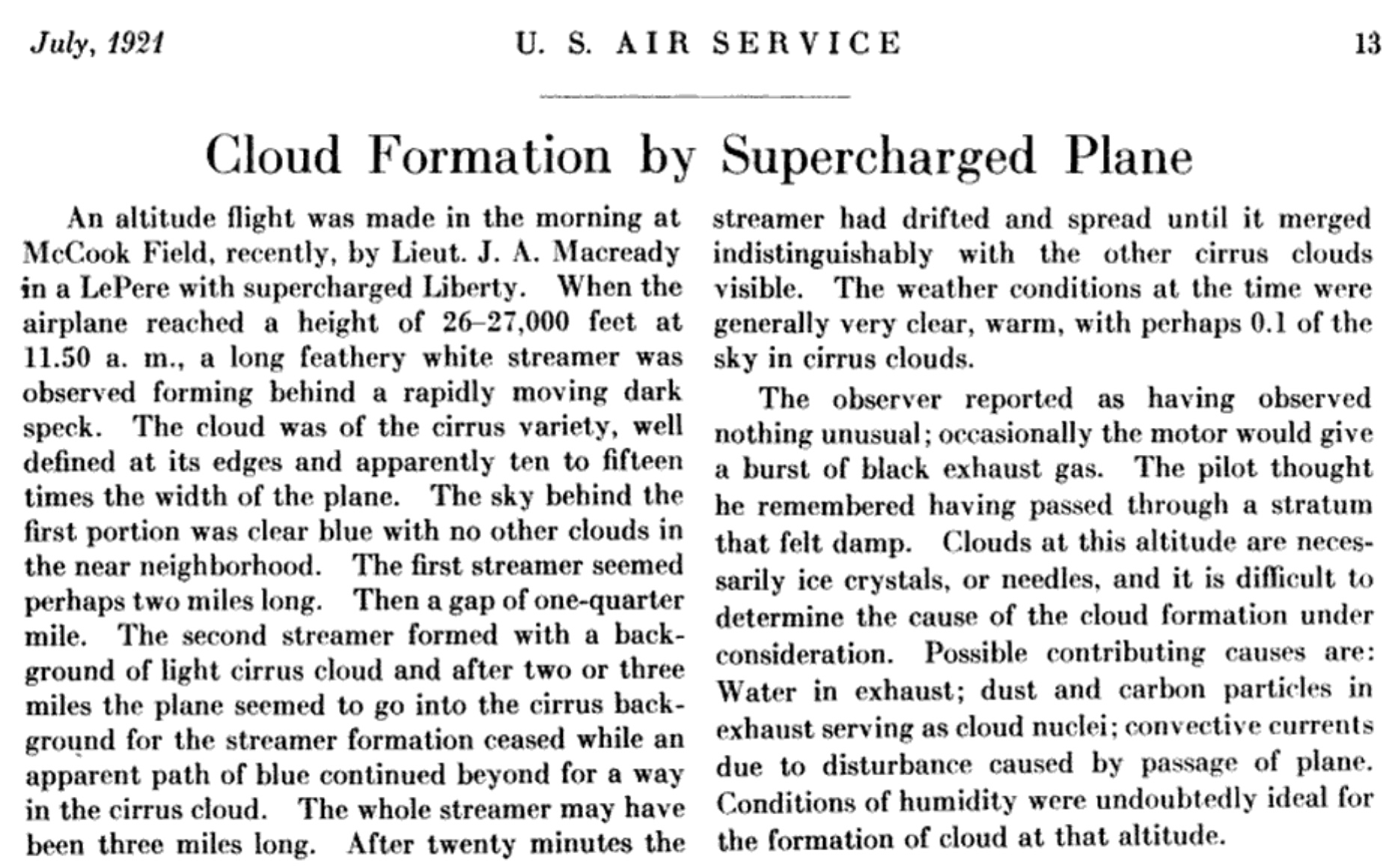
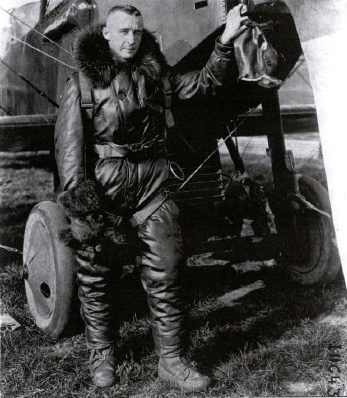 The earliest report of both a persistent spreading contrail, with gaps, and a distrail comes very shortly after, in 1921, in the US. Air Service Newsletter.
An altitude flight was made in the morning at McCook Field recently by Lieut. J. A. Macready in a La Pere with supercharged Liberty [engine]. When the airplane reached a height of 26,000-27,000 feet at 11:50 a.m., a long feathery white streamer was observed forming behind a rapidly moving dark speck. The cloud was of the cirrus variety, well defined at the edges and apparently 10 to 15 times the width of the plane. The sky behind the first portion was clear blue with no clouds in the near neighborhood. The first streamer seemed perhaps 2 miles long. Then a gap of one-quarter mile. The second streamer formed with a background of light cirrus cloud and after 2 or 3 miles the plane seemed to go into the cirrus background, for the streamer formation ceased while an apparent path of blue continued beyond for a way in the cirrus cloud. The whole streamer may have been 3 miles long. After 20 minutes the streamer had drifted and spread until it merged indistinguishably with the other cirrus clouds visible.
Both these accounts were reprinted in the June 1921 Monthly Weather Review, in the article The Argonne Battle Cloud, which also includes an account from Captain W. H. Nead, that includes an account of iridescence in the trails:
The Rainbow Division, on the morning of October 10, 1918, was lying in what had at one time been a wood just back of Montfaucon. The sky was clear except for a few fleecy clouds to the northwest. Three airmen came from the northwest and passed almost over our regiment, continuing on to the southeast.
Behind each machine was a trail of white, which at first sight appeared to be smoke resulting from poor engine combustion, but which upon more careful observation proved too wide to have been caused by smoke. Perhaps the strangest thing of all was the fact that when the planes reached a certain point in the sky the rainbow (sundog) colors became distinctly visible.
And even back in 1921, the mysteries of contrail formation were not too difficult to discern:
The end products of complete combustion of gasoline are water vapor
and carbon dioxide, and it is found that if the water vapor were condensed,
there would result a little more than 1 gallon of water per
gallon of gasoline consumed. It was found by Wells and Thuras, in
studying the fog off the Newfoundland coast (see U. S. Coast Guard ,
Bull. 5, 1916) that there were 1,200 water droplets of diameter 0.01 mm.
in a cubic centimeter of air in a dense fog. If we assume that an airplane
travels 3 miles on a gallon of gasoline (approximately the figure
given by the Aerial Mail Service) it is possible to show that if only a
small part – a fourth or fifth – of the water vapor were condensed,
there would be abundant cloud to produce the effect observed at the
Argonne Battle. It should be stated, however, that this water vapor
would have to be discharged into air which was very cold and nearly
saturated. This seems to be the correct explanation, and is substantiated
by scientists at the Bureau of Standards, who say that they have
actually observed this cloud behind airplanes and automobiles. The
Bureau of Standards is working on a device for condensing and using
this water aboard dirigibles as ballast.
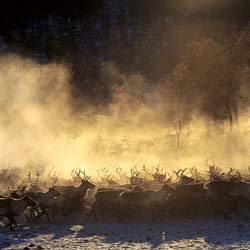 The weather review goes on to discuss how vapor trails (contrails) can form at low altitudes, even down to the ground, if it is cold and damp enough. They even give examples I’d never heard of, contrails formed by a horse, and a herd of reindeer:
A horse, warm from running over the ice, on a cold day in Greenland, was accompanied by a cloud 50 meters in height formed from its breath. Von Hann gives a similar case regarding a herd of reindeer. The human breath also has been seen to transform itself into small clouds of ice needles.

You CONTINUE to erect your Straw Man and then pummel him as if you are Ghengis Kahn on the war path.
NO ONE who has more than a passing interest in this subject denies persistent contrails.
Listen up…
Note the “nearly saturated” comment. We are seeing HUGE contrails forming at levels as low as 25-30%. Can you explain this via the “normal” explanation?
It seems that YOU deny persistent contrails. I quote from your article:
http://sydney.indymedia.org.au/story/unusual-aircraft-contrails-linked-bird-deaths-esperance-western-australia
Which is directly contradicting known science. For example, see the Encyclopædia Britannica article on vapour trails (contrails):
Also see “A Field Guide to the Atmosphere“, by Schaefer and Day, 1981:
And in answer to the question by Quotodt ???
Yes, I answered that here:
https://contrailscience.com/chemtrail-myths/#comment-5185
this is awesome, glad someone finally wrote something better than what is capable on youtube lol
Wakes of war: contrails and the rise of air power, 1918-1945 Part I- early sightings and preliminary explanations, 1918-1938
http://findarticles.com/p/articles/mi_hb3101/is_2_54/ai_n29351723/?tag=content;col1
this is a great article on early thoughts about contrails – trying to figure out what they were exactly, with various explainations over the years.
It covers the Argonne case mentioned above, and how people tried to explain what the contrails were over the years.
There are references to contrails immediately after WW1 being 40 or 50km long, to contrails at ground level from motorcycles. It proceeds through discussion of the practicalities of air combat as seen in the 1920’s and 30’s, early high altitude flights, increasing altitude capabilities of aircraft – P-26’s starting to operate up to 30,000 feet, the Spanish Civil War where 109’s and I-16’s played a game of “who can fly higher and so get the advantage” with each other (109’s had the early advantage until the I-16 type 10 came along) and perhaps the 1st ever eye witness account of combat contrails, in 1938.
There are extensive end notes too.
Thanks, that’s the article I was referencing at the start of the article. I did not have a link at the time though. I’ve added yours.
Hi all,
Ken Caldeira pointed me to this site and of course its content is interesting. But the problem with the chemtrails we see over Bedford is that they are not from passenger aircraft.
You can use planefinder to establish every commercial flight coming and going – and the planes we see laying long fluffy white persistent clouds which spread into filaments and cover the sky over the course of 8 hours – do not show up on planefinder.
Nor do they show up on my own national database of commercial flights. And since on consecutive days with identical temperature, identical windspeed and direction, and identical flight patterns from local airports, one day is pristine blue, and the next is saturadted with wispy trails laid by jets, persisting for hours, always in the same format – we can only assume these are non commercial jets.
And lastly, since these chemtrails always form and persist for the same duration of time, and adopt the same spreading patterns without any variety, despite presumably changing conditions in the atmosphere, we must assume they are of a chemical composition more robust than the air itself. They also reflect sunlight very strongly and even cast a shadow on each other!
Every NATO country is reporting the sme thing, at the same time. Why is this, if these contrails have been around since flight began?
But Ian, people worldwide are beginning to find something quite different from you. England is a small country. Considering the fact that thousands of commercial flights pass over England daily no matter whether it is cloudy or clear, what you are asking us to believe is that thousands of ordinary commercial flights share the exact same small airspace with an army of unknown planes making lines.
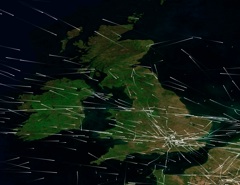
Bedford is indeed under a very busy airway as seen in their recorded flight tracks:
http://metabunk.org/threads/812-Visualizing-Flight-Paths-Above-30-000-Feet?p=16473&viewfull=1#post16473
Your experience may be related to some settings on planefinder, or that the planes you see may be closer or further away horizontally than you think. This visualization might help:
http://metabunk.org/threads/746-Planefinder-net-vs-Flightradar24-com-vs-Flightaware-for-US-traffic?p=18224&viewfull=1#post18224
Your experience is not duplicated here in the USA, where every flight over Las Vegas is identifiable making the same sort of persistent contrails you describe:
http://www.youtube.com/watch?v=WbNkyLQpJoQ
Everytime they spray, I have white mucus and a tough time breathing (often times accompanied by a head-ache)… if I am in a place where they don’t spray or even in the same place and the don’t spray… I don’t have trouble breathing… This is true for me and a lot of the people I know… Water vapor should not have that effect on people, thus… the are NOT water vapor, but some other combination of materials…
For instance, while in the shower, sauna, high humidity areas, I/we do not have any trouble breathing!
So f*** all your research and talk about what it is and isn’t, all the same planes go by every day, some times for months the air is ok, then suddenly, it is full for months or even entire seasons and the air is horrible to breath. I’m not making up my mucus and I’d like to share some spit with you if you dis-agree.
Bye & goodluck with de-bunking this.
oh, and addtionally… when we were younger, I cannot remember having any of these sympthoms. It all started around 1999. I’m 29 now and I have personally always been a healthy & aware person. Just like my friends. Men in general, seem effected most by chemtrails from my experiences in The Netherlands, random seeing an increase in them coffing up the same white shit after a blanket of sprays. When they spray early in the morning, I have trouble during the day, when they spray in the early afternoon, I have trouble at night. It so extremely clear that these things are to blame, next to the fucked-up weather & completely white blinding light they create… pfff.
People’s health generally deteriorates as they get older.
I see the trails all the time..and notice no such ‘symptoms’.
If what greg states is true than all the hospitals and clinics would be crammed with people carrying symptoms. They’re not. Greg, you just got cheap genes.
Chemtrail arguments all break asunder on the rock of logic. Do the “Elite” that are behind this conspiracy live in, visit or work in these cities that are being sprayed? Yes.
Would you, with arsenic, lace the whole bottle of wine that both you and your enemy will drink from? No. No you will not.
Likewise, the Elite will not lace the same air they breathe with the chemicals intended to harm.
I am not anti-conspiracy theories. In fact many theories have been presented with enough evidence to suggest that some conspiracies are probable.