Contrails are a common sight now, but prior to the advent of commercial jet travel in the late 50s, there was little reason for planes to fly high enough to form contrails. However, during the Second World War, high altitude aerial dogfights over the UK were quite common. Contrails in the clear blue sky were a common part of wartime Britain.
This excerpt from a Pathe newsreel shows this quite clearly. It’s a piece about a nice little English village called Meopham – which is in Kent, between London and the bombers. The shots of the contrails are between pretty pastoral scenes, and puppies playing with kittens.
There are two shots of the same contrails. Interesting because you can see that the trails have persisted and drifted to the right. Judging by the amount of change, probably over 20 minutes. You can also see a new contrail being formed.
These contrails look a bit odd, fragmented. We are used to seeing contrails that are long and straight. But the contrails in the film were formed by actual fighter planes, where the pilots were trying to kill each other. Hence they would be climbing and diving, twisting and turning in an attempt to out-maneuver each other. The contrails would start and stop as they climbed in and out of contrail altitude.
While these few contrails are interesting enough, it was just a skirmish on the way to where the real action was taking place: London, where the dogfights must have been incredible, leaving a criss-crossing web of trails:

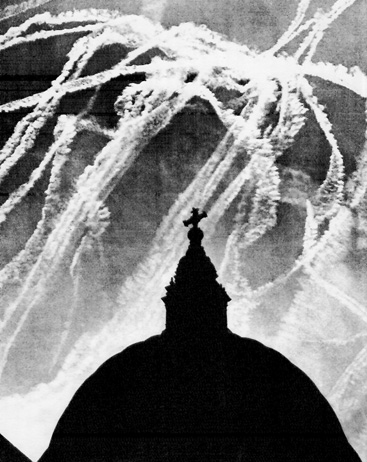

The above photos show dogfights during the Battle of Britain in 1940. The German bombers were accompanied by fighter planes which would try to defend the bombers from the British fighters. They were at a high altitude to avoid anti-aircraft fire. Hence you get these amazing patterns of contrails which tell a tale of life and death at 28,000 feet above London.
The British won the Battle of Britain by 1941, establishing control of the airspace, moving the battle to Europe. This did not end the contrails but brought a certain order to them. Bombers departing for Europe would climb to cruising altitude before crossing the channel, and this created another kind of story in the sky:
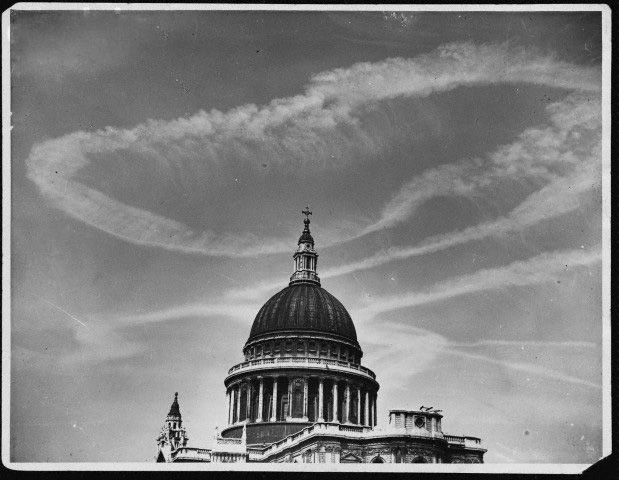
The above photo shows St Paul’s Cathedral in London, with departing bomber contrails behind it. This is probably the best photo of a persistent WWII contrail, showing the trail spreading and dropping “mares tails”, exactly like modern contrails sometimes do. It’s such a good photo you might think it’s a fake, but the original came from the Hulton-Deutsch Collection and can be found in the Corbis photo library as part a retrospective titled “V-1 “Buzz Bombs“.
Here’s another book with contrail photos from 1945:
https://youtube.com/watch?v=KH_f9dkmjzU
Here’s some American newsreel footage of contrails at the Battle of the Bulge, 1945:
One cannot compare old trails with more recent ones. There’s no way to prove or disprove anything. These could be smoke.
All trails you see in the sky “could be smoke”. But what’s more likely? What does the evidence indicate here?
Listen to the commentary in this 1944 video. Are they talking about smoke?
https://contrailscience.com/memphis-belle-wwii-bomber-contrails-1944/
Greetings Uncinus,
You have a very informative website. I commend you for the patience and respect your model when dealing with those who disagree with you. I just wanted to comment on the voodoo trail. The fact that it was left by a Raytheon plane, in my opinion, does nothing to prove the innocent nature of that particular contrail, as Raytheon appears to be largely involved in defense technology. I was surprised that no one else mentioned this.
I also have some questions regarding flight paths that I would like to pose when I have the time. Thank you for providing the information on this site.
I don’t think you can ever prove “innocent nature”, however, Raytheon makes aviation equipment, so it’s the most normal thin in the world for them to fly their test plane around in circles.
Hi
I’m trying to locate the source of the iconic photo of contrails over St Paul’s cathedral in London in order to obtain the right to use the image in a book.
Any ideas?
Gill Richardson
Does this help -> http://www.corbisimages.com/Enlargement/Enlargement.aspx?id=HU034078&caller=imagegroups
???
Uncinus, I’m pretty sure the English village is called MEOPHAM, “ham” being the old English for “village”.
So it is. Fixed.
Unfortunately the 2nd video (from 1945, above the B-o-t-Bulge one) is no longer available on you tube 🙁
From the book “Flight To Arras” by Antoine de Saint Exupery, written in 1942 about a military mission in 1940:
_______________________
“Are the anti-aircraft firing, Dutertre?”
“I believe they are firing, Captain.”
Dutertre cannot tell. The bursts are too distant and the smoke is blended in with the ground. They cannot hope to bring us down by such vague firing. At thirty three thousand feet we are virtually invulnerable. They are firing in order to gauge our position, and probably also to guide the fighter groups towards us. A fighter group diluted in the sky like invisible dust.
The German on the ground knows us by the pearly white scarf which every plane flying at high altitude trails behind like a bridal veil. The disturbance created by our meteoric flight crystallizes the watery vapor in the atmosphere. We unwind behind us a cirrus of icicles. If the atmospheric conditions are favorable to the formation of clouds, our wake will thicken bit by bit and become an evening cloud over the countryside.
The fighters are guided towards us by their radio, by the bursts on the ground, and by the ostentatious luxury of our white scarf. Nevertheless we swim in an emptiness almost interplanetary. Everything around us and within us is total immobility.”
______________________________
(thanks to Jref poster, LTC8K6, for finding the text)
That’s an excellent quote there, “Stupid”. I’ll add it to the “Persisting and Spreading Contrails” Article.
https://contrailscience.com/persisting-and-spreading-contrails/
Hi Uncinus. Saw this vid on another ‘Chemtrail’ debunking site (not quite as well structured as this one) and wasn’t sure which thread to drop it in:
http://www.nmsr.org/chemtrls.htm
(There may be other useful stuff on there, but I havn’t the required design insensitivity to wade through centred blocks of blue and red, italic Times Roman)
I actually have a thread just for that video. It’s one I posted (I’m Epoxynous on YouTube, back from when I picked names randomly for everything)
https://contrailscience.com/memphis-belle-wwii-bomber-contrails-1944/
Still, should probably be here too.
I found this site while googling for a response to a person on Facebook. Good stuff, keep it up. World War 2 does rather put the lie to the chemtrail speculation.
I am a pilot and have watched the skies for years. Just discovered your site and will look it over more carefully, but I have photographed what I would call odd contrails or chemtrails. I have seen high flying aircraft all of a sudden start a contrail lay it for a distance, then it stops, then fly multiple contrail lines off that one, like it was a marker. By doing so they cover a wide patch in the sky. It did not look like normal jet traffic. I have seen this on more than one occasion. There is also the possible connection of aerosols by former Gvt. researcher Clifford Carnicom. His extensive work seems to substantiate some connection of aerosols as he calls them and the strange disease (its existence also officially denied) He posts letter copies of official “denial” but a visit to his “visitors” page shows an extensive list of many hundreds of visits by a dozen or more agencies such as the Dept of Defense, as if they are monitoring his research,but with “no comment.” Also, there is the interview with former USAF Captain, and nurse. Joyce Riley’s interview with former NSA , AC Griffith (might be Griffen) who attests to the validity of the “chemtrail matter” and that it is “the most secret thing he has ever come across…people have been ‘hit’ over trying to reveal what is going on..” An intelligence observer from the Vietnam era has told me he has observed 2 jets the same altitude, one leaving a wide contrail, the other not doing so…explanation?
It is also odd that a soil expert in the film would not know what normal aluminum levels are in soil and be confused on that.
Apology, 6th line down, “…strange disease, Morgellons….” that line should read.
Hi michael, What type of aircraft do you fly?
Michael, certificate level and experience please. Your comments suggest you are nothing more than a private pilot.
Clifford Carnicom’s “research” for the US govt consisted of writing software “to assist in the automation and efficiency of large scale database operations. He investigated and researched alternative and sophisticated technologies for geodetic surveys.” – that is from his biography at http://www.carnicominstitute.org/html/mission.html
In addition “He provided the US Defense research industry with original solutions to system development and modeling problems, including application of higher mathematics, statistics, computer programming, information management, task scheduling, product development, and computer graphics.”
So he’s a computer guru – trying to imply that as a “researcher” he msut have some insid knowledge of chemtrails is duplicitous.
AC Griffiths has been extensively discussed – his “NSA” association sems to be that he was a radio repairman at a base that intercepted chinese communications in the late 1950’s-early 1960’s – again by glossing over his actual qualificatiosn people try to make him look more than he was.
the soil expert in the film is Mangels – you will find his myriad shortcomings discussed on Metabunk, along with Griffiths and some about Carnicom.