People who think persistent contrails indicate some kind of conspiracy (which they call “chemtrails”), sometimes point to the “dark lines” that sometimes accompany contrails. Since they can’t immediately think of why these dark lines should be there, they assume it’s part of the conspiracy. Either there is some kind of “dark chemtrail”, or the plane is projecting a dark beam of some kind of negative energy, or it is following a dark beam.
In reality, these “dark lines” or “black beams” are simply various kinds of shadows. There are actually three main kinds of dark line related to contrails.
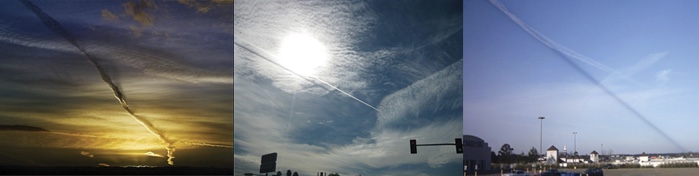
1. Self Shadow
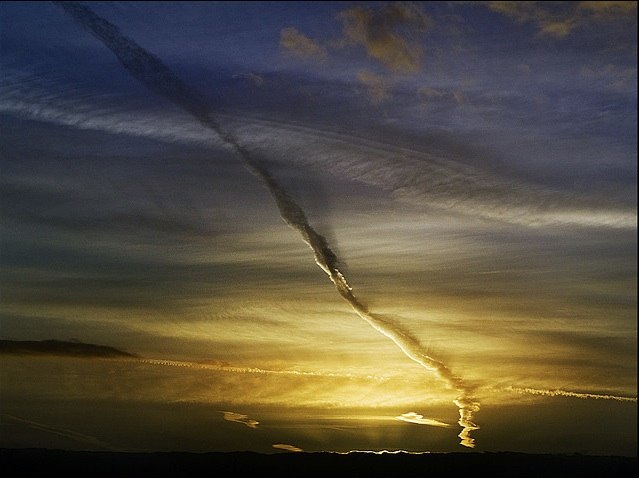
Where the contrail itself is in shadow and appears dark. This can happen in a number of ways. The sun can be low on the horizon and the contrail can be shadowed by a mountain or a thick cloud bank (such as in this video). In rare cases, the plane can be flying directly towards the sun, and the contrail will shadow itself. When self-shadowing, the leading edge of the contrail will be brightly lit, with a dark area behind it, such as parts of the contrail above.
2. Parallel Shadow
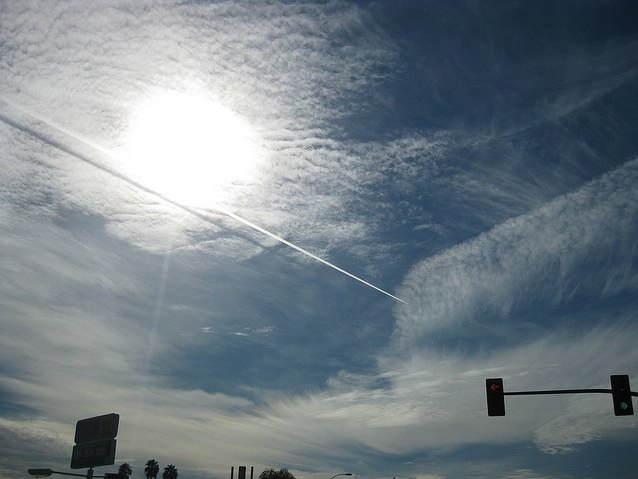
The contrail is simply casting a shadow on a layer of cloud beneath it. The cloud layer is thin enough so you can see through it, but it’s visible, so you can see the shadow on it. Theoretically, you could cast a shadow on a cloud layer above or behind a contrail, if the sun were low enough, but this would be rather difficult to observe. Most “dark lines” are of this type. There’s an excellent explanation of these shadows over at Atmospheric Optics.
There’s nothing new about such shadows. Here’s some from 1955:
http://docs.lib.noaa.gov/rescue/mwr/088/mwr-088-05-0181.pdf
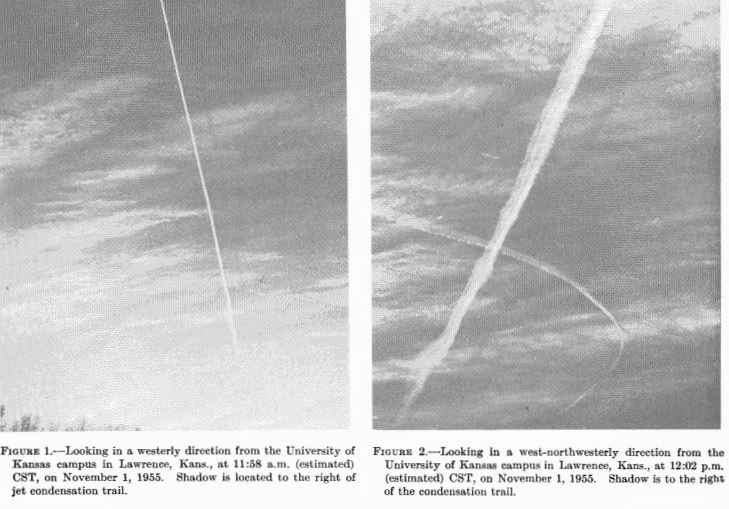
One interesting thing about these shadows is that it frequently looks like the contrail is below the clouds when it’s actually above them. You can see this illusion in the photo above. The reason this happens is that the white of the thin layer of clouds and the contrail are additively transparent, so they look identical, regardless of which one is in front of the other. The illusion happens because the brain interprets the bluer regions of the cloud as being darker regions in the same plane as the cloud when they are actually holes in the cloud. The contrail will seem solid white when viewed through the holes, or when it is in front of the holes.
3. Edge Shadow (Volumetric Shadow)
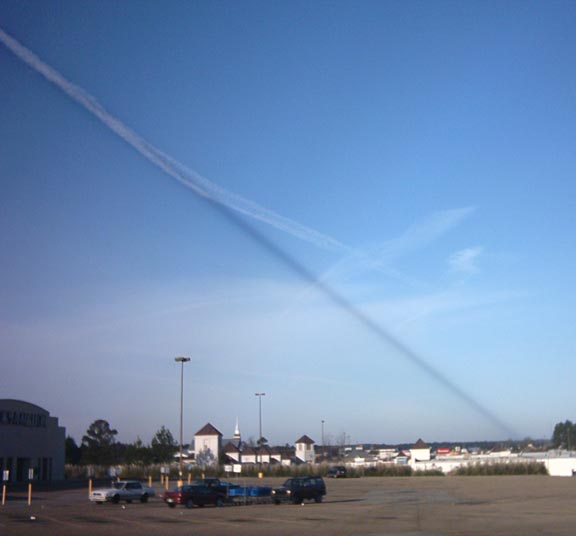
The most interesting type of contrail dark line is when the contrail is lined up with the sun. This produces a slice of shadow through the atmosphere that looks like a dark line when viewed edge-on. It is quite difficult to visualize what is going on since you have to think in three dimensions, and we are accustomed to thinking of shadows as being flat since they are usually cast on surfaces. You are not seeing a thin dark shadow here, you are actually seeing a huge slab of very faint shadow, but it’s viewed from looking along the edge. Imagine you have a thick sheet of glass. Viewed head on, it’s transparent, but if you look at it from the edge, it seems a lot darker.
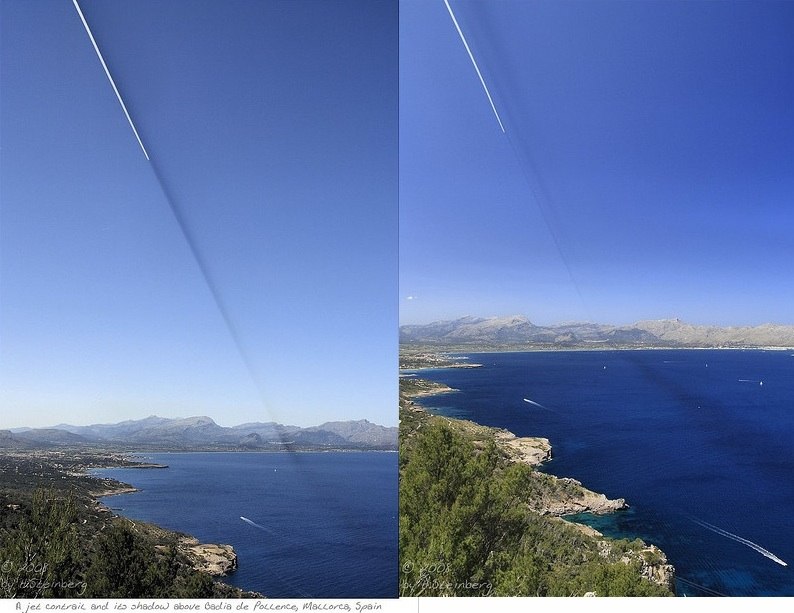
The above image is an excellent demonstrating of the fleeting nature of these edge shadows. Two photos were taken just a few minutes apart, in the first the camera is more fully in line with the plane of the contrail. In the second the contrail (or the photographer) has moved, and we are viewing the edge shadows from a slight angle which reveals they are made up of two or three segments, caused either by the plane turning slightly, or variations in upper-level winds bending the contrail.
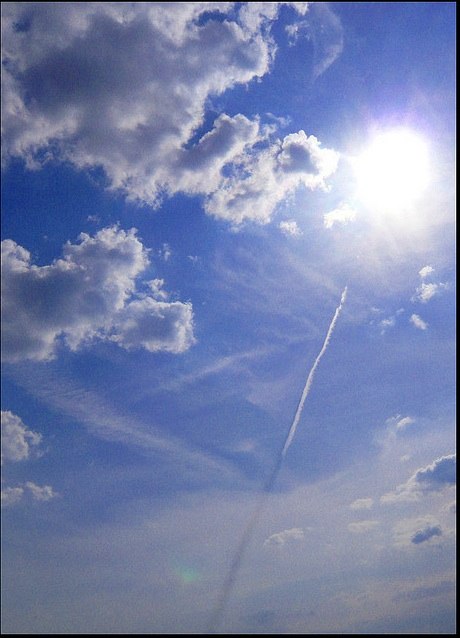
Most photos of these odd shadows don’t include the sun. But when they do, you’ll see that the sun is lined up with the contrail (or part of it)
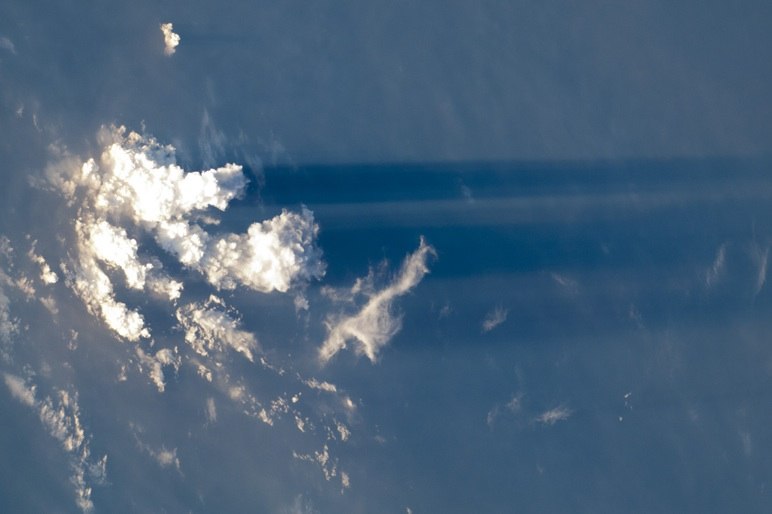
 The photo on the right is a rather dramatic illustration of this effect. The “dark line” here is caused by the slab of shadow cast by the portion of the upper part of the exhaust trail of the space shuttle Atlantis that is lined up roughly in a flat plane with the camera and the sun. The sun has just set, so the rays of the sun are almost parallel to the ground, so the upper portion of the plume is casting a long tall shadow through the air towards the horizon. This is viewed edge-on from below, and so looks like a dark line. Since it’s a full moon, the sun is directly opposite the moon, so the “shadow” looks like it’s pointing at the moon (if you look closely, you’ll see it continues past the moon). This is particularly dramatic because of the combination of the setting sun and a vertical exhaust trail. With normal contrails, the sun has to be higher in the sky to cast the slab of shadow downwards.
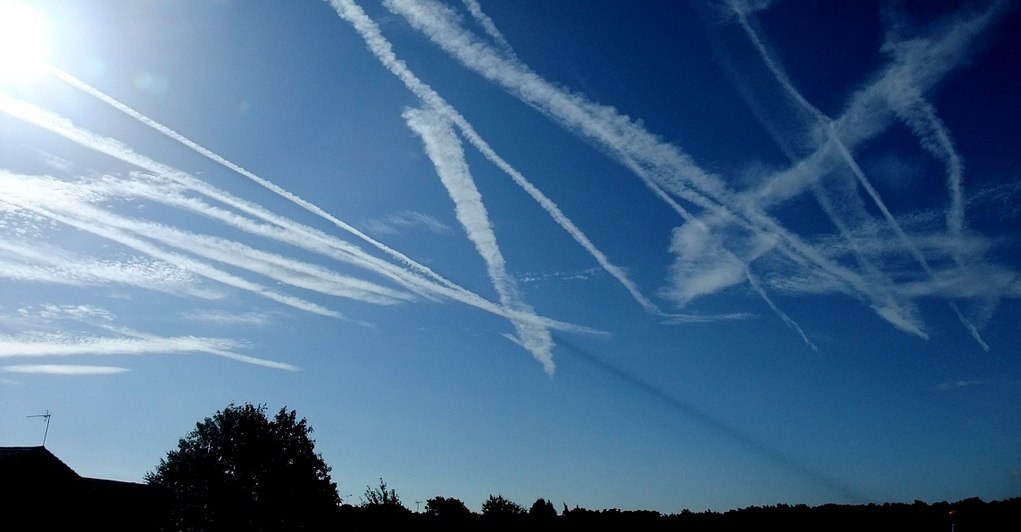
The image above is another great illustration. There are multiple contrails, but only the one that intersects the sun creates the edge shadow. Photo from “Col” on usenet uk.sci.weather.
[UPDATE] This video I shot in my kitchen gives an excellent illustration of these types of shadow.
[Math Warning] It’s a bit difficult to explain these edge shadows (also called volumetric shadows). You can think of them in terms of three-dimensional geometry. The contrail is a line in three-dimensional space. The camera (or observer) is a point in three-dimensional space. The sun is essentially infinitely far away, and so is only really relevant as a directional vector (a vector in three dimensions, where the magnitude is unimportant ). These three quantities are what you need to consider to understand the condition for the edge shadow.
Given the line (contrail) and direction vector (sun), we can form a plane that contains the line and is parallel to the direction vector. This plane cuts through the contrail, the atmosphere, and intersects the ground. Projecting two endpoints of the contrail along the plane in the direction of the sun’s vector, we get essentially a two-dimensional parallelepiped (although the far edge is not very well defined). This parallelepiped is quite thin (it’s as thick as the contrail), so when viewed from the side, you won’t see much. But when the viewer is in the plane of the parallelepiped – specifically anywhere along the line on the ground formed by the intersection with the plane formed by the contrail and the sun – then they will be viewing the parallelepiped from edge-on, and so it will seem to be a dark line that intersects the contrail.
Since only the portion of the contrail that is roughly within this plane is contributing to the shadow, there may be other potions of the contrail that are not in the plane, and hence do not seem to be casting a shadow. In fact, they are, but since it is in a different plane, they are not visible unless the viewer was to move to a new position. This can be seen in the two photos above. In one it looks as if the plane was following a dark line and then veered off. In the Shuttle photo, the highest portion of the trail, although brightly illuminated, is not contributing to the visible shadow. However, a viewer in another location may have been able to see a different edge shadow trailing from this upper portion.
[Update] I found a useful video of a contrail edge shadow (or “volumetric” shadow, described above):
http://www.youtube.com/watch?v=98nE4Gb90Kk
It’s all in one shot, which is great, as you can see how the various misinterpretations can arise. It starts out with a shot of a black line across the sky, with no visible reason for it being there. The sun is obscured by the house on the right.
The cameraman then zooms in in the dark line, and we see a contrail being formed along it. It looks like the plane is following the dark line, or somehow projecting a beam of dark energy in front of it!
Then the cameraman walks around the house, and we see the source of the dark line – the contrail is EXACTLY lined up with the setting sun, and is simply casting a volumetric shadow which the cameraman is lined up with. The shadow is accented as the suns rays are nearly parallel to the contrail. Here I’ve stitched some frames together so you can see this. I encourage you to examine the video to confirm this.
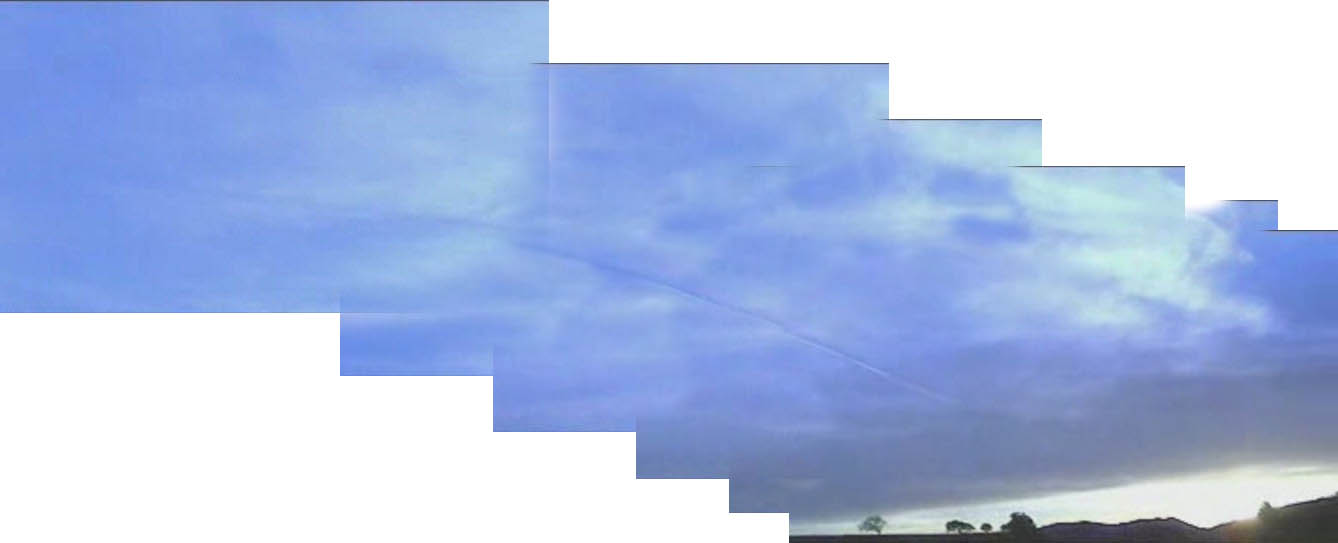
[Update 2] Check out this video of the Space Shuttle launch, a dark shadow forms in the last 30 seconds:
http://www.youtube.com/watch?v=xsRuJ37kyZg
[Update 3] Crepuscular rays are parallel, but usually don’t look it. This is partly why the contrail edge shadows are not recognized as the same type of thing.
view of crepuscular rays from space:
I witnessed the spraying close up that was coming from the rear of a helecopter, and the whole island of hawaii was criscrossed by them . A R
Probably crop-spraying or bug spraying (like for mosquitos) from a helicopter. You don’t get many real contrails in Hawaii, as there is not a lot of high altitude overhead traffic besides a few flights from the USA to Australia.
u r talking bollocks, i saw this dark beam just appear ,no planes no clouds, it went as far as the eye could see, then a plane deliberatly, flew into it and puffed out whatever then the plane flew out of it, i could not have been any closer to it, it was just to the side of me, and only 4-500 feet above me, it was thick, solid, perfectly parallel, i am from WW2, i have worked outside all my life, i am constantly watching whether as rain would ruin my work, i spent 10 years plus water sports , constantly watching every cloud to gain a wind advantage, never was there any black beams, never these chemtrails, only in last 10 years or so. people like u ought to be hung from the gallows, pure cointelpro crap, and one day u will b held accountable, the people r not stupid, they are only commatoised, i have every faith that one day they will awaken, but it is hard work. this is for real people not fakes like you.
http://www.whisperycat.co.uk/trail/trail.jpg
Please don’t insult our collective intelligence. Look at the light on the clouds in this pic, and plot the path of the light back to its source. Now explain how this plane was moving into and along a ‘shadow’, when the light source is from upper left quadrant of the picture. I don’t pretend to know what’s going on, but I know a glib dismissal which fails to account for the empirical evidence, when I read one.
I explain these shadows in the article above, under Edge Shadows, and with a more detailed explanation under [Math Warning]. Read those explanations first.
I don’t think it’s a “glib dismissal”, but I understand it’s quite a difficult thing to visualize how the shadow is forming. It looks like a line, but it’s actually more like a slice of the sky that is darkened, and you are looking at from the edge.
You need to be inside (technically coplanar with) the shadow slice in order to see it. That explains why it can quickly appear and disappear, as the shadow (or you, in a vehicle) move in or out of the plane of the shadow.
Your multi-syllabic response is not coherent. To cast a shadow, the laws of physics demand a light source, and something at least partially opaque to that light. The light streams from the source and illuminates the objects. It is not possible for any shadow to appear on a side of the object which is illuminated. Basic physics. The shadow can only be seen to the right of an unlit face of the object. In the picture I link to, the source of light – the sun – is streaming from top left towards bottom right. The black line cannot possible be a shadow. The line which extends beyond the front of the plane is in space through which the con trail has not yet been. It is not a shadow. Any shadow can only be cast on the unlit side of the object creating it. Your fancy words make no sense.
http://www.whisperycat.co.uk/trail/trail.jpg [BROKEN LINK]
In your photo, the sun is directly above the contrail, lined up with it. You just can’t see it in the photo, as it’s some way above the top edge.
Note the buildings in the foreground, they are fully shadowed, meaning the sun is directly behind them.
You would need a photo that showed the sun (or at least some shadows), in order to make the claim that the dark trail was at all unusual.
What about this photo.
http://www.coasttocoastam.com/gen/page836.html [BROKEN LINK]
See the shadows of the cars.
I saw one at dusk yesterday evening in Austin, Texas. The sun was not lined up with with the contrail. It was not a shadow. I have seen lines that could possibly be attributed to the trails alignment with the sun, but such was not the case with what I observed yesterday. My friends and I have witnessed this phenomenon on mutiple occassions, and we have concluded that some of the lines are the result of directed energy weapons, or something very similiar. *Peace and blessings to all, especially to the walking wounded. One day we’ll all remember who we are, and the chains will fall away, for they were only an illusion in the first place*
There are a few different kinds of dark line. You probably saw a “Parallel Shadow”, where a contrail above casts a shadow on a thin (often invisible) layer of cloud below it. The sun need not be lined up in this case. Have you seen a photo anywhere that looks like what you saw?
See:
http://www.atoptics.co.uk/atoptics/contr2.htm
For one example of this type of shadow.
i can’t deny the chemtrails but can the conspiracy theorists that believe the chemtrails are BAD at least provide some answers to simple logical questions?
1. Why would the gov’t poison the very atmosphere with which they live in?
2. What financial gain comes from citizens being sick all the time?
3. What is your accusation for chemtrail spraying??
a. Do you believe the government is trying to murder the weak or old in order to alleviate overpopulation?
b. Do you believe the government is trying to sicken us for pharmaceutical company’s gain?
They wouldn’t murder us because they need our money to maintain society and their positions of power. Lets imagine they are trying to kill 4-5 billion and only the world leaders and richest people will live. So who runs that group? The leaders of all the countries would be saved. Who leads the leaders? Bush? Cheney? Someone we dont know? THIS DOESN’T MAKE ANY SENSE!
The financial gain coming from citizens being sick all the time would be huge for pharmaceutical companies but again, sick people don’t tend to buy as much as healthy people. so again the financial gain could be offset somewhat. So I think its safe to rule out chemtrail sprayings being deadly.
The most logical and probable answer is there IS chemtrail sprayings as a part of weather modification. I believe there is frightening evidence that without help, global warming is about to speed up very quickly in the next 15-20 years that will cause sea levels to rise and cover land where billions of people live. It has to be frightening enough evidence that it would cause the government to fear a mass panic or a looting spree. Therefore, I believe they are spraying a chemical that increases the amount of sunlight that is reflected back into the atmosphere. This answer would explain the secrecy, the chemtrails, the lack of negative health effects despite what hypochondriacs tell you. Chemtrails have been appearing for over a decade and America is no more unhealthy than it was in the 80s or the early 90s.
Fear of the unknown is the most absolute powerful tool for fear. You don’t even know if chemtrails are bad for you, as you eat your triple cheeseburger that hardens your arteries and smoke your cigarettes that eat your lungs. You people know something is killing you and you ignore it and allow it, yet you rail on the possibility of a conspiracy involving contrail spraying that might possibly be bad even though theres no scientific proof. what fuckin world am i living in?
p.s. if chemtrails targeted stupid people, i am for the genocide.
So why can’t you deny the chemtrails? They look just like contrails.
Hi Uncinus,
Thanks for the good explanation, I’m sure I’ll be referencing your work here when I run across people who’s opinion might actually be swayed by reality.
It’s strange to me that so many apparently want to ignore all the advancements we’ve made in understanding the natural world so that they can hold on to belief in some crackpot conspiracy. Perhaps it makes them feel they have special knowledge, or are part of some special subgroup that holds the only “truth.”
Sad and dangerous, in my opinion.
I have just witnessed my first black line/beam/shadow and it freaked me out as it appeared to grow in front of the plane. It could well be a shadow as there was soooo much crap in the air thanks to all these naturally occuring persistant trails that have been appearing over the last two days!!!
The point I am really trying to make though is that I have been looking at chemtrails/persistant contrails for well over a year now and have only just noticed this phenomenon. Why are people only now noticing these eerie looking black lines if it has been happening for over 50 years? They are DEFINITELY something that would stick in your mind, bit like a rainbow.
How do you know nobody noticed them?
You’ve basically answered your own question. You said “I have been looking at chemtrails/persistant contrails for well over a year now and have only just noticed this phenomenon.”
So here’s you – someone actually interested in contrails, and it takes you a whole year before you see the black line in front of a plane. You should be able to tell from that why people who are not interested in contrails (i.e. pretty much everyone) would not have noticed this.
I first noticed the black line about ten years ago – since then I’ve probably averaged about one a year – more when I was actively looking for them.
Why don’t you look up Anticrepuscular rays (similar, but not the same), and see them if you still think the shadows in the air are odd.
http://images.google.com/images?q=anticrepuscular%20rays
Have you noticed anticrepuscular rays before?
Seen 2 more this evening and the entire sky (about 2 hours ago) was completely full of “clouds” made by plane trails – and I know this for a fact as sadly I’ve been watching all day.
As a result rainbow effects on either side of the sun and when wearing decent shades I can see more of these “shadows” stretching right across the sky. I personally don’t accept that they are just shadows but that is my choice and until I study more evidence I will remain open minded to all options.
Can’t remember the last time I saw a sky that wasn’t choc-a-bloc full of persistent trails. Has it really always been like this???
Have you always watched the sky all day?
No, it has not always been like that, and if you give it a while, then it won’t be again. You are likely in a period of weather that is conducive to contrail formation.
Have you tried looking through a years worth of satellite photos? It will give you some perspective on how variable and wet the weather is in the UK.
http://rapidfire.sci.gsfc.nasa.gov/subsets/?subset=Europe_2_01.2008257.terra.1km
It’s a lot wetter than California. We don’t see many contrails at all in the summer.
you dont know what you are talking about! your explanation for the black lines,which appear in front,not behind or alongside,is utter nonsense,are you from the pseudo-intellect brigade? or is your explanation based on hard science? I have just wittnessed this phenemena again today,and it is perfectly clear that some very unusual technology is at work.Once you see this occuring with your own eyes,then you will come to the same conclusion as me.
All the dog mess left behind on the streets and in the parks by selfish inconsiderate dog owners,is probably much more harmful to our health than anything coming from the chemtrail spraying.Toxocariasis which can be caught from coming into contact with dog dirt,can and does cause blindness,and seriously affects other organs of the body.12 children a year are permantly blinded by this nasty stuff in britain,might not seem many,but its 12 too many!Yet for some strange reason,certain people are more concerned about planes flying overhead,spraying us with poisons!Also,what about all the carcenogenic chemicals we have to breathe in on a daily basis from hundreds of thousands of car exhaust fumes? Get a reality check people,there is more harm being done to us down on the ground than up there in the skies,its self inflicted harm,its an i”m alright jack f**k you” society,so even if we might be getting sprayed with something dodgy,so what! cant surely do much more harm to us than we are already doing to ourselves.
Some of the things these conspiracy believers go on about is just utter nonsense,it sells books and dvds,basically they are good story tellers!there is never any strong evidence to back up their stories,its all just stupid crap,and its made a lot of money for some!
basically,people like david icke etc never did want to do a “normal job” in life,they are the type that just want to sit on their lazy backsides all day long,coming up with wierd fanciful tales,and then making thousands in book and dvd sales!,while the rest of us have to do all the dirty work,with sweat beads on our foreheads on a daily basis,and hope/expect that we will buy their crap,to keep them in their comfy lifestyles
Well, I am a realist! I live in Tennessee and I have seen these “whatever you want to call them” chemtrails or contrails before many times…the thing that worries me is that they “hang” in the air all day long. Now if they were natural elements…like ice crystals…how could they hang there all day long…?….hours upon hours…I believe they are some kind of chemical…and thats why they hang there and spread out until they cover almost everything. Let me point out one more fact about the trails where we live….they are in a grid pattern…suspicious to me…and one more thing….it would not surprise me to find out the goverment is experimenting on us…not one bit!
Judith, how do clouds hang in the air all day long? It’s the same thing. Besides, if you watch them for several hours, you will see they are blown across the sky and spread out by the wind.
And that’s how grids form. One plane comes alone an airway, leaves a trail, it gets blown to the side. Later another plane comes along the same airway, and now you have two trails side by side. The process repeats for several trails, and anywhere near where the airways intersect this will give you a grid.
uncinus says:
“It’s a lot wetter than California. We don’t see many contrails at all in the summer.”
I wonder which California uncinus lives in. Me and many others have complained about massive spraying all summer long. It is true however, we dont see many contrails, because they are NOT contrails, but there are plenty of them whatever they are!
I live in Los Angeles. Other parts of California have very different weather, such as the area around Redding, which has weather more like Oregon. It’s also a big flyover region with more high altitude traffic than LA. Most of your contrails are north-south, right?
Uncinus,thanks for the great info, you are very patient,remember you cant argue with stupidity.
For any non-believers…there is so much data out there supporting secret societies and govt conspiracies that you could never read it all. It’s not about the “evidence” or lack there-of. It’s about connecting the dots, which requires an open mind. The stories of secret societies/govts have been in entertainment forever (X-files, James Bond, Wizard of Oz, The Matrix, The Golden Compass, The Manchurian Candidate, Eyes Wide Shut, and on and on). Why is it so hard to believe? When you look at all of the corruption in politics… War… recessions… etc. couldn’t it make sense? Someone somewhere is always profiting from the ills of society. How far fetched is it to believe that the super rich and powerful are so drunk with power and have been for so long that their feet have not touched the ground for centuries, and that they want to “rule the world”.
I am always scratching my head when a billionaire gets busted for stealing. Really!?
There certainly was a time when I didn’t believe, but I do now. The tipper was a 60 Minutes piece on Douglas Feith. I saw this and it opened a door I never knew existed. After two years of research I am amazed and over-whelmed at what I’ve found.
I give you this… You can make up your own mind. There is all kinds of evidence supporting an inside job on 9/11, but to me this is the most damning…
1. Why was there never any footage of a Flt77 hitting the Pentagon. This building is surrounded by banks, shopping centers, and gas stations that all have security cams.
2. The hole in the side of the Pentagon is 8′ X 12′.
3. When in history has the NTSB not rebuilt a plane from wreckage in order to investigate it?
4. Where is the wreckage? None was ever removed.
5. It was said that the wreckage was vaporized. Then how did they identify the bodies?
If you can answer these questions away and are confident then that is fine.
So, assuming all your government conspiracy theories are correct, and other than “it sound like the kind of thing they would do”, is there any actual evidence you think indicates a massive program of spraying something that leaves visible trails?
LABound…
…for all your “research” you seem woefully ignorant of the facts:
1. there WAS footage of the Pentagon crash- it was just confiscated by authorities- which is usual in a crime scene investigation- a snippet was even released albeit an crappy one.
2. Your hole dimensions are utterly inaccurate- perhaps you were thinking of the exit hole the debris punched thru on the inside of the pentagon? Where do you get that figure?
3. There was plenty of wreckage- both on the inside and outside….and plenty of photos detailing this fact.
4. who said the wreckage was “vaporized’?? …and DNA is a wonderful thing…you can determine who it belongs to from even the smallest sample as they have done with many of the victims from the WTC.
I encourage you to look at this analysis and see if you still draw the same conclusions as before. At the very least the pictures of plane debris and the eyewitness accounts should give you pause:
http://www.isgp.eu/disinformation/911/pentahole_dimensions_est.htm
My apologies to Uncinus for deviating from Contrails….thanks for your patience.
LAbound:It’s about connecting the dots, which requires an open mind.
Hey Unicus, I really like your site, sadly though I discovered it in reference to chemtrails – but I feel your site is informative and quite interesting, even though chemtrails are bogus, I now take the time to pay attention and appreciate contrails now anyways. The pictures of the WWII contrails are simply incredible- Ive always liked planes but never really paid attention to contrails before, until people came out claiming they were chemtrails. What can I say, I’m a sci fi lover, of course I have to entertain the possibility, though after reading the site references from Nasa extensively, I realise how and why people have blown this way out of proportion over common ignorance. Keep up the good work!
I was wondering if you could look at these pictures or have any opinion of them? Im sorry, but they dont look very common to me, and somebody again is swearing that they are chemtrails, and they only beleive it because they think planes are causing these strange weather phenomenon. Pics are taken from Ontario, Canada.
http://img264.imageshack.us/my.php?image=photoedit1jpgdb6.jpg
http://img91.imageshack.us/my.php?image=dscf2000rt0.jpg
http://img520.imageshack.us/my.php?image=photoedit4lm7.jpg
http://img218.imageshack.us/my.php?image=dscf1996sn3.jpg
http://img529.imageshack.us/my.php?image=dscf1995io7.jpg
Please let me know what you think – I know somebody who simply cannot drop the idea that the chemtrails is false, and screams that these “powdery” things are caused by planes, and some clouds resulting in haze – he even claimed they happen quite often or systematically ( I have my doubts but still)
Thanks,
-Greg
Greg, the dark clouds in your photos are simply clouds that are in shadow.
The white “smears” are cirrus clouds or some kind, possibly formed by contrails. They are not really strange, you’ll see similar clouds every year.
I’ve been following the chemtrail contrail discussion for about 2 years now. Over that time I have seen an increase in the amount of lines in the sky and take account of what the weather was like, when they occur, and how many times that day. There are specific places I travel to around the continental US a few times each year, and each time I return there has been an obvious progression in these lines at these places. I notice less lines in top states such as Minnesota and North Dakota. In Virginia and North Carolina they were daily, sporadic and moderate. In Wisconsin and Iowa I actually have made a fanfare out of watching the sky because there are so many.
For a 2 week period in Wisconsin, a place I have visited frequently for 9 years, I would sit outside for 2 hours each late morning and on the dot, two small planes would appear and go in opposite directions releasing trails. Then they would fly back to the beginning position and continue again after each line had dissipated, repeating these exact coordinated positions in the sky as if tracing the old line. This would continue for 45 minutes, then the directions would change with the same duration of time. These lines especially caught my interest because it was a scheduled occurrence. The planes were low enough for me to see the parts so identifying them as the same from previous days was possible. After 4 days I was smiling shaking my head. I am well aware of all of the possibilities and reasons as to why these lines exist and what their purpose is. My own opinion is not really necessary here, I wanted to identify my visual facts. I smiled because I said to myself, “great, what am I exposed to now?!” It was blatantly obvious that these planes were to be in this specific position at that time repeating for so long. Airplanes do not make a point of repeating the exact traceable path or a perfect grid blanketing a specific geographic location. Perfect grid. Like my old math tablet.
I don’t know the answers and I will not get carried away with assumptions, but I am a proactive being aware of their surroundings.
Don’t let yourself become distracted.
It seems that what your were seeing were simply scheduled commuter flights flying overhead at their regular times. That’s why they show up at the same time each day. They were not the same planes flying back and forth, but rather multiple planes flying overhead from airports far away.
I live in Dallas Texas and I found this site just today. I saw four dark lines today for the first time in my life in the sky with no apparent source of light to cast them. What makes my case even stranger is the four lines are not parallel to each other but extended from the ground, dissipating as they went up all pointing in opposite directions. Sort of reminded me of a laser light show I once saw where the lines would branch out and away from the stadium. It was sunset and there were clouds but there’s no way these lines were caused by sunlight flitering through them. They were spread apart in a very organized fashion like someone took a protractor and measured out a 60 degree angle with each line. While I doubt its UFO’s or a secret government conspiracy there is no doubt in my mind that this is a man made phenomenon and its not caused by plane chem trails or other airtraffic.
Hi Xelrebus, that sounds exactly like anticrepuscular rays, which are most often seen at sunset. You don’t see them very often so they can look rather strange. See:
http://images.google.com/images?q=anticrepuscular+rays
I have been observing Chemtrails in Vegas for a little while and today was the 1st time I saw a strange black beam in front of a plane spraying. The beam was perfectly straight and disappeared into some clouds. I just did a search and found this site…I haven’t heard of anyone seeing these beams before. The beam I saw was very thin…almost looked like a fishing line in the sky. I couldn’t see it with my visible eyes…only with polarized sun glasses. Our government is testing on us without our knowledge…that I’m convinced of…
Hi FU, don’t you think these black lines are simply shadows, as explained above?
Finally someone with some scientific sense. Bless you and this site. I have always used pseudoscience in any form as “entertainment” while surfing the web (my husband reads about the Civil War and Titanic–I tell him the North won, the ship sank, and yet he continues). To that end, I was looking up about Morgellon’s and so, chemtrails on YouTube. Absolutely floored at what passes for evidence, and what standard science is outright ignored. Apparently no one ever sees a plane not spraying something, a cloud not artificially produced/affected, and a contrail act like a contrail. People actually video tape their sky daily, and don’t know a cirrus cloud preceds further cloud cover and probable rain. People don’t know that planes flying at high alt will make a smaller looking contrail than one landing a few miles away. Or that we have more air traffic all the time. Or that wind blows in different directions at different altitudes. Or clouds make shadows. Or colors are seen in clouds. Or colors are seen at sunset/sunrise. At first I was sad, then puzzled/irritated, now I’m amused. I will probably use your site often, and will be back myself.
My goal for this year is to capture and post a Kelvin-Helmholtz, because I know it is 1) rare, and 2) will be wrongly proclaimed as evidence for the artificiality of cloud formation. I’ve seen them a few times all without a camera at hand.
Thanks Stars15k, I too would love to capture a Kelvin-Helmholtz cloud, particularly one formed on a contrail.
I was trying to find an answer to a “black contrail” I saw today, and this seemed to be the best explanations I’ve seen. However, the circumstances I observed today were very different. Let me explain.
I was flying home from San Jose, CA, heading south towards L.A. with the sun (at about 4:45, so the sun was starting to set) when I noticed another aircraft flying the opposite direction t an only slightly lower altitude, maybe 1,000 feet lower. There was a VERY dark trail following it, extending maybe 5 or 6 plane lengths behind, and dissipating very rapidly, unlike contrails which usually stick around for a little while. Also, none of the other aircraft I saw during the flight were leaving contrails, just this one.
I asked the stewardess about this, who then asked the captain, who replied that it was a shadow and it was normal. However, it didn’t look anything like a shadow. As I said, it dissipated very quickly, and was far darker then a shadow. It much more closely resembled the smoke produced by a B-52 on take-off, very black, which, at least when concerning cars, indicates that far too much fuel is being burned. And, since the plane was at cruising altitude like us, and the sun was still fairly high in the sky, I doubt there would be anything high enough to cast a shadow.
So does anyone have an explanation for this, or am I right in thinking that something was wrong and the plane was burning excess fuel?
Hi David, I suspect the most likely explanation would in fact be a shadow. I’ve seen similar short-lived shadows in the form of dark lines as the aircraft cross the plane of the sun. Remember the captain sees these this type of thing much more often, and has a much better view.
It’s possible, I suppose, that it may have been something else. But a shadow certainly seems the most likely, especially as shadows IN the air are rather unexpected, and easy to mistake for something more substantial – like smoke. All it takes is a slight haze, and for the other jet to be lined up with the sun and (to a degree) yourself. No contrails is needed, although you do have to be reasonably close to make out the shadow. When I saw it, it was watching planes take off, and they were probably at around 1,500 feet as they passed overhead, and created this shadow.
Today in Greenville Michigan, at 4:00PM, I was driving west when I looked up and saw a contrail that abruptly stopped. I looked closer to see if the plane was visible, but could’nt see one, prompting me to think it was the end, not the beginning. But then I noticed a faint black line extending from the end of this contrail, and checking furthur, I could only see it with my polarized sunglasses on, and not with my prescription glasses or without glasses. I’ve had cataract surgury, and my vision is sharp as far as color contrasting goes, and I was probably the only one in Michigan who saw this! But it is strange! I can’t say it was a shadow because 1. The contrail was to the east of this black line, and the sun was to the west. 2. There were no other clouds nearby to make a shadow. 3. This line was super straight like a laser, very uniform and as far as the eye could see. This is not the first time I’ve ever seen the black lines, I see them all the time, but this was the first time I’ve ever seen one behind the plane, unless for some reason the planes exhaust stopped, thus exposing the black line, and this presents a mystery that someday will be solved. My personal opinion is that the spraying is to deflect uv rays. I have been watching the uv index and since I got cataracts at the young age of 45, I have been trying to figure out how I got them and I naturally came across sunlight/uv rays as a possible answer.
k, I’m a little puzzled as to why you make the jump from this dark line to “spraying to deflect uv rays”. Did you not read my explanation of the dark lines above?
And if it’s to deflect uv rays, then why has no change in uv rays been detected? Does it not make much more sense that these trails are simply contrails, the same contrails that have been observed since 1921?
You needn’t be puzzled by my jump from black laser straight lines to chemtrails, since they go together like bacon and eggs. Did you not read my 3 explainations on why they were not shadows? And as far as changes in UV rays go, I’ve got news for you……. the ozone is thinner and can be extremely thin in certain places. The sun is hotter now and everybody knows this. The UV index in the southern states like texas is always in the high zone now and I’ve recently noticed that the uv index has changed from 1-12 to 1-15 to accommadate the higher uv readings that they are finding. They may have reduced cfc’s but they still allow methlyl for tomatoes which they know is bad for the ozone layer but our government keeps extending the deadline. I really wish that there wasn’t all these contrails in the sky, cuz it’s an indicator that there is more particles in the air and more moisture, and both are bad in there own ways, one hurts our lungs and the other is a indication of planet warming, as more evaporated water in the sky means our planet is heating up. And as far as chemtrails go….the black lines convince me, the looping planes that continually go back and forth convince me, the trails that stop and start convince me. The fact that loading our skies with barium and aluminum is the cheapest way to cool the planet convinces me. Whats your day job? Mine is Solar Panels.
k, the three reasons you describe all exactly conform to the “edge shadow”, where you are viewing a shadow from the edge on. It’s kind of a difficult shadow to understand. Maybe try reading the explanation again. Look at the photos, see where the sun is.
k:
Amusing, isn’t it – how these boys are reading and quoting this very phrase (some CT script), not knowing what it reveals of their understanding of science.
Do you suppose they could be sold a torch which “shone black light” to amaze and impress their friends?*
Well, as they’ll buy copper tubes stuck in a resin casting packed with swarf, why not this? I reckon it’s a business opportunity just waiting to be taken up – don’t you?
It reminds me of my grandmother who used to say “shut that door – you’ll let the cold in!” Or the (alchemical) description of oxygen gas, which was known in the early eighteenth century as “dephlogisticated air”.
*Of course, there would have to be a sophisticated and plausible pseudoscientific reason why it didn’t appear to work. 🙂
I can understand not comprehending how the black lines (shadows) are created. There are a few factors that come into play which require quite a bit of abstract thinking in order to visualize. The biggest factor being the humidity in the air. When a person looks up at a contrail, they’re looking through miles of atmosphere and humidity. The sun’s light is scattered through almost every inch of that atmosphere, when something like a contrail is introduced between the sun and the viewer, a shadow forms on those miles of atmosphere. Yes, it looks strange and doesn’t “appear” to be normal, but when you consider how much humidity is in the air (thanks to those great lakes surrounding Michigan), it starts to make sense.
What I don’t understand is how people can’t comprehend the simplicity of “looping planes” and contrails that stop/start.
Looping planes – A couple quick (and most obvious) examples are:
1. Airplanes in a holding pattern, flying around a city waiting for a runway to become available. I’ve had personal experience with this, being in holding patterns around airports in Dallas, Seattle, Ithaca, Baton Rouge to name a few. We would circle the city for anywhere from 10 to 30 minutes (or so it seemed). If the conditions are right up there, they will leave contrails, and they will look strange.
2. Military bases sending out training flights. They have to learn somehow, banking turns, loops, evasive maneuvers. If the conditions are right up there, they will leave contrails, and they will look strange.
Contrails stopping and starting: You said “Today in Greenville Michigan, at 4:00PM, I was driving west when I looked up and saw a contrail that abruptly stopped.”
I take it you didn’t factor in the LOCATION of your “on/off” sighting? You were in the middle of a land mass (Michigan) bordered on 3 sides by some of the largest lakes in the world (Michigan, Huron, Erie). Does it seem logical that an airplane travelling hundreds of miles from horizon to horizon might pass through different pockets of humidity and temperature? Remember to factor in flying over a huge lake, then the state of Michigan and then over another huge lake.
Is it really that much of a stretch to think that the air up in the sky is different in different portions of the sky? The airplanes are covering hundreds of miles when they pass above you, to think that the air has no temperature or humidity fluctuations (even in states like NM, AZ, TX) over a several hundred mile path is just unreasonable.
Overall, I feel that the chemtrail believers do not look at the bigger picture (even though they think they are), they only see what they want to see and that’s conspiracy. Look around, there is a REASON for these thing happening, and it more than likely isn’t a clandestine spraying operation, it’s basic atmospheric science.
Note how few photos of loops actually are. I think a lot of what the theorists describe as planes “looping” or “flying back and forth” are actually different planes flying in opposite directions along a busy route.
Like, if you are in Los Angeles, and see a plane flying south, leaving a contrail. It vanished into the distance, and then a few minutes later, you see a plane flying back the other way, also leaving a contrail. There are two interpretations of this:
A) One plane was flying from San Francisco to San Diego, and the other was flying from San Diego to San Francisco, as they do about 30 times a day with normal commercial air traffic.
B) It’s one plane flying to the horizon and back, spraying you with poison.
Ahh, good point Uncinus, the silliness is really put into perspective with your answer. It’s really quite a stretch to think that one plane is flying from horizon to horizon on a clandestine spraying mission.
Jazzrock:
First of all, I’m a girl, not a boy. When I mentioned “black laser straight lines”, I was referring to the fact that the black line was perfectly straight like the light emitted from a laser, not that the black line CAME from a laser! I guess I should have stated that better. I’m not ashamed to say that I believe in conspiracy theories. I belive 911 was an inside job, and if you check it out enough, it really does add up. As far as chemtrails go, I’m still not sure. Like a curious being that I am, I am studying the information that is out there, and some of it is really “out there”, so common sense plays a role in my findings. I do find this all entertaining, you bet! But it is also like a puzzle, and the black lines is another piece of the puzzle. We can all say ” I don’t really know” to all of this, but I’m one to say ” I don’t know, I need more info” hence I’ll take a look at anything and everything just to rule it out if nothing else. California Skywatch.Com is a good website for info that gives sources of info in the footnotes. I was wrong about the chemtrails helping the uv problem, it actually is detrimental to it. -K-
k, the black lines have a perfectly reasonable explanation, given above.
What do you think of this one? Is there something sinister about it? Sure, it looks odd, but it’s just a shadow. Read the explanation at the top of the page.
K, you still seem to be confused about the whole black line thing. Please try and think of a mechanism that would project black in a sunlit sky. There isn’t any. The only thing dark in any sunlit sky is parts of the sky where the sun is partially blocked by shadow. I’m amazed people even ask about this. You are right, common sense will answer a lot of questions.
As far as the california skywatch site, they assume chemtrails exist and take it from there. That’s a pretty big bias. If they test water, and find barium (one of the most common things mentioned), then they “know” it “must” have come from a “chemtrails”. You simply cannot do that. Barium is one of the most abundant minerals in the earth, so is going to show up in most ground level air and water sources. There is no way known yet to say a chemical fell from the sky and polluted the water. You need to test only the trail itself, which I don’t believe that site has ever done. It’s common sense again. Why test your feet if you have a headache?
The other less than common sense thing that I’ve seen from that site ( and pretty much everywhere chemtrail ) is people complaining that the “chemtrails” they see overhead are the cause of their symptoms of burning eyes, stuffy nose, cough, etc. Not unless the LAW OF GRAVITY has been suspended. Anything in aerosol in the atmosphere will remain suspended for hours or days, and will drift for hundreds or even thousands of miles. Common sense should be telling you/them that, but they still report it. Common sense should also tell you that wind will blow anything away before it hits the ground. Not even all rain hits the ground. It’s called Virga. If rain drops don’t hit the ground, how will a mist?
So, this is the website where you get your information? I wouldn’t use it for just the two things above. They have taken the puzzle and manufactured pieces that they think fits instead of using the pieces that came in the box.
I’ve finally figured out what those black lines are! You won’t believe this but it is true! It is simply alien ships scooping up our atmosphere, and since they are in cahoots with our government, it must be covered up so that the masses don’t find out! Thats why you see planes hurrying up to fill in the stolen atmosphere with dense white vapor! The aliens may have wonderful time traveling ships but their mother planet is having a severe shortage of water and other neccesary things, due to their neglegience in the past. These aliens pose no threat to us except they also have a hankering for our ozone layer and the sad part is…. they will never stop until they get it all! Oh well, I knew we had it too good on this blue marble. May heaven help us all!!! As Pink Floyd would say ” Into the Valley of Steel”
k:
You’re correct. I don’t believe it. Thanks for the laugh. 🙂
Perhaps they’re here to collect your BULLSHIT. (After all, they’ve just come by Jupiter, which is FULL of gases (but maybe not bullshit!), and if they needed water, then stopping by to chip a lump off Europa would have done.
But maybe it’s Earth that’s the ultimate repository of BULLSHIT, eh?
Sarcasm won’t help you find the truth, k, it just shows you choose to believe what you will, without any proof. And I’ve seen UFOs attributed to chemtrails before. Someone took a video I had made and put one in, badly. Yet people still believed his doctored version over my own, because I declared what I had over my head while making the video only natural clouds, having looked up online what airplanes had been and were flying into my airspace, and finding nothing.
Alright, what is up with the past week and peoples sudden insistence that somehow a black line is being projected across the sunlit sky? I’ve had SIX different people claim just that in the past 7 days. I’m so confused. I’ve been wracking my brain, trying to think of a visual way to “debunk” (I’m using quotes, because while it is debunking, it’s mostly trying to contact the remaining synapes in peoples brains to remember everything they ever learned about light) this sudden new interest in black chemtrails.
I’ve been asking and never have a reply, so please, if you believe they are black, projected, lines and not shadows, answer this for me:
How can something suck the light out of a space/line in a sunlit sky?
This is the only way besides shadow I can think of for a dark line in the sky, and no where in all the known universe can I find that a darkness in a lighted area is anything other than light being blocked, i.e., a shadow. I’m really trying to understand, but come on, light has certain universal rules that it obeys, and responding to some force sucking light is only seen at black holes, which are not in our atmosphere the last time anyone checked. So, teach me. Please.
Well, if you read the bit on “edge shadows”, you might appreciate it’s a bit complicated to explain, because it’s NOT really a shadow.
Shadows are cast on a surface. The dark lines are cast in a volume of air. They are 3D shadows, flat planes of shadow viewed edge on, which is hard to comprehend.
This video might help, rather poor quality though. Watch in HD, and read the full description:
http://www.youtube.com/watch?v=j7F5ZELJA2A
Oh, that’s way too advanced for the people I’m getting letters from. They are thinking along the line of orbs sending out particle beams, or beams of dark matter, or DOR aka, “Death ORgone”.
You are clearly talking rocket science; they understand, well, bottle rockets, maybe. 😉
After doing a little research, I’ve discovered that those black beams could actually be violet as in ultra violet light. I’ve come across such things as light canceling beams. I’ve lost my notes however, but it may be possible that we have aquired the ability to cloak using this technology. It’s actually Tesla technology. I will update later.
Well, they look exactly like shadows. So why do you think they are not shadows?
“Well, they look exactly like shadows. So why do you think they are not shadows?”
I once met someone that INSISTED that it was a navigation aid and that they used the “black beams” to precisely navigate. The “proof” to this person was how the aircraft followed the line PERFECTLY and didn’t deviate even a foot (based on the fact that the trail lined up with it…perfectly). Can you imagine how shocked I was when I read that?! Yet, to a person who has never studied aviation. It does make sense…kinda.
So many people have no idea that VORs or other navigational systems even exist and think we need to “project” a path and follow it to leave a trail over a specific area. Again, sad!
“Tower of Babel” meets “cargo cult”.
Modern-day peasants (babel) babble nonsense lest the sky fall down.
“Black Laser” light measures its way across fevered imaginations.
Chicken Little takes notes for the sequel.
Let’s hope no-one reverts to human sacrifice to propitiate the rising sun.
Sorry, slight bilious attack…
Hmm. So what you are saying is that these lines we see are caused by light that we are unable to see? Please make sense out of that for me.
What’s more, you then go on to suggest it’s about cloaking. Isn’t cloaking about making something invisible? It’s not very well cloaked if you can see it, is it?
Hi
Great initiative to explain this to some people!
There are a lot of aviation-ignorant people around who have all kind of crazy idea’s which make no sense, just a bunch of C***. So Here again it is explained that contrails are indeed not more than ice crystals at high altitude.
Do this people ever think, when they are on a plane, they leave contrails as well and they are NOT on a military airplane? If every contrail would be a ‘chemtrail’ than there must be a hell of a lot military aircraft in the skies on any given moment :D.
I’ve read quite some already but what I’ve read here what people have heard around when you ask them something about contrails really makes me roll on the floor :D.
Keep up the good work! 😉
Regards
I wonder why people never question the natural occurrence of a rainbow? Strictly speaking the rainbow is much more difficult to understand than any shadow, even if three-dimensional. Probably the difference is in nice colors as opposed to “dark” shadows. Along the line “white is good, black is evil”… It would be amusing if it would not be sad.
Take a look at this amazing pic: http://www.doobybrain.com/2009/04/01/a-rainbow-touching-a-car/
Anybody there to set a new conspiracy theory?
Do you think the driver knows about the pot of gold in the boot of his car?
Hi, MyMatesBrainwashed asked me a question in regards to my statement that “I’ve discovered that those black beams could actually be violet as in ultra violet light.” So I want to explain my hypothesis.. the black beams LOOK black, but if you think about it, they could be actually violet, or they could be just the absence of light which would make them dark. That means that if there was technology that could cancel light, then anything TRAVELLING in that beam would also be invisible and would be an excellent cover for things that certain people didn’t want us to see. I’ve touched apon things on the internet that light cancelling properties use violet light and I meshed it with a strange sighting of a triangular shape shifting craft that was flying through a black beam that was witnessed by an individual flying on a commercial flight on the west coast. Remember folks, this is just a hypothisis! Kathy
Kathy, what good would this invisibility technology be if it’s signature was so visible?! Sorry, it’s obvious that these black lines are shadows. I admire people with interesting ideas but, there has to be SOME evidence to support them before other can entertain the ideas! I DON’T think it’s just a coincidence that whenever we see one of these dark lines, we also see a persistent contrail that is near it, and grows at the exact same rate.
…. and the contrail is lying across the sun.
No, the illusion is that the “contrail is lying across the sun”.
Atoptics.co.uk serves as a reminder.
http://www.atoptics.co.uk/atoptics/contr2.htm
Goodbye all. I have decided not to waste another moment TRYING to help the chemtards understand that they have nothing to worry about when it comes to the lines in the sky. No matter how much time I waste on them, they are still going to believe the paranoid bullshit. I have closed my youtube account (fightforyourrights01)and I won’t be returning here. It’s a noble thing to try to help others but these people don’t want or need our “help”. They WANT to live like scared rats and I say “Let ’em”. Don’t get me wrong, I will still laugh at them from a distance, but I won’t waste another second of my time trying to explain the facts to these ignorant, paranoid fools. It’s a monumental waste of time. Let ’em live live Chicken Little/Cavemen. Nothing we say or do will change these morons. Again, goodbye all.
I am not sure about these ‘trails’ being much more than a harmless weather condition at that specific planes altitude and place mixed with a normal contrail under the right circumstances for a heavier longer lasting trail. HOWEVER, 11 years ago I came out of my house to see a very distinct and perfect grid pattern across the sky of airplane trails. This was many many trails PERFECTLY laid out across the entire horizon so high and spaced far enough apart that it was completely illogical to think that any of the trails were likely to be made by the same plane. It seems it would have taken a ridiculously coordinated effort of many planes traveling from many places. The trails were all equally dissipated at the time I saw them, which also strongly suggest they had to be made at roughly the same window of time and by different planes. I had never heard of any theories of such things at that time. I simply assumed there was something planned and innocent going on that would surely be reported in the news that day or something and I was curious to know what it was all about. I did a quick internet search that evening to try to get some info. on what I had seen. (Remember this was 11 years ago) I found nothing accept one person in another state telling of seeing a complex grid of equally spaced trials and suspecting it was some type of chemical spraying and adding that they also had seen some type of ‘fall out’ on their property. (I did not) If there was more on the internet at that time I did not find it with what ever search engine I was using.
I never forgot about it but didn’t think much of it either over the years. I ran across something this week about a video of ‘tic tack toe’ patterns in the sky and thought.. ‘someone else saw the same thing!’ and clicked to see what they had recorded. I then did some digging and was shocked to see all of this ‘conspiracy theory’ stuff all over the internet! Good grief! I must say it sounds a little wacked! BUT I also must admit that it is unsettling and one of my thoughts was that IF there is anything to it… someone has certainly become much better at it over the last 11 years! None of the videos or pictures I have seen this week come remotely close to the intricacy and perfect large scale pattern that I witnessed that day. If you think these look suspicious you would have completely flipped out over what was going on that day 11 year ago! Of course, it would certainly make much more sense to not follow a PERFECT elaborate grid pattern in the sky if you did not want to call so much attention to what you were doing. I would suspect that it would be quickly determined that eloborte perfect grid patterns… not so smart. These that we are looking at today are much less suspicious but non the less.. hard to explain.
kf68, thanks for that description. Pity there’s no photo, it sounded very impressive!
Imagine two airways crossing at roughly right angles. Now imagine wind blowing at 45 degrees to both those airways at 100 mph. If a plane flys along each airway every 15 minutes, then you’ll get four per hour, and the wind will naturally blow them apart by about 17 miles. Two hours and you’ve got an 8×8 grid covering 150×150 miles – horizon to horizon.
What that would take of course would be very even conditions, deep stable flow, and consistent temperature and humidity over a wide area, and the regular flights at particular times. Uncommon circumstances, which explains why it’s not seen very often.
We still see grids of course, but more frequently they are much more irregular for various reasons. People notice them a lot more now, but only if they are looking for them – which started when the conspiracy theory took off.
I was browsing through he newspaper archives on Google, and saw this from 1980:
http://select.nytimes.com/gst/abstract.html?res=F50F14F63B5A12728DDDAB0894DB405B8084F1D3
Wow, check out 0:36 of this video for an incredible view of an “edge shadow”. That picture really puts the shadow itself into perspective!
http://www.youtube.com/watch?v=sHc6D9hjtuw
Ok, I found the actual photo, Uncinus if you could throw this baby up for me, that’d be awesome!
http://www.airliners.net/photo/Ryanair/Boeing-737-8AS/1402297/L/
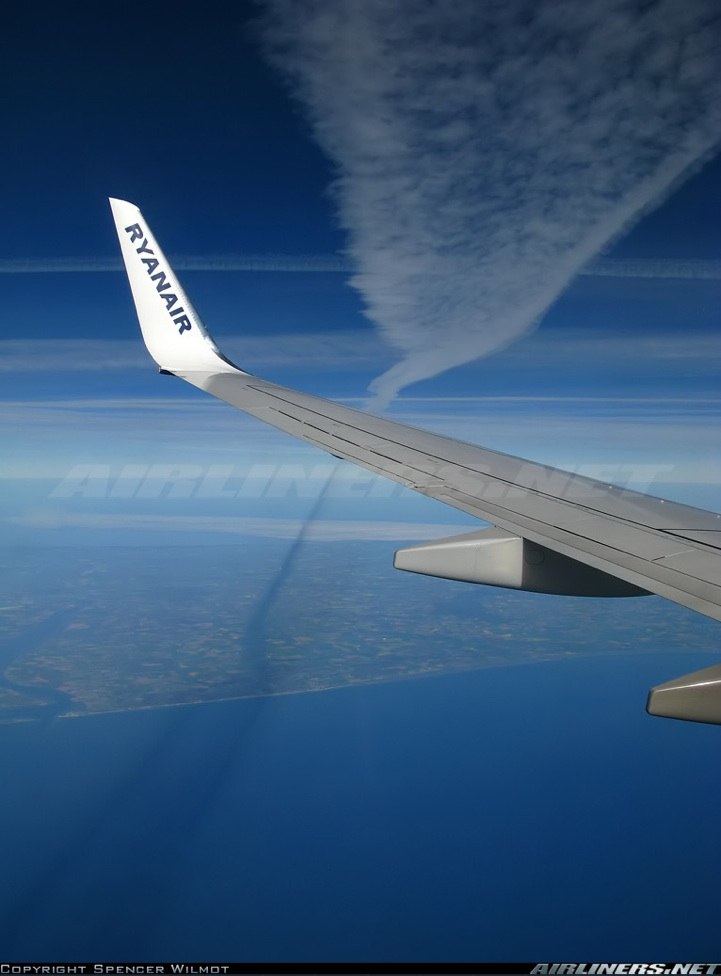
I’m not sure that’s all (or even partly) an edge shadow. Maybe a shadow on a slightly lower layer of haze. Edge shadows would be lines of constant thickness.
Yeah, you’re right, it could actually just be called a contrail shadow I suppose lol.
Another photo of a contrail shadow from the air. I wish the guy had focused on the clouds rather than the windshield wiper lol.
http://worldtravels.markwdanielson.com/myPictures/Penang%20-%20vapor%20trail.jpg
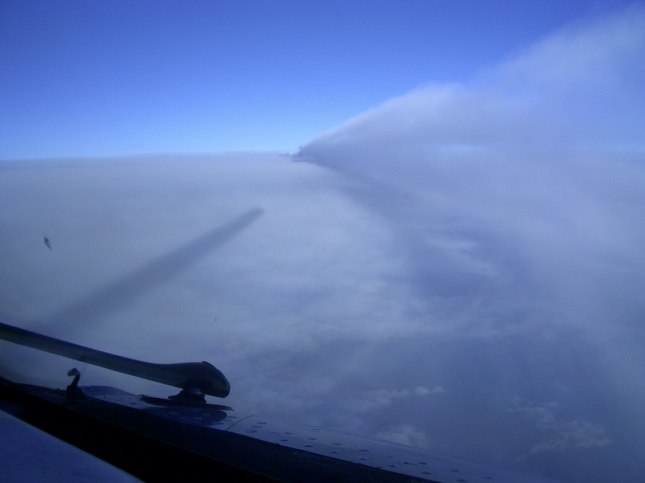
It took me a second but the shadow in the pic is actually his own shadow- not from the contrail in the picture. The sun must be low over his right shoulder. If you look carefully you can see the shadow of the visible contrail directly underneath it, fading into the contrail as it extends.
Woah, that’s weird when you mention it…I’m going to have to try to wrap my mind around that lol.
Aha, on the source site it says below the photo:
Hmm, “our shadow contrail”? I guess I don’t get it lol.
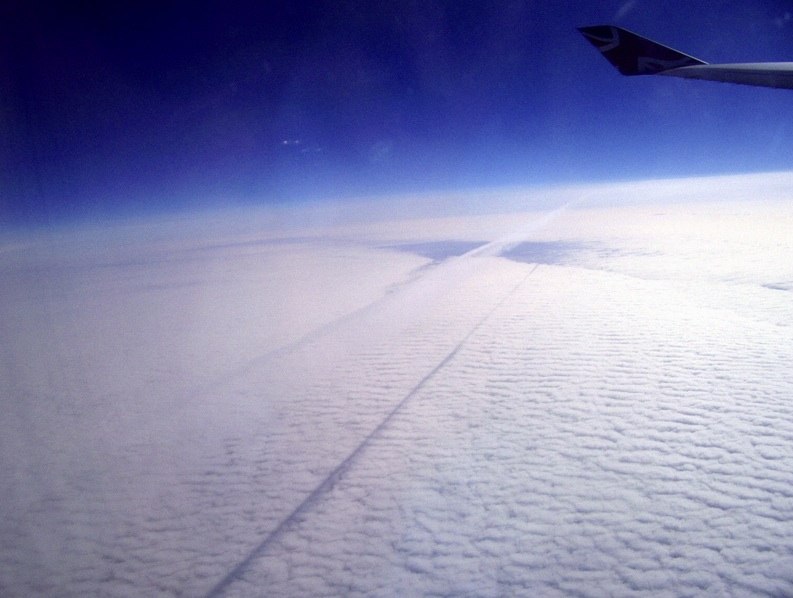
Interesting picture at this flickr account, picture from ABOVE a contrail with its shadow cast on clouds below it.
http://www.flickr.com/photos/candace/47787221/
Hi-I’m back for more fun! I haven’t seen anything interesting in the sky latley except for on easter when I looked up at the sky and saw some developing mammatus clouds which makes the sky look like it has udders! But the top of these clouds looked like a roiling sea, with spiked tops that resembled wave peaks, it was cool. But I still believe that our atmosphere is being bombarded by chemtrails, and if you could, explain to me how persistent contrails can form at 6000 feet which is the level of cumulus clouds when NASA itself claims they only form in the 26,000 feet range. Tell me that! K
Those spiked clouds sound like these:
http://images.google.com/images?q=kelvin+helmholtz+clouds
Generally contrails don’t form at 6,000 feet. Where did you see this, and how did you measure the altitude?
Gentlemen, ucinous…
I have written on this website long ago. Contrails sure exist, however the mounting evidence for Chemtrails is there, and irrefutable at this point…
http://www.noonehastodietomorrow.com/agenda/weather-modification/2259
Enjoy the spray..and…there are many more files being gathered on and off internet.
By “there”, you mean a weatherman explaining how chaff affects weather radar?
What’s the actual evidence? What’s the best evidence? Why don’t you make a list?
Wow, if someone actually believes that “chaff” has ANYTHING to do with the trails in the sky, they need to add chaff to the list of things they are ignorant about…right under contrails. “chemtrails” ARE contrails!
It still almost amazes me that the debate over whether ‘chemtrails’ exist continues, when the operation is going on in plain sight for all to see, a host of research at everyone’s disposal exists on the internet and further some governments have actually admitted it. Anyone who denies ‘chemtrails’ to suggest they are normal vapor trails (like “uncinus”) in these forums are most probably on assignment from NASA or similar agencies and should not be taken seriously. It’s common sense that vapor trails cannot expand to white-out the entire sky (let alone for hours and even days), no matter if a million jets pass across at a given time. NASA has never proven this and can’t, so they have no choice but to use their puppets to present random conjecture that attempts to sound intelligent, ridicule those who question their nonsense, and other various psychological methodologies in an effort to manipulate people into believing obvious falsehoods.
How so? Can you quote a science book that says this?
Because I can quote lots that say quite the opposite. Or just the encyclopedia:
http://www.britannica.com/eb/article-9074829
Jim:
So WHOSE puppet are you, bozo?
How come your OBVIOUS TRUTHS cannot be found within a single SCIENCE publication?
How in a career lasting forty-five years in aerospace and engineering have I never met a single instance of your “commonsense”?
I KNOW about the LIES you are repeating here, and someone ought to tell you that you have been lied to. SO I’ll do it. Your problem is you don’t understand German. Ask a German friend to tell you the difference between what was spoken, and what was translated.
Please DO NOT CONTINUE to tell us about commonsense. Most of us here have opinions about that which don’t agree with yours. As far as I’m concerned – your sense MAY be “common” – but it ain’t sense.
I saw one of these lines in the sky yesterday and it looks a lot like some of the pictures on here. Only the one I saw was in the middle of the night (no sun and it was cloudy so no moonlight) and there was not a plane near the line in the sky. I don’t think it was smoke, clouds or any contrail either because the line was perfectly vertical to the ground and did not move for at least an hour. Any ideas?
What happened after an hour?
So, it was night time, and there was a trail in the sky, and because you didn’t see a plane, that means it wasn’t a contrail?!? OK, I get it now….
I couldn’t see it anymore after an hour. Usually when I see a trail line from a plane it doesnt stay in the same exact place for an hour, especially if its windy like it was. Also since it was cloudy with low clouds a trail line from a plane would most likely be above the thick low layer of clouds.
Why could you not see it? Did it fade away, or get too dark?
I’m a little confused by your description, if it was cloudy enough to obscure the moon for an hour, then how could you see a contrail? I’m afraid I’m inclined to think you saw something like a power line. Any kind of trail, regardless of it’s a contrail or a (hypothetical) sprayed trail, would have moved after an hour.
Can you link to a picture that most resembles what you saw?
I took pictures of it but its kind of hard to see (since it was dark and wouldn’t work if I used a flash) but you can see it. Once you see it in one pic you can see it in the others that I took over about a 20 min time period. How do I put my pics on here though? It wasnt a power line because it was right outside my house and I know there are no power lines. I guess what I am wondering is how it can it be a contrail when it was cloudy (actually rain/storming) and at night? Wouldn’t the contrails caused by planes be above the clouds? And it was windy so it seemed odd that it remained in the exact same spot and remained a perfectly strieght line.
I would love to see the pictures.
You can just email me the pictures at [email protected] and I wil post them for you.
Or upload them to some photo sharing site, like picasaweb, or flickr, and then post a link to the album