chemtrails

How Long do Contrails Last?

Q) How long do contrails last?
A) Anywhere from less than a second, up to several hours.

This is an oft-asked question. The answer is reasonably straightforward, but misunderstanding is common. To understand why a contrail can last as little as a fraction of a second, or as long as several hours, you need to understand what a contrail is, and how it forms.

Here’s another question, which has the same answer:

snowflakecvr2.jpgQ) How long does a snowflake last?

Why is this basically the same question? Because contrails are generally made of ice crystals. Jet exhaust contains a lot of water vapor (the chemical reaction actually produces more water than there was originally jet fuel), and when this gets shot out of the back of the engine at 2000MPH, it hits the frigid air (typically colder than -40 degrees), and the water vapor condenses and freezes, very quickly, into tiny ice crystals, just like snowflakes.

So why do these ice crystals sometimes stay around for a long time, and sometimes vanish in seconds? The temperature is well below freezing, so they can’t melt, can they? This is puzzling, because it involves something that most people know nothing about: “sublimation“.

Sublimation is when a substance (in this case, water), goes directly from being solid to being vapor (a gas), without actually melting into a liquid. It’s like evaporation, except instead of a liquid evaporating, it’s a solid (ice). If the air is dry (i.e. there is little water vapor in it), then the ice crystals will quickly sublimate into vapor, and the trail will vanish quickly.

However, if the air already has a lot of water vapor in it, then the ice will sublimate slower, and the trail will last longer.

If the air has so much water vapor in it already that it can’t hold any more (i.e. it’s “supersaturated”), then the ice crystals can’t sublimate, and so the contrail will stay around for a long time. The ice crystals might even attract water from the air, if there is enough, and the contrail will get thicker. Winds might make the contrail spread out to even cover the whole sky.

The above is a simplification, as other factors like temperature, pressure, and sunlight have an effect. But it explains the basic reasons why some trails last only a few seconds, and some can last for hours, and spread out to cover the sky.

Finally, there is one more way of asking the question:

Q) How long do clouds last?

This is the same question because contrails are clouds. Contrails are physically very similar to cirrus clouds (except they are long and thin), and so they act almost exactly the same. You see cirrus clouds that last for hours, so why not contrails?

Racetrack Contrails

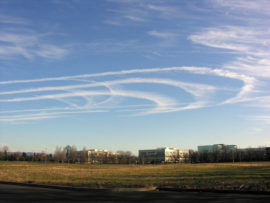
Here’s a contrail you don’t see every day: the racetrack contrail (or, as I like to call this one, the paperclip contrail)

paperclip-contrails.jpg

This photo was taken near Portland, Oregon on December 11th, 2005, at around 11AM.

So why would a plane be flying in this unusual pattern? Well, it turns out it’s not really very unusual. It’s called a “holding pattern“, and it’s a very specific pattern that planes fly in when they need to hold their position. Holding patterns have this very distinctive shape because the aircraft have to fly them in a very particular way that takes exactly four minutes to complete, so the ATC can know where they are, and when they will be facing in a particular direction. They fly straight for a minute, then turn 180 degrees over a minute, and then fly straight again. It looks like this:

166-1.jpg

For passenger jets, holding patterns are most common on the approach to busy airports (the one above is for Martha’s Vineyard), and it’s not too uncommon to make a few turns in a holding pattern shortly before landing. The contrails in the above photo is probably not this, as it’s at too high an altitude. Passenger jets do sometimes enter high altitude holdings (I’ve been in one once as a passenger), which could account for this.

poster360.jpgHigh altitude holds are also used by refueling tankers, as they wait for the planes they are going to refuel. Pilots obviously also have to train to fly in high altitude holds, and given the number of turns above, that’s the most likely explanation for this particular photo.

Remember the winds at altitude are typical around 50-100mph, so after the four minutes loop, the previous contrail could be blown around five miles away, giving the illusion that the plane is now holding over a different area. It’s not. The plane is playing over the same area, but the contrails have moved.

Of course, if you don’t know this, it might look a bit odd to you. Some people work these racetrack contrails into the “chemtrails” conspiracy theory. Look at this poster on the right. There’s a photo of a racetrack contrail with five turns, separated and distorted by the wind. Overlaid is the text “Look up, Phone Radio DJs”.

These racetrack contrails are pretty rare (unless you live near a training area), but hopefully now if you see one, you’ll be able to tell what is going on, and not feel the urge to call a DJ.

[BTW, the plane in the upper right of the poster is a Boeing E-6 Tacamo, dumping fuel]

Pre WWII Contrails

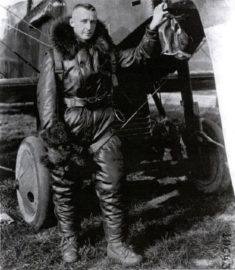
In a fascinating article: Wakes of war: contrails and the rise of air power, 1918-1945 Part I–early sightings and preliminary explanations, 1918-1938, (Air Power History. 54.2 (Summer 2007): 16(16).), Donald R. Baucom give an account of the rise of high altitude flight, and the inevitable accounts of contrails, both persistent and otherwise, that occurred during that time. The first powered plane had only flown in 1903, and the very earliest report of a contrail is just 15 years later, in the autumn of 1918, in an account of Captain Ward S. Wells, Army Medical Corps, who was serving with the 60th Infantry, 5th Division, American Expeditionary Force, during the Meuse-Argonne campaign.

Our attention was first drawn to the sky by the sudden appearance of several strange and startling clouds–long, graceful, looping ribbons of white. These were tapering to a point at one end and at the other where they dissolved into nothingness 60 degrees across the sky, were about as broad as the width of a finger held arm’s distance from the eye. On close observation we noticed some distance ahead of each cloud point the tiny speck of a chasse [sic] plane…. [N]ever before had I seen a plane writing in white upon the blue slate of sky.

This is very interesting, as it’s the earliest known account of contrails (note that these are non-persistent). It was also very novel and interesting at the time, and was reported in a letter to Scientific American, (”Clouds formed by Airplanes“, Jun 7, 1919, p 60) by Wells’ brother, Everett Wells, and provoked some discussion of what might be forming these clouds.

Continue Reading »

Barium Chemtrails

Executive Summary:
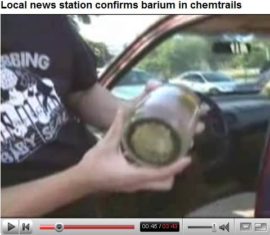
  • Samples of water were collected in August 2007, in Stamps Arkansas, by leaving some bowls outside for a month
  • The resultant dirty water was tested by KSLA and was found to have the same amount of barium in it as most municipal tap water.
  • The reporter misunderstood the results, and said there was a lot of Barium

ksla-jar.jpg

Some conspiracy theorists think that persistent spreading contrails indicate some kind of deliberate aerial spraying, probably by the government. They speculate as to what could be in these trails, and one of the most common things they claim is barium.

Some people are so obsessed by this idea that they have rainwater tested to see if it has barium in it. They usually find some, and then trumpet this as evidence that their theory is correct.

Unfortunately they are wrong. I’ll explain why, but first, some basic science. Continue Reading »

Where are all the Chemtrail Photos?

Some people think that persistent spreading contrails are somehow unusual, and are actually something dangerous being deliberately sprayed on the US people by the government, or perhaps for weather control purposes. They call these persistent contrails “chemtrails”.

Some of them are very insistent that this is a practically constant assault, saying the sky is never blue any more, and there are “chemtrails” constantly criss-crossing the sky.

Continue Reading »

Broken Contrails

Contrails are clouds made from water vapor that condenses then freezes behind a plane engine. Since the engines are on constantly, it seems a bit odd when you see contrails with gaps in them, or even contrails that stop and start. If the engine is pumping out a constant amount of water, then why is the trail not constant? This puzzle is sometimes seized on by people who think that persistent contrails are actually “chemtrails”, or some kind of deliberate spraying operation. Continue Reading »

“Chemtrail” Aircraft Photos

Several planes look a little odd, or have attachments that look odd, and so some people feel they must be part of a decades long conspiracy to spray stuff into the atmosphere to alter the weather or reduce the population. That’s obviously nonsense, but what are these strange planes?

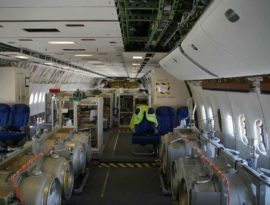
Here’s one making the rounds, scary looking barrels, and a sign on the wall that possibly says “Hazmat inside”

chemtrail-inners3.jpg

What is it? It’s a Boeing 777-200LR Worldliner, specifically it’s WD001, a plane that was used for flight testing. The original photo can be found here - note the “Hazmat” text was added later.  The barrels contain water, which is pumped around to shift the center of gravity to test various flight characteristics.

From Boeing’s blog:

Remember, we test at the extremes of the weight/CG envelope. This requires us to control the CG during ground and flight conditions. We can move weight, in the form of water, forward or aft with the use of the water ballast system. This system is comprised of 48 barrels, each capable of carrying 460 pounds, connected by tubing to a pump. A computerized system tracks fuel placement, fuel burn, people placement, ballast, flap setting, landing gear position and water barrel quantity. The information is processed to display the airplane’s current CG. We move water or specify fuel tank usage to configure the CG within the specified test requirements.

Why are there overhead luggage compartments? It’s a test plane, and for FAA certification they have to demonstrate that everything works. That includes stuff like the emergency oxygen system, and more minor things like the luggage compartments. It’s a requirement that they don’t pop open in flight - so that needs to be tested. They are also handy for stowing the engineers’ stuff.

Here’s some pictures from Boeing:

wd001_group_interior_sm.jpgwdoo1_interior_sm.jpg

And a lot more photos can be found on Boeing’s site.

——————————————————————————————–

This one gets a lot of use in the “chemtrail” forums:

chemtrailplaneonground1forum.jpg

Particularly because of the unusual collections of pipes sticking out in various places. There’s those two at the front, and then there is a group over the wing. Here’s some close ups

chemtrailplaneonground2forum.jpg:

chemtrailplaneonground3forum.jpg

Very sinister looking tubes, but why are half of them facing the wrong way?

The plane is not for spraying the atmosphere, it’s for sampling the atmosphere. It’s a research aircraft, registration N701BN, operated by th e department of energy’s national labs. It’s pretty much one of a kind, so it’s hardly likely to be responsible for all the persistent contrails we see every day. The research is mostly on pollutants in the atmosphere, particularly from coal and oil burning power plants. But they also investigate the properties of clouds, which includes contrails.

————————————————————

Here’s another photo you see in “chemtrail” videos, with the implied suggestion that it’s some kind of evil spraying device:

nkc-135-attachment.jpg

Actually it IS a spraying device, but quite innocuous. It’s used by the air force to test icing of planes in flight. See:

https://www.safaq.hq.af.mil/news/march04/raptor.html

nkc-135-spays-water-test-icing-raptorbig.jpg

Here’s some more details:

nkc-135-icing-attachmentpv1983_2688.pdf

—————————————————————————————————

This plane is quite interesting:

e6-below-from-tacamoorg.jpg

It’s an E-6B “Tacamo”. This photo shows it dumping fuel (photo from tacamo.org). The E-6B is used by the United States Strategic Command as an airborne communication center. You can see the navy logo on the right wing. The E-6B is a modified version of the Boeing 707-320, and the fuel vents have been moved from the wing tips to between the fuselage and the engines in order to separate it from the communication equipment in the wing tips. This is what the wing-tip ESM/SATCOM pod looks like:

navy-e6-070403-03cr-6.jpg

It looks like this odd assemblage is also creating some wingtip vortex contrails as well. The plane is pretty much all white, which is something you hear mentioned form time to time in “chemtrail” conspiracy theories.

Here’s another photo of the same plane, taken from a “chemtrail” YouTube video:

e6b-tail-youtube.jpg

It shows the opening for the ELF trailing wire antenna. This is a very long wire antenna that is extended behind the plane for several hundred feet and used for communications with submarines.

—————————————————————————————————-

This plane also occasionally get brought up in chemtrail conspiracy groups:

This is obviously not a contrail, it’s far too low and the trail is dropping too rapidly.

It’s a Boeing 747-100 “Supertanker”, modified by Evergreen Aviation, the only one of its kind. Specifically designed for fire fighthing. That’s it dumping water.

Here’s a video of it in action, titled “B747 chemtrails”. It’s interesting reading the comments, as the first comment correctly identifies what it is, and then everyone else just ignores that and starts speculating.

———————————————————————

This one looks like a plane spraying stuff. But again it’s rather close to the ground. It’s actually taking off with the assistance of rockets. It’s not spraying, that’s just rocket exhaust.

762px-boeing_b-47b_rocket-assistedw.jpg

This particular plane is a Boeing B-47B, rocket assisted take off, April 15, 1954. An no, that’s not a contrail in the sky behind it - it’s rip in the photo. Click on it for a large version.

————————————————————————

This one is used for cloud seeding. It does not actually spray anything but uses silver iodine flares that are either ejected, or burn in place.

sandylandwater-slide7.jpg

It’s operated by the Sandy land Underground Water Conservation district of Plains, Texas, as part of their SOAR program. They have some more photos of similar equipment on their site. They are all small aircraft not capable of getting to the above 30,000 feet where contrails normally form.

—————————————————————————

This next photo is also of silver iodine flares, fixed underneath at large plane.

weathermod-eject_rack1.jpg

These also show up in “chemtrail” literature. They are sold by Weather Modification Inc, they make a range of weather modification equipment. About this one they say:

WMI racks for ejectable flares are mounted on the belly of the aircraft fuselage. Each rack holds 102 cartridges. When fired, the pyrotechnic is ignited and ejected from the aircraft. In this configuration, the WMI Lear 35A is equipped with four 102-count racks for ejectable glaciogenic pyrotechnics, a total of 408 flares.

Here’s another, this time from North American Weather Consultants, Inc.

seedinggen_nawc.jpg

About which they say:

This aircraft-mounted cloud seeding generator is fixed in place, and can burn a silver iodide solution during flight.

————————————————————————–

Persisting and Spreading Contrails

Do contrails sometimes persist and spread out?

Yes, see the Encyclopædia Britannica article on vapour trails (contrails):

Contrail, streamer of cloud sometimes observed behind an airplane flying in clear, cold, humid air. It forms upon condensation of the water vapour produced by the combustion of fuel in the airplane engines. When the ambient relative humidity is high, the resulting ice-crystal plume may last for several hours. The trail may be distorted by the winds, and sometimes it spreads outwards to form a layer of cirrus cloud.
vapour trail. (2007). In Encyclopædia Britannica.Retrieved May 4, 2007,from Encyclopædia Britannica Online: http://www.britannica.com/eb/article-9074829

Also see “A Field Guide to the Atmosphere“, by Schaefer and Day, 1981:

Sometimes [contrails] are ephemeral and dissipate as quickly as they form; other times they persist and grow wide enough to cover a substantial portion of the sky with a sheet of cirrostratus (Page 137)

Are spreading contrails a relatively new thing?

No, it has been exactly the same for decades, the only change has been the size of jet engines (producing bigger contrails), engine efficiency (burning fuel more efficiently creates more water vapor) and the amount of air traffic (producing more contrails).

See, for example, all these articles on contrails. In particular the one titled “Airborne Observations of Contrail Effects on the Thermal Radiation Budget“, from 1970:

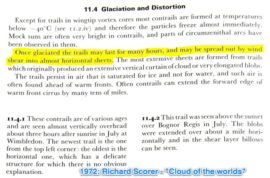
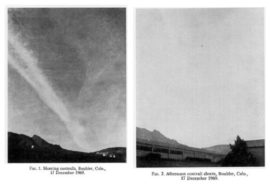
The spreading of jet contrails into extensive cirrus sheets is a familiar sight. Often, when persistent contrails exist from 25,000 to 40,000 ft, several long contrails increase in number and gradually merge into an almost solid interlaced sheet.
[....]
Contrail development and spreading begins in the morning hours with the start of heavy jet traffic and may extend from horizon to horizon as the air traffic peaks. Fig. 1 is a typical example of midmorning contrails that occured on 17 December 1969 northwest of Boulder. By midafternoon, sky conditions had developed into those shown in Fig. 2 an almost solid contrail sheet reported to average 500 m in depth.

Airborne Observations of Contrail Effects on the Thermal Radiation Budget
Peter M. Kuhn
Journal of the Atmospheric Sciences
Volume 27, Issue 6 (September 1970) pp. 937–942

(Click on any of the images in this article for a larger view)

Then a few years later, in 1975, we have the article : Multiple Contrail Streamers Observed by Radar, which again has photos (taken in 1971) of spreading and persisting contrails, as well as extensive discussion of these observations.


Multiple Contrail Streamers Observed by Radar.
Konrad TG, Howard JC (1974)
Journal of Applied Meteorology:
Vol. 13, No. 5 pp. 563–572

Here’s a description from 1970, from a local newspaper, the Arcadia Tribune, April 29, 1970:

Aircraft contrails begin to streak the normally bright Arizona sky at dawn. Through the day, as air traffic peaks, these contrails gradually merge into and almost solid interlaced sheet of cirrus cloud - an artificial cirrus cloud that is frequently as much as 500 meters deep.

One of the earliest reference to contrails covering the sky is from the Mansfield News Journal, August 11, 1957, Page 29:

“Within the past few years, the weather bureau has begun to report the trails as actual cloud layers when there are sufficient trails to cover a portion of the sky.”

But even earlier, and with a perfect description of what “chemtrail” theorist claim cannot happen comes this account from 1944:

The News, Frederick, MD, March 7, 1944

Contrails frequently have a tendency to cause a complete overcast and cause rain. In Idaho I have seen contrails formed in a perfectly clear sky and four hours later a complete overcast resulted

Below is the entire top of the page of that newspaper, in case you want to look it up.